
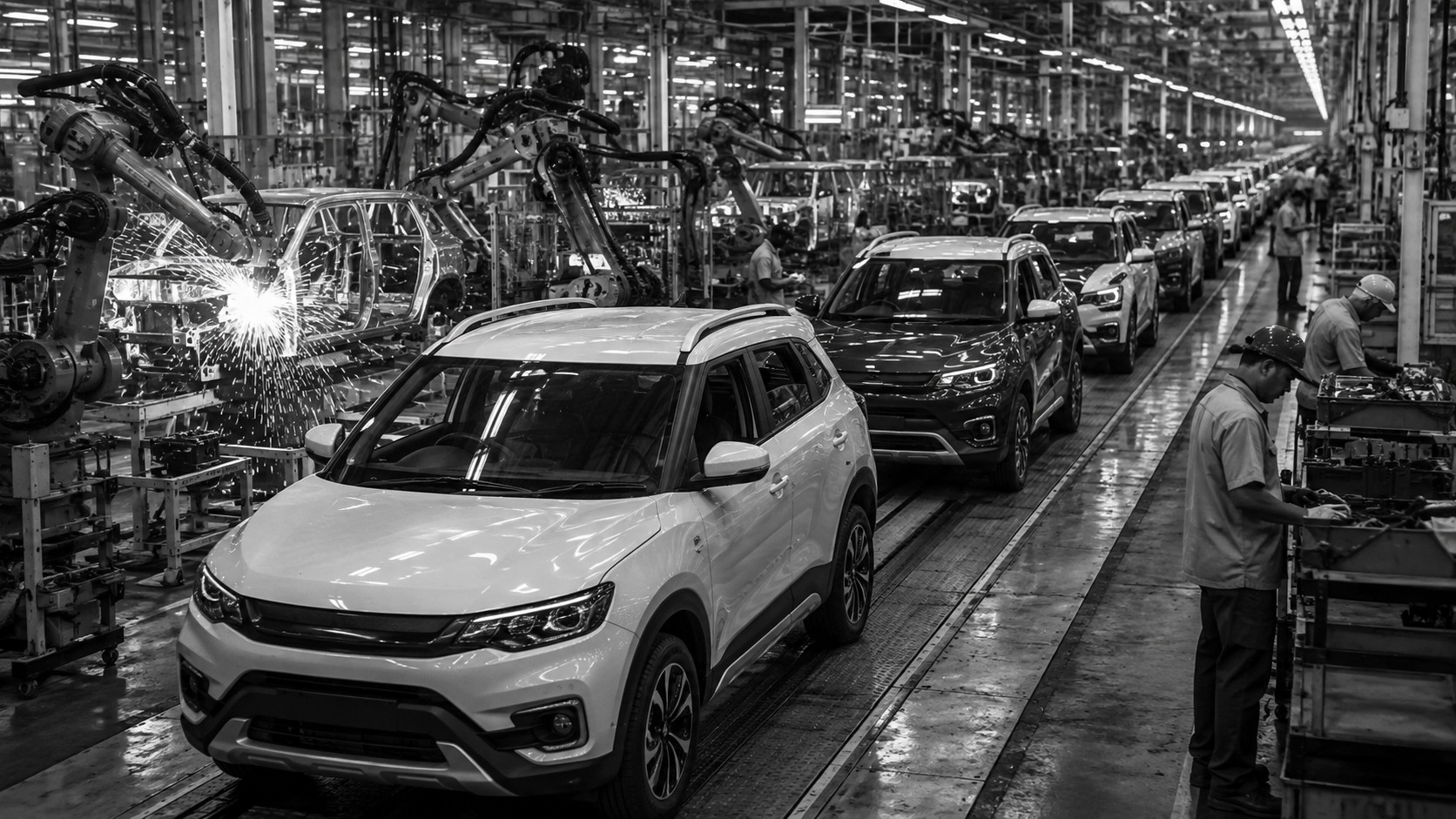
India’s largest carmaker, Maruti Suzuki, expects the country’s passenger vehicle market to reach between 6.1 million and 6.3 million annual sales by the 2030–31 financial year. Renewed demand for affordable small cars and continued growth in the sport utility vehicle segment are prompting the manufacturer to reassess its expansion plans.
Small cars return to the growth story
Maruti Suzuki chairman R.C. Bhargava said the small-car market could expand significantly faster during the next five years than it did in the previous five. The forecast represents an important change for a segment that has faced pressure from rising vehicle prices, stricter safety requirements and higher ownership costs.
Small cars have traditionally provided millions of Indian households with their first entry into private vehicle ownership. A sustained recovery would therefore benefit manufacturers with established production networks, extensive dealerships and competitively priced models. Maruti remains particularly well placed because of its strong position in compact cars and its access to technology from parent company Suzuki Motor.


Record sales support expansion
The company sold a record 2.42 million vehicles during the 2025–26 financial year. Exports also reached an all-time high of 447,000 units, strengthening India’s position as a manufacturing and distribution centre for Suzuki vehicles.
Maruti now expects to achieve its next million-unit sales milestone earlier than previously anticipated. To prepare for greater demand, the carmaker plans to invest approximately ₹350 billion, equivalent to about $4 billion, and raise annual production capacity to 3.65 million vehicles by 2030–31.
The company has already accelerated the programme by adding capacity for another 500,000 vehicles during the current financial year. The spending is likely to create opportunities for component manufacturers, logistics operators, technology suppliers and other businesses connected to India’s automotive industry.
Seven new SUVs planned
While affordable cars remain central to Maruti’s strategy, the manufacturer is also strengthening its presence in the more profitable SUV market. Managing director and chief executive Hisashi Takeuchi said Maruti plans to introduce seven new SUVs over the next five to six years.
The broader product range could help the company compete more effectively with manufacturers that have gained market share through compact and mid-sized SUVs. These vehicles have become increasingly popular among Indian consumers because of their higher driving position, interior space and wider selection of premium features.
Cleaner energy enters the investment plan
Maruti’s board has separately approved an initial investment of ₹5.61 billion for four biogas plants. The company believes locally produced biogas could reduce reliance on imported compressed natural gas while supporting India’s long-term emissions targets.
The manufacturer is also increasing local sourcing, developing supplier capabilities and identifying alternative sources for essential materials. These measures are intended to limit disruption from geopolitical tensions, volatile commodity prices and international supply-chain problems.
A wider signal for Indian consumption
Maruti’s forecast reflects confidence that rising incomes, urbanisation and improved access to finance will continue expanding India’s consumer economy. However, the outlook depends on vehicles remaining affordable as manufacturers face higher material, energy and regulatory costs.
If demand reaches the company’s projections, India will become an even more important global centre for vehicle production. Maruti’s investment programme is therefore more than a corporate expansion plan: it is a substantial bet on the spending power of India’s growing middle class.
Newshub Editorial in Asia – 10 August 2026

Ask NF GPT
If you have an account with ChatGPT you get deeper explanations,
background and context related to what you are reading.
India’s largest carmaker, Maruti Suzuki, expects the country’s passenger vehicle market to reach between 6.1 million and 6.3 million annual sales by the 2030–31 financial year. Renewed demand for affordable small cars and continued growth in the sport utility vehicle segment are prompting the manufacturer to reassess its expansion plans.
Recent Comments