
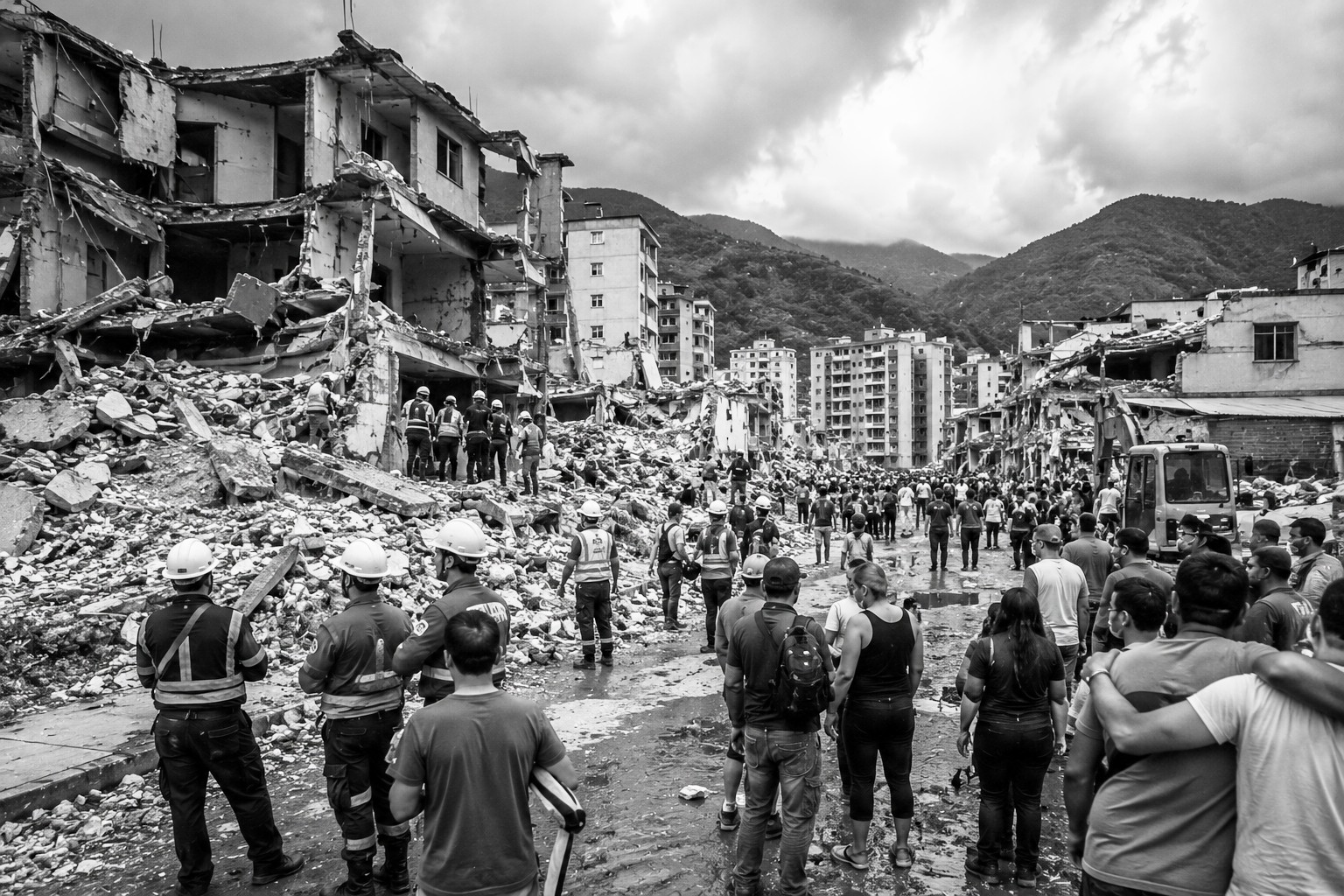
A powerful aftershock has shaken northern Venezuela, sending frightened residents back into the streets just days after twin earthquakes devastated parts of the country. The magnitude 4.6 tremor struck the areas around Caracas and the heavily damaged coastal state of La Guaira, as rescue workers continued their race against time to find survivors beneath collapsed buildings.
Fresh panic after days of devastation
The latest aftershock struck in the early hours of Monday, reviving fears among communities already traumatised by last week’s twin earthquakes. While authorities reported no significant new structural damage, the shaking temporarily halted rescue operations in several locations and prompted renewed evacuations in neighbourhoods where buildings remain unstable.


Residents who have spent recent nights sleeping in parks, tents and makeshift shelters once again fled into open spaces as emergency sirens sounded across parts of Caracas and La Guaira.
Death toll continues to climb
Officials have confirmed that more than 1,700 people have now lost their lives, with over 5,000 injured. Tens of thousands remain displaced, while many others are still listed as missing or unaccounted for, raising fears that the final death toll could increase significantly in the coming days.
The earthquakes, measuring magnitudes 7.2 and 7.5, struck northern Venezuela on 24 June, causing widespread destruction in La Guaira and parts of the capital. Hundreds of buildings collapsed or suffered severe structural damage, overwhelming emergency services already operating under difficult conditions.
Humanitarian emergency grows
The disaster has rapidly evolved into a major humanitarian crisis. Thousands of families remain without permanent shelter, while access to clean water, sanitation, healthcare and electricity remains limited in some of the worst-affected communities.
International rescue teams from dozens of countries continue to work alongside Venezuelan emergency personnel, supported by search dogs, heavy equipment and humanitarian aid. The United Nations has warned that millions of people could ultimately require assistance as recovery efforts move from rescue to long-term reconstruction.
Aid agencies have also expressed concern over shortages of temporary housing, medical supplies and essential food, while reports of isolated looting have added further pressure to an already fragile situation.
Hope fades but rescue efforts continue
Although the critical 72-hour rescue window has passed, search teams continue to comb through collapsed buildings after several remarkable rescues over recent days demonstrated that survivors can still occasionally be found beneath the rubble.
Authorities have vowed to continue operations for as long as there remains a realistic possibility of locating additional survivors. However, rescue workers acknowledge that the focus is gradually shifting towards recovery, identification of victims and providing support for displaced communities.
As aftershocks continue to rattle northern Venezuela, the disaster has become one of the country’s deadliest natural catastrophes in more than a century, exposing longstanding weaknesses in infrastructure and emergency preparedness while highlighting the immense humanitarian challenges that lie ahead.
Newshub Editorial in South America – 30 June 2026

If you have an account with ChatGPT you get deeper explanations,
background and context related to what you are reading.
Open an account:
Open an accountA powerful aftershock has shaken northern Venezuela, sending frightened residents back into the streets just days after twin earthquakes devastated parts of the country. The magnitude 4.6 tremor struck the areas around Caracas and the heavily damaged coastal state of La Guaira, as rescue workers continued their race against time to find survivors beneath collapsed buildings.
Recent Comments