
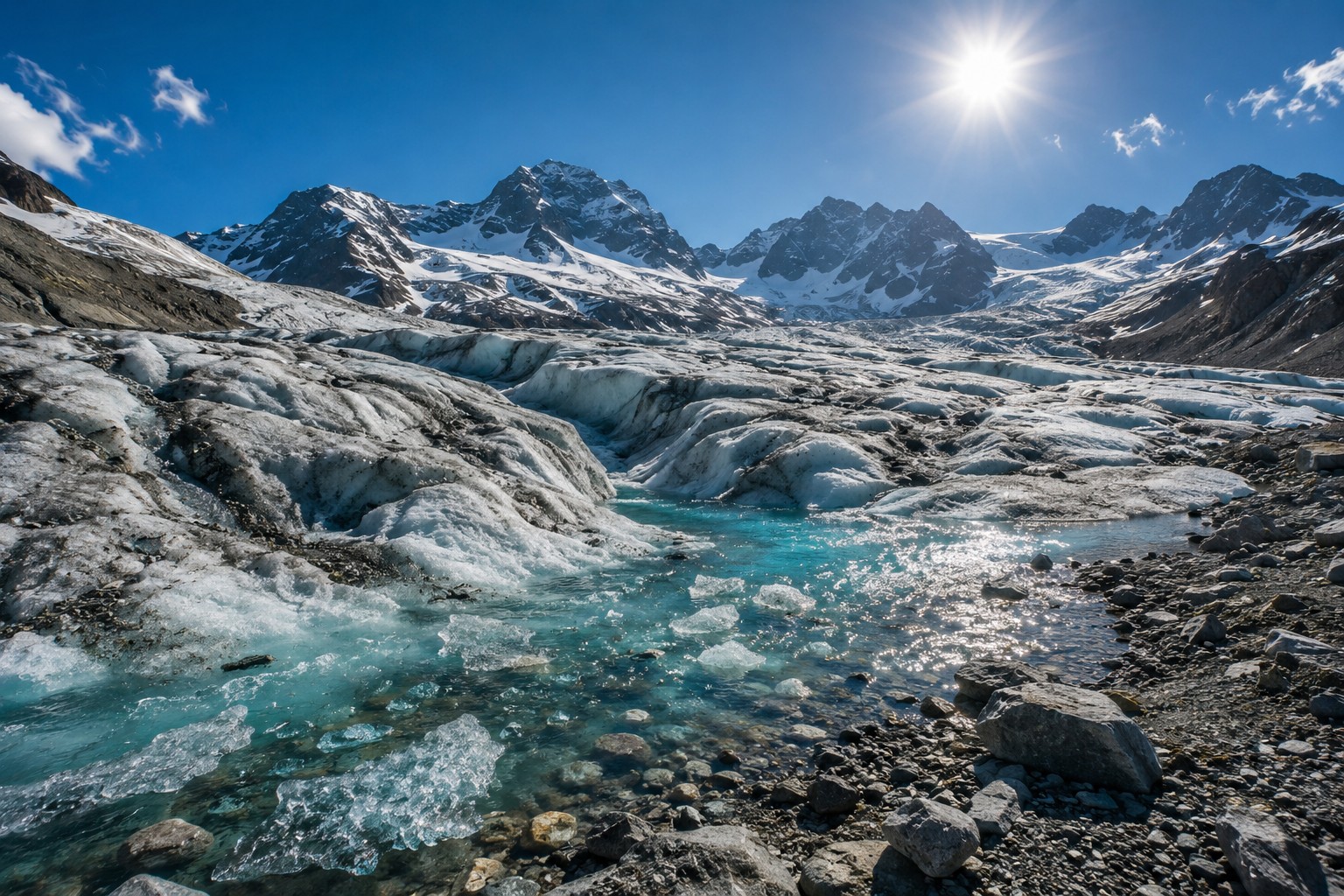
Switzerland’s glaciers are experiencing one of the fastest melt periods on record as an intense early-summer heatwave grips the Alps, with experts warning that all snow accumulated during last winter could disappear within days. The rapid loss of snow and ice has renewed concerns about the long-term future of Alpine glaciers and the consequences for Europe’s water resources, tourism and climate resilience.
Extreme melt rates
Glaciologists monitoring Switzerland’s mountain ranges say exceptionally high temperatures have dramatically accelerated the seasonal melting process. Snow that normally protects glacier ice well into the summer is vanishing weeks earlier than expected, exposing darker ice beneath that absorbs even more solar radiation.


Researchers estimate that the entire accumulation of snow from last winter may have melted away by the beginning of next week, marking an unusually early transition into the period where glaciers begin losing their older, permanent ice reserves.
The combination of prolonged sunshine, warm nights and sustained high daytime temperatures has created what scientists describe as “enormous” melt rates across large sections of the Alps.
A shrinking natural reservoir
Swiss glaciers play a crucial role in storing freshwater and gradually releasing it during warmer months. As glaciers shrink, rivers initially experience increased flows from accelerated melting. Over the longer term, however, diminished ice reserves reduce water availability during dry summers.
This affects not only Switzerland but also downstream regions that depend on Alpine rivers for drinking water, agriculture, hydroelectric power generation and industry.
Scientists warn that continued glacier retreat could fundamentally alter water management across much of central Europe during the coming decades.
Climate change driving long-term decline
While annual snowfall varies from year to year, researchers stress that the long-term trend remains unmistakable. Rising global temperatures have caused Swiss glaciers to lose a substantial share of their total ice volume over recent decades, with several recent summers ranking among the most destructive on record.
The current heatwave illustrates how increasingly frequent periods of extreme heat are amplifying glacier loss. Once protective seasonal snow disappears, glaciers become significantly more vulnerable, causing melt to accelerate further through the remainder of the summer.
Climate experts note that reducing greenhouse gas emissions remains essential if a meaningful proportion of Alpine glaciers is to survive into the second half of this century.
Economic and environmental consequences
The rapid retreat of glaciers has implications far beyond mountain landscapes. Switzerland’s tourism industry, which relies heavily on its iconic Alpine scenery, faces increasing challenges as glaciers shrink and mountain environments become less stable.
Infrastructure in high-altitude regions is also becoming more vulnerable as thawing permafrost destabilises rock faces, increasing the risk of landslides and rockfalls.
Environmental scientists view the disappearing glaciers as one of the clearest visible indicators of a warming climate. Each successive summer of exceptional melting reinforces projections that many smaller Alpine glaciers could disappear entirely within decades if current warming trends continue.
As Europe experiences another season of extreme temperatures, Switzerland’s glaciers once again provide a stark reminder of the accelerating pace of climate change and its far-reaching consequences.
Newshub Editorial – Europe – 27 June 2026

If you have an account with ChatGPT you get deeper explanations,
background and context related to what you are reading.
Open an account:
Open an accountSwitzerland’s glaciers are experiencing one of the fastest melt periods on record as an intense early-summer heatwave grips the Alps, with experts warning that all snow accumulated during last winter could disappear within days. The rapid loss of snow and ice has renewed concerns about the long-term future of Alpine glaciers and the consequences for Europe’s water resources, tourism and climate resilience.
Recent Comments