
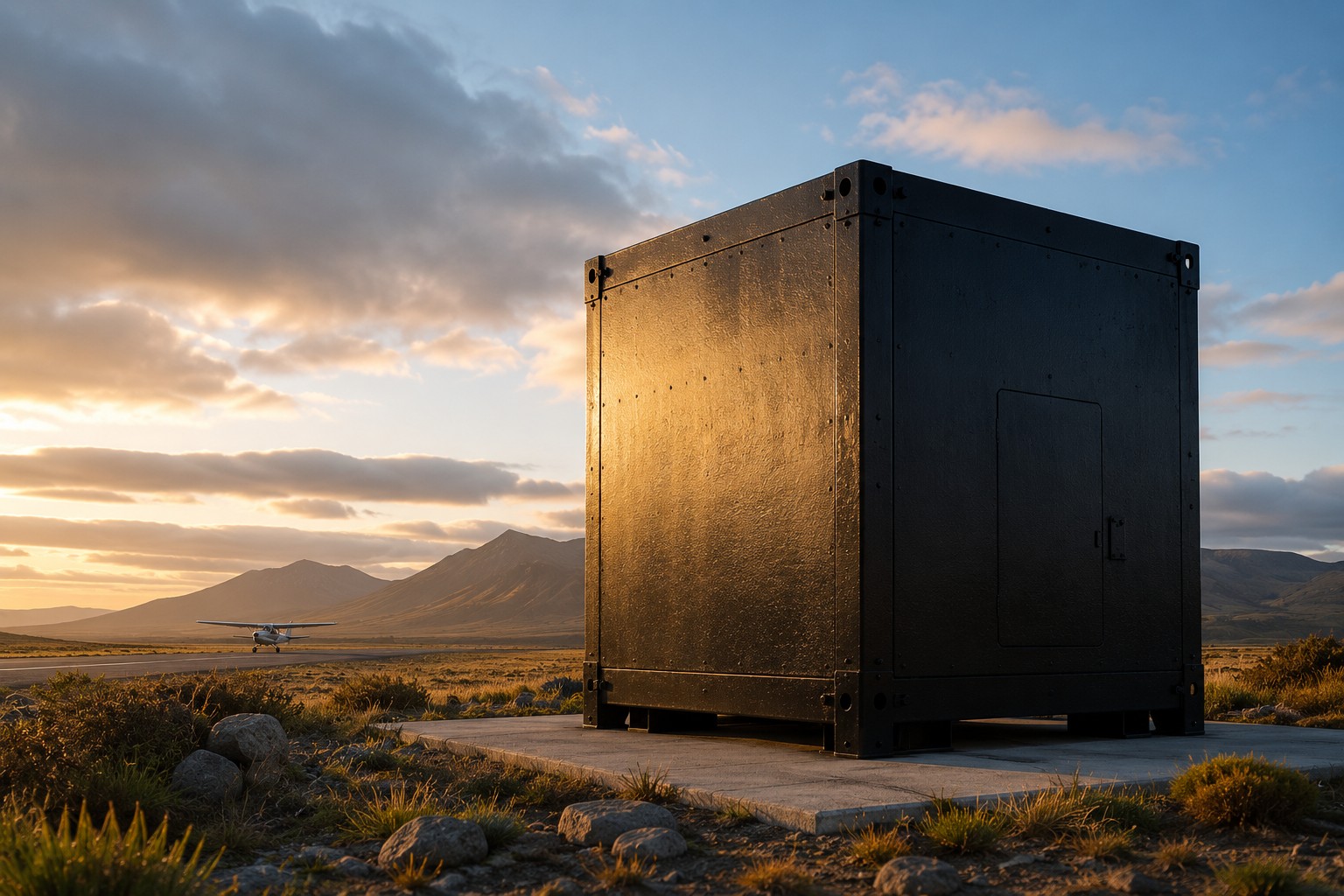
A massive steel structure known as “Earth’s Black Box” is set to be installed at a remote airfield in Tasmania, creating what its developers describe as an enduring archive of humanity’s response to climate change. Developed by Australian collective Rouser Lab, the project is designed to continuously record environmental, political and social data, preserving a detailed account of the decisions that shape the planet’s future.
Inspired by aviation’s flight recorder
The concept draws inspiration from the black boxes fitted to commercial aircraft, which preserve critical information following an accident. Rather than documenting a single event, Earth’s Black Box will continuously collect vast quantities of data relating to climate change and global sustainability.
The reinforced steel structure will be located in Tasmania, chosen for its geological stability and relative isolation. Developers hope the installation will continue operating for decades, even under increasingly severe environmental conditions.

According to Rouser Lab, the project will capture “every step” humanity takes as it confronts the accelerating climate crisis.
A permanent climate archive
The installation will automatically gather publicly available information from a wide range of sources. These include atmospheric carbon dioxide concentrations, global temperature records, sea-level measurements, biodiversity indicators, energy production, international climate agreements and major environmental policy decisions.
The archive will also record significant news events, scientific research and political developments that influence global climate action.
By bringing together environmental data with records of human decision-making, the creators aim to produce a comprehensive historical timeline showing how governments, businesses and societies responded to one of the defining challenges of the modern era.
Encouraging accountability
The project is intended not merely as a scientific archive but also as a symbol of accountability. Its creators hope future generations will be able to examine the evidence and understand both the successes and failures of global efforts to address climate change.
Supporters argue that maintaining an objective record may encourage policymakers to take stronger action, knowing that future historians will have access to an unfiltered account of today’s decisions.
The project also highlights the growing role of digital preservation in documenting complex global challenges that unfold over many decades.
A reminder of what is at stake
Although the name “Earth’s Black Box” evokes disaster, its creators stress that the installation is not a prediction of inevitable catastrophe. Instead, they describe it as a reminder that the future remains shaped by choices made today.
Climate scientists continue to emphasise that limiting greenhouse gas emissions, accelerating clean energy deployment and strengthening climate resilience can significantly influence long-term outcomes.
The archive is therefore intended to document both progress and setbacks rather than merely recording decline.
Technology meets climate responsibility
As climate risks become increasingly central to economic planning and public policy, innovative projects such as Earth’s Black Box demonstrate how technology can contribute to public awareness and historical accountability.
Whether viewed as an engineering curiosity, a scientific archive or a warning to future generations, the Tasmanian installation serves as a powerful reminder that every policy, investment and environmental decision leaves a lasting mark on history—and that humanity is still writing the next chapter.
Newshub Editorial in Oceania – 18 June 2026

If you have an account with ChatGPT you get deeper explanations,
background and context related to what you are reading.
Open an account:
Open an account
Recent Comments