
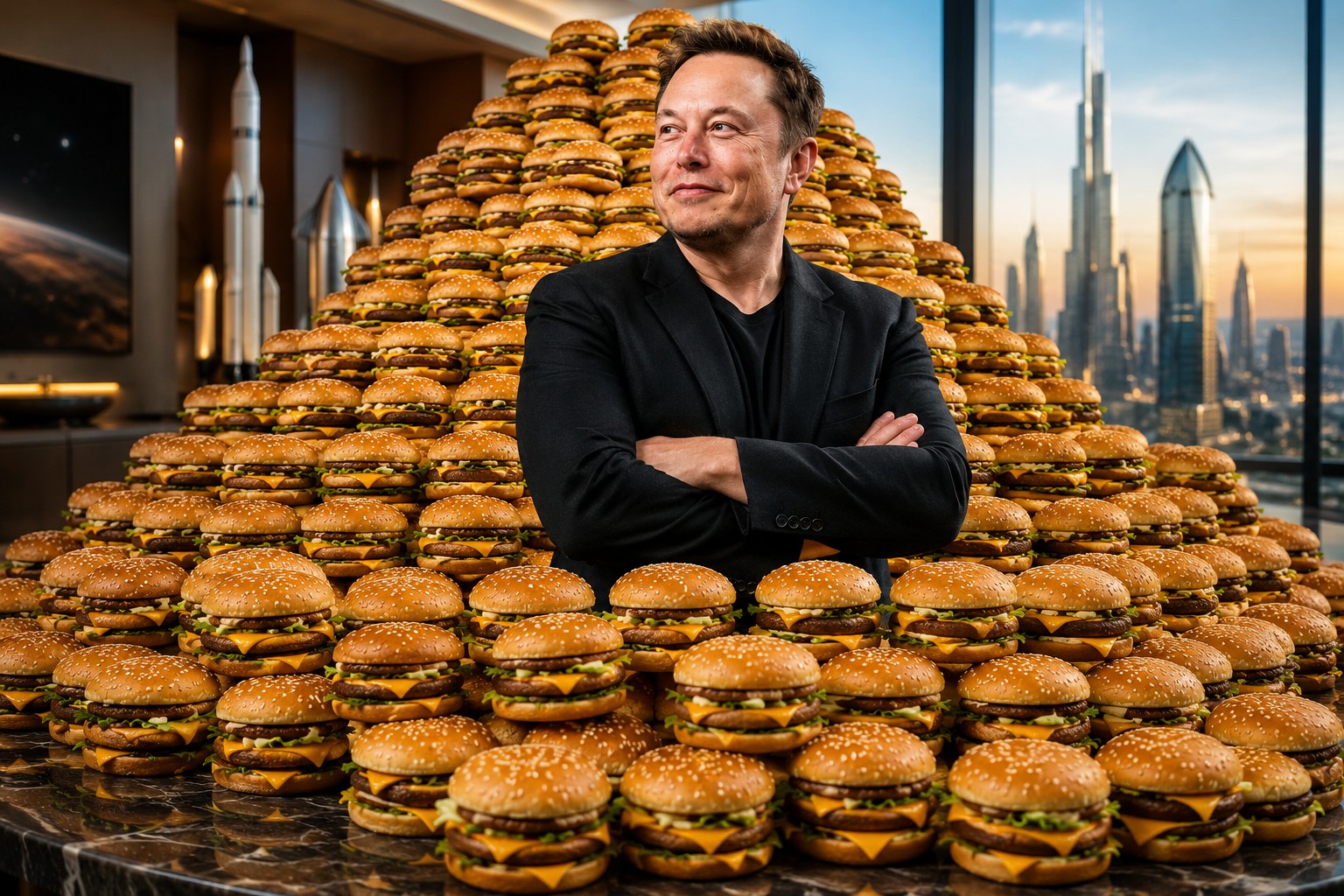
At an estimated net worth of US$1.5 trillion, Elon Musk’s fortune can be difficult to comprehend. Numbers measured in trillions are so large that they often lose all meaning. One way to visualise such extraordinary wealth is through everyday purchases. Using the average price of a Big Mac in the United States—approximately US$5.79—Musk’s fortune would be enough to buy around 259,067,358,000 Big Macs, offering a striking perspective on the scale of modern wealth creation.
Putting the numbers into perspective
While financial markets routinely discuss billionaires in terms of stock valuations and market capitalisation, translating wealth into consumer goods makes the figures easier to grasp. More than 259 billion Big Macs would be enough to provide approximately 32 burgers for every person currently living on Earth.
The comparison is not intended to suggest that such wealth exists as cash. The overwhelming majority of Musk’s fortune is tied to ownership stakes in companies, making his net worth heavily dependent on market valuations. Nonetheless, the calculation illustrates the sheer scale of wealth represented by large equity holdings in today’s technology sector.

A fortune built on innovation
Much of Musk’s wealth has been generated through significant ownership positions in companies spanning electric vehicles, space technology, artificial intelligence, robotics and social media. As investor confidence in these businesses has grown, so too has the market value of his holdings.
Unlike traditional fortunes based primarily on property or inherited wealth, Musk’s balance sheet reflects the extraordinary valuations that global financial markets have assigned to high-growth technology companies. As a result, his net worth can fluctuate by tens of billions of dollars within a single trading session.
The mathematics of modern wealth
The Big Mac comparison also highlights how difficult it is for the human mind to distinguish between millions, billions and trillions. One million dollars can purchase roughly 173,000 Big Macs. One billion dollars buys approximately 173 million. At US$1.5 trillion, the figure expands to more than 259 billion burgers.
Such comparisons have become increasingly popular among economists and financial commentators seeking to communicate the magnitude of extreme wealth in a more accessible way.
More than a headline
Whether admired as one of history’s most successful entrepreneurs or criticised for the concentration of wealth in modern society, Musk represents an unprecedented era of value creation driven by innovation, global capital markets and technological disruption.
For investors, the story extends beyond one individual. It demonstrates how ownership of transformative businesses can generate extraordinary shareholder value over relatively short periods. For the public, however, the image of more than 259 billion Big Macs may remain the simplest—and perhaps the most memorable—way to understand what a US$1.5 trillion fortune actually looks like.
Newshub Editorial in North America – 16 June 2026

If you have an account with ChatGPT you get deeper explanations,
background and context related to what you are reading.
Open an account:
Open an account
Recent Comments