
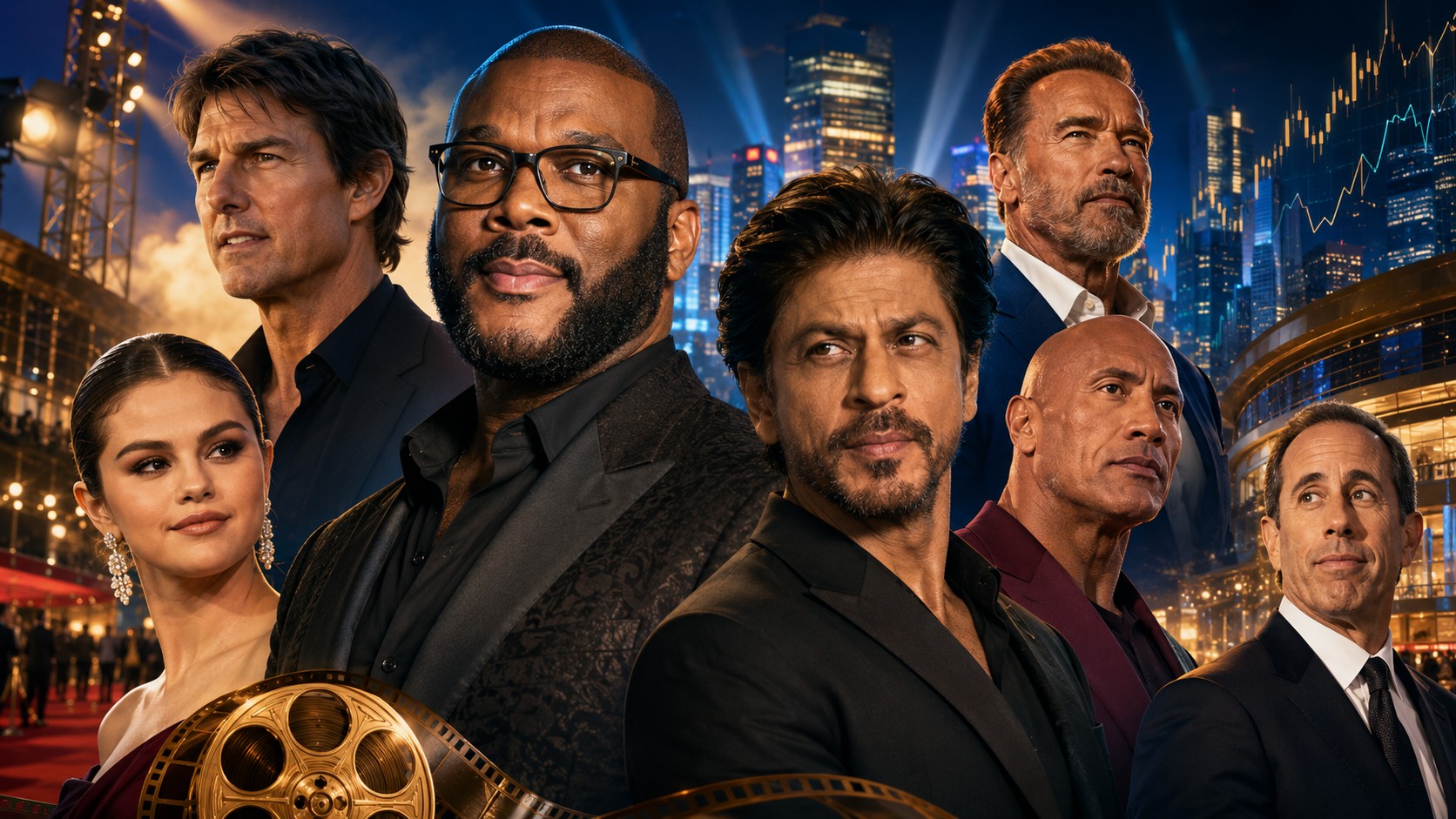
The world’s wealthiest actors did not build their fortunes simply by collecting large fees in front of the camera. At the top of the industry, acting has become the foundation for something much bigger: ownership of studios, production rights, consumer brands, sports teams, restaurant groups, property portfolios and businesses capable of growing long after the final scene has been filmed.
A successful Hollywood star can command $20 million or more for a leading role. Yet even that extraordinary figure is reduced by taxes, agents, managers, lawyers and the high cost of maintaining an international career. The performers who have reached the very top of the wealth rankings have therefore found ways to move beyond salaries.
Some have negotiated a percentage of a film’s revenue. Others have retained ownership of characters, programmes or production libraries. A growing number have used their fame to launch businesses in industries such as cosmetics, fashion, alcoholic drinks, technology, restaurants and hotels.

The result is a new class of actor-entrepreneurs whose most valuable performances increasingly take place in boardrooms rather than on film sets.
Why measuring celebrity wealth is difficult
There is no official global register showing the assets and liabilities of film stars. Most of the companies involved are privately owned, while property, art, contractual rights and business investments can be difficult to value.
The figures in this article are therefore rounded estimates based on the most recent publicly available wealth rankings, reported transactions, corporate valuations, property holdings and known commercial interests as of 8 August 2026.
They represent estimated net worth rather than annual income. A performer may earn $50 million in one year without increasing their overall fortune by the same amount. Equally, an actor may appear in very few films while the value of an existing company, television library or investment portfolio continues to rise.
There are also important questions about whose wealth should be counted. Actress Jami Gertz, for example, is regularly placed at the top of online rankings with a supposed fortune of around $12 billion. However, most of that figure is connected to the wealth of her husband, billionaire investor and Atlanta Hawks owner Tony Ressler. She has therefore not been included in this ranking.
Oprah Winfrey has delivered several acclaimed dramatic performances, but her estimated $3.2 billion fortune was created primarily through broadcasting, television production and media ownership. She is consequently classified here as a media entrepreneur rather than principally as an actress.
Mary-Kate and Ashley Olsen have also been excluded. Although they became famous as child actors, their combined fortune is now largely derived from fashion, and they have not maintained significant acting careers for more than two decades.
The list instead focuses on living people with substantial and established acting careers whose estimated wealth can reasonably be attributed to their own work, ownership and investments.
At the lower end of the ranking, several actors are tied at approximately $400 million. Their precise order cannot be determined with any confidence. At that level, a change in the estimated value of one property, private company or contractual right could immediately alter the ranking.
Ownership has replaced salary as the ultimate prize
The central lesson from the list is that even the largest acting fees rarely create billionaire status on their own.
Forbes estimated that the 20 highest-paid actors in Hollywood earned a combined $590 million during 2025, down approximately 20 per cent from the previous year. Adam Sandler led the annual ranking with an estimated $48 million after professional fees, while Scarlett Johansson, Mark Wahlberg, Brad Pitt and Denzel Washington were among the other leading earners.
Those numbers are enormous, but they are small when compared with the value of a successful studio, global consumer company or perpetual television rights.
A salary is paid once. Ownership can continue producing income for decades.
That distinction explains why Tyler Perry is wealthier than Tom Cruise, despite Cruise having starred in some of the most commercially successful films ever made. It also explains how Jerry Seinfeld continues to earn substantial sums from a television programme that ended in 1998.
The billionaire actors did not merely perform in successful productions. They secured control over the economic machinery surrounding them.
The four members of the billion-dollar club
Only four people who are primarily recognised for substantial acting careers are estimated to be worth more than $1 billion under the criteria used for this ranking.
Tyler Perry leads with approximately $1.4 billion. Shah Rukh Khan follows at around $1.3 billion, ahead of Arnold Schwarzenegger at $1.2 billion and Jerry Seinfeld at $1.1 billion.
Their careers and business models are very different.
Perry created an integrated entertainment operation in which he writes, produces, directs, performs and owns his work. Shah Rukh Khan combined one of the world’s largest film careers with production, property, endorsements and ownership in professional cricket. Schwarzenegger used film income to finance an extensive investment portfolio. Seinfeld retained a valuable share of the television programme bearing his name.
Each represents a different route to the same destination: converting fame into assets capable of generating income independently.
1. Tyler Perry – $1.4 billion
Tyler Perry is the world’s richest actor under this ranking, with an estimated fortune of $1.4 billion, equivalent to approximately SEK 13.3 billion.
Perry’s wealth is built on control. He owns the content he has created, including a production library stretching back to his stage work in the 1990s and the hugely successful Madea franchise.
Rather than functioning only as an actor or director hired by a studio, Perry developed an operation covering writing, production, performance and physical studio infrastructure. Tyler Perry Studios in Atlanta occupies hundreds of acres and has become one of the largest privately owned production facilities in the United States.
His films are often produced on controlled budgets and targeted at a highly loyal audience. By retaining ownership and taking a producer’s share of the revenue, Perry has kept far more of the long-term economic value than a conventionally employed actor would receive.
2. Shah Rukh Khan – $1.3 billion
Shah Rukh Khan’s estimated fortune of $1.3 billion corresponds to approximately SEK 12.3 billion.
Known internationally as the King of Bollywood, Khan has spent more than three decades building one of the most recognisable film careers in the world. His wealth, however, extends far beyond acting fees.
He is a co-owner of Red Chillies Entertainment, which works across film and visual effects production, and holds an interest in the Kolkata Knight Riders of the Indian Premier League. The cricket team has developed into a major international sporting brand.
Khan also has extensive property holdings, endorsement agreements and commercial investments. His global reach demonstrates that the modern entertainment economy is no longer centred exclusively on Hollywood.
3. Arnold Schwarzenegger – $1.2 billion
Arnold Schwarzenegger is estimated to be worth $1.2 billion, or approximately SEK 11.4 billion.
He was one of the highest-paid film stars of the 1980s and 1990s, with major roles in franchises including Terminator and films such as Predator, Total Recall and True Lies.
His film contracts included both large guaranteed payments and profit-sharing arrangements. Schwarzenegger is estimated to have earned around $500 million from film salaries and participation before taxes and professional fees.
Yet his investments may have created even more wealth than his acting career. He began buying property before becoming an international star and later invested across property, financial services and major companies. His minority interest in investment manager Dimensional Fund Advisors became particularly valuable as the company’s assets under management expanded.
Schwarzenegger’s fortune is the clearest example of a film career being used as investment capital.
4. Jerry Seinfeld – $1.1 billion
Jerry Seinfeld has an estimated net worth of $1.1 billion, equivalent to approximately SEK 10.4 billion.
Most of his wealth can be traced to one of the most valuable television comedies ever produced. Seinfeld ran for nine seasons between 1989 and 1998, but its commercial life continued through syndication, international licensing and streaming.
Seinfeld and co-creator Larry David retained significant participation in the programme’s profits. Every major licensing agreement therefore had the potential to generate new income for them.
Netflix reportedly paid more than $500 million for global streaming rights under a five-year agreement. Although that payment was divided among several rights holders, it illustrates the enduring value of the programme.
Seinfeld did not simply receive a salary for appearing in a successful television series. He owned part of the asset.
5. Dwayne Johnson – $800 million
Dwayne Johnson is estimated to be worth around $800 million, corresponding to approximately SEK 7.6 billion.
Johnson first became famous through professional wrestling before developing into one of the highest-paid actors in the world. His films have included the Fast & Furious and Jumanji franchises, while his commercial activities extend across production, advertising, sport, fitness and consumer products.
A large part of his estimated wealth is now connected to Teremana Tequila. Johnson’s reported ownership in the brand gives him substantial exposure to its private valuation.
This also introduces uncertainty. A private drinks company is only worth what an investor or buyer is ultimately prepared to pay. Johnson’s fortune could rise sharply if Teremana continues to expand or is sold, but it could also be revised down if its valuation weakens.
6. Selena Gomez – $700 million
Selena Gomez has an estimated fortune of approximately $700 million, equal to around SEK 6.6 billion.
Gomez began her career as an actress and achieved international recognition through Disney before expanding into music, production and business. Her starring role in Only Murders in the Building has maintained her position as a major television performer.
However, most of her wealth is connected to Rare Beauty, the cosmetics company she launched in 2020. The company’s rapid growth transformed Gomez from a highly paid entertainer into one of America’s wealthiest self-made celebrities.
Some valuations have placed her fortune above $1 billion, but more conservative assessments remain closer to $700 million because the exact size of her ownership and the value of the privately held business are not fully public.
7. Tom Cruise – $600 million
Tom Cruise is estimated to be worth $600 million, equivalent to approximately SEK 5.7 billion.
Few actors have remained commercially powerful for as long. Cruise has led major films since the 1980s and has been central to the Mission: Impossible franchise as both actor and producer.
His financial strength comes from negotiating participation in a film’s revenue rather than relying only on an initial salary. Such agreements can generate enormous payments when a production becomes a global success.
Top Gun: Maverick demonstrated the power of this model. Cruise reportedly received a comparatively modest initial salary by his standards but earned much more through his share of the film’s commercial performance.
Unlike several people above him, Cruise has not built his fortune around a large consumer brand. His wealth remains unusually closely connected to films, production and box-office participation.
8. Robert De Niro – $500 million
Robert De Niro’s estimated $500 million fortune is worth approximately SEK 4.7 billion.
His film career includes some of the most acclaimed performances in modern cinema, but his commercial interests outside acting have become an increasingly important part of his wealth.
De Niro was a co-founder of Nobu, which developed from a single restaurant into an international luxury hospitality group with restaurants, hotels and residences around the world.
He has also been involved in the Greenwich Hotel, the Tribeca Film Festival and other property and hospitality ventures.
Nobu demonstrates how an actor can use cultural influence, relationships and capital to build an entirely separate international business.
9. Kate Hudson – $500 million
Kate Hudson is also estimated to be worth around $500 million, equivalent to SEK 4.7 billion.
Although Hudson established herself through films including Almost Famous, her largest financial asset is believed to be her ownership in activewear company Fabletics.
The business passed $1 billion in annual revenue during 2025 and continues to expand through physical stores and international markets.
Hudson was not the sole founder of Fabletics, but she became its central public face and remains a shareholder. Her position shows how celebrity marketing can be converted into genuine long-term equity rather than a conventional endorsement fee.
10. George Clooney – $500 million
George Clooney’s estimated fortune of $500 million is also equivalent to approximately SEK 4.7 billion.
Clooney earned large sums as an actor, director and producer, but the defining financial event of his career was the sale of Casamigos Tequila.
Clooney founded the brand with Rande Gerber and Mike Meldman before the company was sold to Diageo in a transaction potentially worth up to $1 billion, including performance-related payments.
The sale turned an already wealthy film star into one of Hollywood’s richest actors. It also helped inspire a generation of celebrity-backed alcohol brands seeking similar outcomes.
11. Adam Sandler – $440 million
Adam Sandler is estimated to be worth $440 million, corresponding to approximately SEK 4.2 billion.
Sandler moved from Saturday Night Live into a highly successful film career before creating Happy Madison Productions. The company allowed him to exercise greater control over production and to generate income as both performer and producer.
His long-term relationship with Netflix has become one of the most valuable arrangements between a streaming platform and an individual actor.
The agreement provides Sandler with substantial annual income while giving Netflix a reliable supply of broadly accessible films with an established global audience.
Sandler was also the highest-paid actor of 2025, earning an estimated $48 million after professional fees.
12. Mel Gibson – $425 million
Mel Gibson has an estimated net worth of $425 million, equal to approximately SEK 4 billion.
His wealth was initially built through major acting roles in the Mad Max and Lethal Weapon franchises, followed by directing and producing.
The Passion of the Christ became the most important financial project of his career. Gibson helped finance the film and retained a substantial ownership position when many established studios were reluctant to become involved.
The film became a major international success, allowing Gibson to benefit as an owner rather than simply as a director receiving a fixed payment.
13. Kevin Hart – $400 million
Kevin Hart’s estimated $400 million fortune corresponds to approximately SEK 3.8 billion.
Hart developed his audience through stand-up comedy before becoming a major film star, producer and advertising personality. His tours have generated substantial ticket revenue, while films including the Jumanji series expanded his global audience.
His company Hartbeat was valued at approximately $650 million when a private equity investor acquired a minority interest in 2022.
That valuation is now less certain. Hartbeat has faced restructuring, staff reductions and the wider contraction affecting independent production companies after the streaming boom.
Hart remains extremely wealthy, but his position illustrates why private company valuations must be treated cautiously.
14. Brad Pitt – $400 million
Brad Pitt is estimated to be worth approximately $400 million, or SEK 3.8 billion.
In addition to decades of major film salaries, Pitt co-founded Plan B Entertainment. The company has produced critically and commercially successful films including 12 Years a Slave, Moonlight and The Big Short.
Pitt later sold a majority interest in Plan B, turning the production company into a major personal asset. He has also held extensive property and commercial investments.
15. Keanu Reeves – $400 million
Keanu Reeves has an estimated fortune of $400 million, equivalent to approximately SEK 3.8 billion.
Much of his wealth was created through The Matrix films, where his compensation reportedly included participation in the franchise’s commercial results.
The continuing success of John Wick created another major source of income through acting, production and the expansion of the series into a wider entertainment property.
Reeves is an example of an actor building extraordinary wealth mainly through franchise participation rather than unrelated consumer businesses.
16. Tom Hanks – $400 million
Tom Hanks is estimated to be worth $400 million, or approximately SEK 3.8 billion.
Hanks combined high acting fees with strategic profit-sharing agreements. His arrangement for Forrest Gump, in which he reportedly exchanged part of his guaranteed salary for a share of the film’s performance, became one of Hollywood’s most famous examples of a successful back-end deal.
He has also worked extensively as a producer through Playtone, creating income and ownership beyond his acting roles.
17. Mark Wahlberg – $400 million
Mark Wahlberg’s estimated $400 million fortune corresponds to around SEK 3.8 billion.
Wahlberg has earned substantial sums from acting and production, but his business portfolio stretches across restaurants, fitness, clothing, property and consumer investments.
His producer credits include successful television series and films, allowing him to benefit from projects in which he does not necessarily appear on screen.
Wahlberg represents the diversified model in which a film career serves as the public platform for a much wider portfolio of companies.
18. Sylvester Stallone – $400 million
Sylvester Stallone is estimated to be worth $400 million, equivalent to approximately SEK 3.8 billion.
Stallone did not simply play Rocky Balboa. He created the character and wrote the screenplay that launched one of cinema’s longest-running franchises.
He later developed the Rambo and Expendables series while working as an actor, writer, director and producer.
Although ownership of the Rocky rights has been a source of public frustration for Stallone, his creative participation in several global franchises produced decades of high earnings.
19. Jackie Chan – $400 million
Jackie Chan has an estimated net worth of $400 million, corresponding to approximately SEK 3.8 billion.
Chan built an international career that connected the Hong Kong, mainland Chinese and Hollywood film industries. His physical performance style and willingness to carry out dangerous stunts made him one of the world’s most recognisable actors.
His fortune has been expanded through production companies, endorsements, licensing agreements, property and other commercial interests across Asia.
Chan’s presence on the list reflects the importance of film markets outside the United States.
20. Jennifer Lopez – $400 million
Jennifer Lopez completes the list with an estimated fortune of $400 million, equivalent to approximately SEK 3.8 billion.
Her career spans acting, music, television, live performance, production, fashion, beauty products and property.
Lopez first gained major film recognition through Selena and later became one of the few performers capable of maintaining simultaneous careers in cinema and music.
Her fragrance business has generated billions of dollars in retail sales, although total sales should not be confused with Lopez’s personal earnings. She has also benefited from production agreements, television contracts, endorsements and ownership of several consumer ventures.
Several stars share the final position
The cut-off at $400 million is especially uncertain. Clint Eastwood, Jack Nicholson and Indian cinema legend Amitabh Bachchan have also been estimated to possess fortunes of approximately the same size.
They could reasonably be included in the top 20 depending on the source, valuation date and treatment of private assets.
Ashton Kutcher has also appeared extremely high in some rankings because of his successful technology investments. However, more conservative assessments place his personal fortune closer to $200 million, while the much larger figures often refer to assets managed by investment funds rather than money owned directly by Kutcher.
Reese Witherspoon has similarly been valued at between $300 million and $440 million following the sale of a majority interest in Hello Sunshine. The lower figure reflects the important difference between a company’s total transaction value and the amount ultimately received by one shareholder after dilution, debt, tax and other costs.
These examples show why celebrity wealth rankings should be read as financial estimates rather than audited league tables.
Why women remain underrepresented
Only three women appear in this top 20: Selena Gomez, Kate Hudson and Jennifer Lopez.
The imbalance reflects decades in which male actors were more likely to receive the largest salaries, lead long-running action franchises and secure powerful profit-participation agreements.
Men were also more frequently given opportunities to produce, direct and own the commercial rights surrounding major films.
That pattern is changing. Reese Witherspoon, Margot Robbie, Scarlett Johansson, Nicole Kidman and other female stars have expanded aggressively into production, while performers including Gomez, Rihanna and Jessica Alba have demonstrated how celebrity-driven consumer companies can create wealth beyond traditional Hollywood structures.
Future versions of the ranking may therefore look significantly different.
Annual earnings and personal wealth are not the same
The world’s highest-paid actor in a particular year is not necessarily the world’s richest actor.
Annual income measures what someone earned during a limited period. Net worth attempts to calculate the value of everything they own after liabilities are deducted.
A star may receive $25 million for a film but retain only a fraction after tax and professional expenses. Another actor may receive no film salary at all during the same year while their company increases in value by $200 million.
Paper wealth is also not the same as cash. Dwayne Johnson cannot necessarily withdraw the full estimated value of his Teremana interest. Selena Gomez’s Rare Beauty stake would need to be sold, refinanced or produce dividends before its entire estimated value could become available to her.
The same principle applies to property, film rights and private production companies.
Streaming has changed the economics
Streaming initially appeared to create a new golden age for stars and independent production companies.
Netflix, Amazon, Apple and other platforms competed for talent, signed large multi-film agreements and paid actors substantial guaranteed fees. Adam Sandler became one of the clearest beneficiaries of this period.
However, streaming contracts frequently replace traditional profit participation with a larger payment at the beginning. That gives actors security but may prevent them from sharing in the exceptional long-term success of a production.
The industry is now attempting to find a new balance. Actors want guarantees, performance bonuses and ownership. Streaming platforms want predictable costs and permanent global rights.
The outcome will help determine which members of the next generation can move from being highly paid to becoming genuinely wealthy.
The actor as a global business
The list also demonstrates how the centre of the film economy has widened.
Shah Rukh Khan’s wealth is tied partly to Indian cinema and cricket. Jackie Chan built his career across Asian and American markets. Consumer companies connected to actors now sell globally from the moment they launch.
Social media has accelerated this development. A performer with hundreds of millions of followers possesses a direct marketing channel that previous generations could never build.
That audience can be used to promote films, cosmetics, clothing, drinks, books, fitness products or subscription services without relying entirely on traditional advertising.
Fame has effectively become a form of commercial distribution.
The real route to a billion-dollar fortune
The 20 names on this list followed different paths, but the largest fortunes share a common structure.
Tyler Perry owns his studio and content. Shah Rukh Khan owns production and sporting interests. Jerry Seinfeld owns part of the programme that made him famous. Arnold Schwarzenegger converted film salaries into long-term investments. George Clooney, Selena Gomez, Dwayne Johnson and Kate Hudson used their public profiles to build equity in consumer companies.
Tom Cruise, Tom Hanks and Keanu Reeves negotiated participation in the success of their films. Robert De Niro created an international hospitality business. Adam Sandler combined production ownership with streaming guarantees.
The lesson is not that acting has become unimportant. Without the original performance, audience and public trust, many of these businesses would never have existed.
But acting created the opportunity. Ownership created the fortune.
For the world’s richest actors, the most valuable role is no longer simply the character whose name appears on the cinema poster.
It is the role of owner.
Newshub Editorial in North America – 8 August 2026

Ask NF GPT
If you have an account with ChatGPT you get deeper explanations,
background and context related to what you are reading.
Recent Comments