
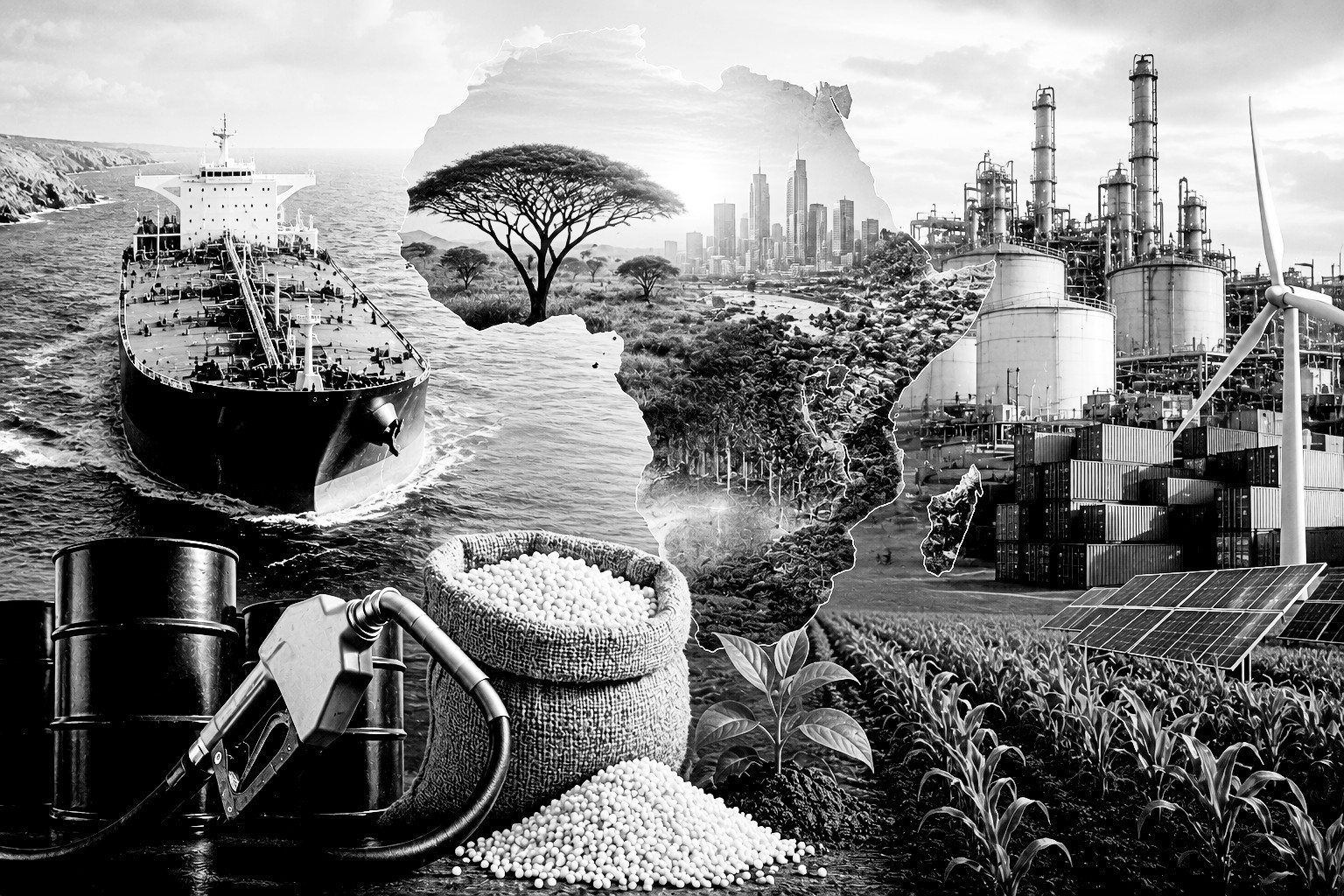
The latest crisis surrounding the Strait of Hormuz has once again exposed a critical vulnerability in Africa’s economic structure: the continent remains heavily dependent on imported fuel, fertilisers, and industrial inputs from regions over which it has little influence and virtually no strategic leverage. As tensions in the Middle East threaten global shipping and energy markets, policymakers and business leaders across Africa are being reminded of the urgent need to strengthen local production and improve economic resilience.
A strategic chokepoint with global consequences
The Strait of Hormuz is one of the world’s most important maritime corridors, handling a significant share of global oil and liquefied natural gas exports. Any disruption to shipping through the waterway can have immediate consequences for energy prices, transportation costs, and industrial supply chains worldwide.
For African economies, the impact is particularly significant. Many countries depend heavily on imported petroleum products and fertilisers, making them vulnerable to price spikes and supply disruptions whenever geopolitical tensions escalate.

Dependence creates economic vulnerability
While Africa possesses substantial natural resources, many countries continue to import refined fuel products, fertiliser components, and industrial chemicals from abroad. This dependence exposes governments, businesses, and consumers to external shocks that originate far beyond the continent’s borders.
Higher fuel prices often lead to increased transportation costs, inflationary pressures, and reduced purchasing power. Rising fertiliser costs can also affect agricultural productivity, food security, and rural incomes.
The latest developments in the Gulf region have highlighted how quickly external events can ripple through African economies, affecting everything from food prices to industrial production.
Building resilience through local capacity
Economists increasingly argue that long-term resilience requires greater investment in local refining capacity, fertiliser production, renewable energy infrastructure, and regional supply chains. By processing more resources domestically and expanding intra-African trade, countries can reduce exposure to disruptions originating elsewhere.
The implementation of the African Continental Free Trade Area (AfCFTA) is widely viewed as an important step in creating stronger regional value chains and reducing dependence on distant suppliers.
Investment in energy infrastructure is also becoming a strategic priority. Expanding refining capacity, natural gas utilisation, solar generation, and regional electricity networks could help shield economies from future global shocks.
A lesson for policymakers
The Hormuz crisis serves as a reminder that economic security is increasingly linked to supply chain security. Nations that rely heavily on imports for essential goods often find themselves vulnerable when geopolitical tensions disrupt global trade.
For African governments, the challenge is not merely responding to the current crisis but addressing the structural weaknesses that make such shocks so damaging in the first place.
As uncertainty continues in global energy markets, the message for Africa is becoming increasingly clear: reducing strategic dependence is no longer simply an economic objective. It is a matter of long-term resilience, competitiveness, and national security.
Newshub Editorial in Africa – 11 June 2026

If you have an account with ChatGPT you get deeper explanations,
background and context related to what you are reading.
Open an account:
Open an accountThe latest crisis surrounding the Strait of Hormuz has once again exposed a critical vulnerability in Africa’s economic structure: the continent remains heavily dependent on imported fuel, fertilisers, and industrial inputs from regions over which it has little influence and virtually no strategic leverage. As tensions in the Middle East threaten global shipping and energy markets, policymakers and business leaders across Africa are being reminded of the urgent need to strengthen local production and improve economic resilience.
Recent Comments