
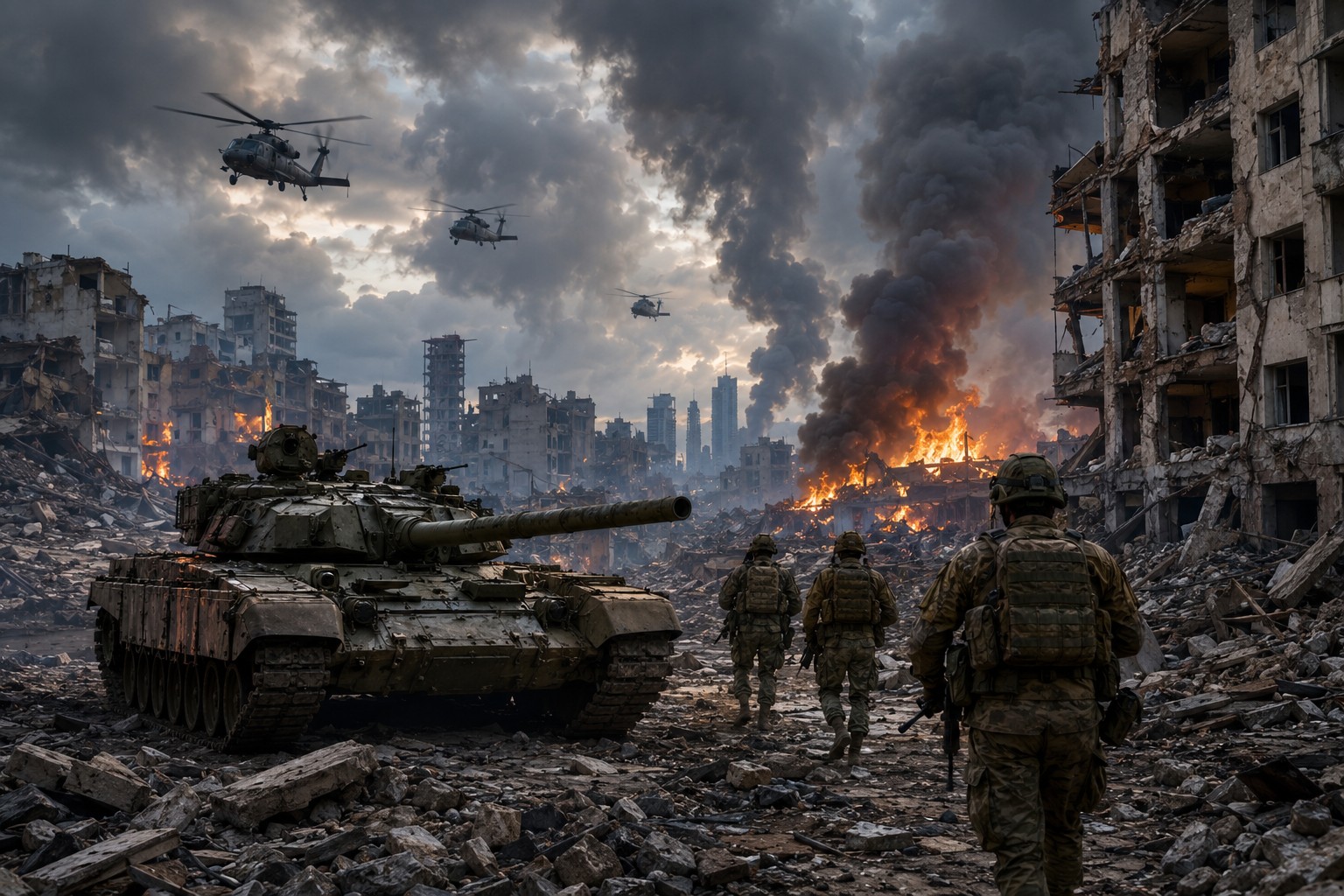
The fear is no longer irrational. The United States and Iran are again exchanging military blows. Russia’s war against Ukraine continues to grind through Europe’s security order. NATO countries are preparing for the possibility of Russian provocations near Poland or the Baltic states. China is increasing pressure around Taiwan. Sudan remains one of the world’s worst humanitarian disasters. Across the Sahel and central Africa, old conflicts are mutating into wider regional crises. The world is not yet in a third world war, but it is entering a more dangerous era in which several separate conflicts could begin to connect.
A world at war, but not yet a world war
The first distinction is important. The world is already full of wars. That is not the same as a world war.
A world war begins when several regional conflicts become tied together through alliances, direct great-power confrontation, economic mobilisation and military escalation across continents. That has not happened yet.

The United States is not formally at war with Russia. NATO is not directly fighting Russia in Ukraine. China has not invaded Taiwan. Iran and the United States remain in a dangerous cycle of attack and response, but neither side has yet crossed into a declared full-scale war. Sudan’s war is catastrophic, but it is not currently integrated into a global military alliance system.
But the danger is that all these crises are no longer isolated. They are beginning to interact.
Russia watches American behaviour in the Middle East. China studies Western unity over Ukraine. Iran tests US resolve in the Gulf. NATO watches Poland and the Baltic region. Smaller states and armed groups calculate what they can get away with while major powers are distracted.
This is how a global crisis can form: not through one dramatic declaration, but through the gradual collapse of boundaries between separate conflicts.
The Iran flashpoint
The most immediate escalation is between the United States and Iran. US forces have launched strikes against Iranian targets after attacks on commercial vessels in the Strait of Hormuz, while Washington has also revoked an oil-related waiver previously allowing limited Iranian crude sales. The Strait of Hormuz remains one of the most sensitive chokepoints in the world because disruption there quickly affects energy markets and global inflation.
This matters because an Iran-US conflict is not simply regional. It touches Gulf monarchies, Israel, Iraq, Syria, global shipping, oil prices, European energy security and Asian importers. If Iran attacks US bases in Bahrain, Kuwait or Qatar, the conflict immediately becomes wider. If shipping is repeatedly hit, insurers, navies and energy companies become part of the crisis. If Israel enters more deeply, the confrontation changes again.
The danger is not only one American strike or one Iranian retaliation. The danger is a ladder of escalation in which both sides believe they are responding defensively while the conflict expands geographically.
Ukraine remains the central European war
Russia’s war against Ukraine is still the most dangerous conflict in Europe. It has already transformed NATO, pushed European governments into rearmament and made the eastern flank the most sensitive military line on the continent.
The concern now is not only Ukraine itself, but whether Russia might test NATO through a provocation against Poland or the Baltic states. Reports have described Western concern over possible Russian actions designed to test alliance resolve, including hybrid or limited military provocations near NATO’s eastern flank.
That does not mean a full Russian invasion of Poland is certain or even likely. It means NATO planners must take seriously the possibility of grey-zone action: drones, sabotage, border incidents, cyberattacks, “lost” missiles, proxy forces, disinformation or limited attacks designed to create confusion.
This is the most dangerous kind of pressure. It is not always clear whether Article 5 should be triggered. It is not always clear whether an incident is deliberate, accidental or deniable. That uncertainty is exactly what makes escalation possible.
Poland is not just another country
Poland is central because it is both a NATO member and a frontline logistics state for Ukraine. Much of the Western support effort for Kyiv depends on territory, railways, airfields and command arrangements connected to Poland.
Any Russian move against Poland would therefore not be symbolic. It would test the credibility of NATO itself.
If NATO failed to respond, the alliance would be weakened. If NATO responded too aggressively, the risk of direct confrontation with Russia would rise. That is why Poland is one of the key places where the future of European security may be decided.
The most likely Russian strategy is not a tank invasion. It is pressure, probing and ambiguity. Moscow may seek to discover whether NATO unity still exists, especially if Washington appears divided or distracted.
Taiwan is the other great-power trigger
Taiwan remains the most consequential possible flashpoint in Asia. China has increased military activity around the island, and Taiwanese officials have tracked an upward trend in Chinese naval movements during the peak exercise season, including activity connected to wider drills.
A Taiwan crisis would be different from Ukraine. It would immediately involve the world’s two largest economies: the United States and China. It would disrupt semiconductor supply chains, shipping routes, insurance markets, technology production and global finance.
China may not need to begin with a full invasion. It could impose a quarantine, blockade, cyber campaign or sustained military pressure designed to force political concessions. That creates a dangerous middle zone between peace and war.
The United States would then face a terrible choice: accept a change in Taiwan’s status by force, or confront China militarily. Japan, Australia, the Philippines and South Korea would all be affected. Europe would face economic shock. Global companies would face supply-chain rupture.
A Taiwan war would not automatically become a world war. But it would be the closest thing to a global economic heart attack.
Greenland, Cuba and the return of territorial language
What makes the present moment especially unsettling is not only the wars already underway. It is the return of language that many assumed had disappeared from modern diplomacy: great powers talking openly about territory, spheres of influence and strategic control.
When the United States speaks about Greenland, it touches the Arctic, NATO, Denmark, minerals, shipping routes and military positioning. When Washington talks about Cuba, it revives Cold War geography in the Caribbean. When Russia speaks about Ukraine, it denies the finality of borders. When China speaks about Taiwan, it frames reunification as a historical mission.
This is the deeper shift. The post-1945 principle that borders should not be changed by force is under pressure. The post-Cold War assumption that economic integration would tame geopolitics is also weakening.
We are moving from a rules-based order into a harder world of power blocs, strategic resources and military positioning.
Africa’s wars should not be treated as background noise
Sudan is not a side story. It is one of the world’s largest humanitarian disasters. Millions have been displaced, with UN and humanitarian agencies warning of catastrophic needs across Sudan and neighbouring countries.
The danger in Africa is not that Sudan alone triggers a world war. The danger is state collapse spreading across regions already under pressure from armed groups, food insecurity, foreign mercenaries, climate stress and weak institutions.
The Sahel, parts of central Africa and the Horn of Africa are increasingly shaped by overlapping conflicts. External powers are involved through arms, mining interests, military contractors, port access and diplomatic influence.
Africa’s conflicts may not begin a global war, but they are part of the same global disorder. They show what happens when institutions weaken, borders become porous and armed power replaces political compromise.
The new axis of disruption
One reason people feel that the world is moving towards something larger is that the same states often appear on the same side of different crises.
Russia, Iran, China and North Korea do not form a single alliance like NATO. But they increasingly share an interest in weakening US influence and challenging Western power. They learn from one another. They trade technology, weapons, methods and political support.
On the other side, the United States, Europe, Japan, South Korea, Australia and other allies are trying to preserve an international system built around alliances, open trade and military deterrence.
This is not yet two formal blocs at war. But it is a world increasingly organised around opposing camps.
That is how the pre-war atmosphere deepens: not because everyone wants a global war, but because every regional conflict becomes another test of the same larger contest.
Why a third world war is still not inevitable
There are still powerful brakes on escalation.
The first is nuclear deterrence. Russia, the United States and China all understand that direct war between nuclear powers could become catastrophic. That fear still restrains decision-makers.
The second is economic interdependence. China depends on global trade. Europe depends on stability. The United States depends on financial confidence and supply chains. Gulf states depend on energy exports. Even hostile powers often remain commercially entangled.
The third is domestic politics. Most governments know their populations do not want a world war. They may support toughness, deterrence or retaliation, but prolonged global conflict would bring inflation, conscription debates, energy shortages, cyber disruption and mass uncertainty.
The fourth is diplomacy. Even in dark periods, back channels remain. Military hotlines, intelligence contacts, neutral mediators and crisis talks can prevent incidents from becoming disasters.
So the answer is not that a third world war is unavoidable. It is not.
But the margin for error is shrinking.
The greatest danger is miscalculation
World wars often begin when leaders misread one another.
One side thinks the other will back down. One side believes a limited strike will remain limited. One side assumes an ally will not respond. One side thinks economic pressure will break the opponent quickly. One side believes its enemy is too distracted to act.
That is the danger today.
Russia may misread NATO. Iran may misread the United States. The United States may misread Iran. China may misread Taiwan’s resilience or Washington’s willingness to intervene. NATO may misread Russian desperation. Smaller actors may provoke larger crises because they believe the world is too distracted to stop them.
In such a world, war can spread without anyone having planned a world war.
Where are we heading?
We are heading into a period of permanent tension.
It may not become the Third World War. But it is likely to look like a long global confrontation: more rearmament, more sanctions, more cyberattacks, more proxy wars, more drone warfare, more pressure on shipping routes, more political extremism and more competition over energy, minerals, food and technology.
The old peace dividend is gone. Defence spending will rise. Neutrality will become harder. Smaller countries will be forced to choose sides more often. Global trade will become more political. Supply chains will be redesigned around security, not only efficiency.
The most likely future is not one single explosion. It is a grinding age of instability.
The lesson from history
The lesson from the twentieth century is not that history repeats exactly. It does not. The world of 2026 is not the world of 1914 or 1939.
But the warning signs are familiar: rising nationalism, military build-ups, weakened institutions, alliance anxiety, economic rivalry, territorial claims, propaganda, arms races and leaders who believe force can solve political problems.
The world still has time to avoid catastrophe. But avoiding it will require discipline from leaders who often benefit politically from confrontation.
The central question is no longer whether the world is peaceful. It is not. The question is whether the world can keep its wars separate, contained and negotiable.
If it can, this era may become a dangerous new Cold War.
If it cannot, historians may one day look back and say that the Third World War did not begin on one day, in one capital, with one declaration. It began when too many leaders in too many places decided that escalation was manageable.
That is the real danger now.
Newshub Editorial – Global Affairs – 8 July 2026

Ask NF GPT
If you have an account with ChatGPT you get deeper explanations,
background and context related to what you are reading.
The fear is no longer irrational. The United States and Iran are again exchanging military blows. Russia’s war against Ukraine continues to grind through Europe’s security order. NATO countries are preparing for the possibility of Russian provocations near Poland or the Baltic states. China is increasing pressure around Taiwan. Sudan remains one of the world’s worst humanitarian disasters. Across the Sahel and central Africa, old conflicts are mutating into wider regional crises. The world is not yet in a third world war, but it is entering a more dangerous era in which several separate conflicts could begin to connect.
Recent Comments