
• Global
    • Africa
      • Burundi
      • Ghana
      • Gambia
      • Senegal
    • Asia
      • Indonesia
      • Laos
      • Malaysia
      • South Korea
    • Caribbean
      • Central America
    • Climate & energy
      • Climate
      • Carbon
      • Coal
      • Disruptive
      • Gas
      • Nuclear
      • Oil
      • Solar
      • Water
      • Waves
      • Wind
      • Renewable
      • South America
    • Lifestyle
      • Best chefs
      • Cocktail of the week
      • History
      • Influential women
      • Newshub long-read
    • US politics
      • Epstein
    • War
  • Finance
    • Africa finance
    • Australia
    • Asia finance
    • Banking
    • Business of the week
    • Central Banks
    • China
    • Commodities
    • Corporate
    • Europe
    • Investment
    • Japan
    • MSTRpay
    • Neobanking
    • South East Asia
    • UK
    • US
  • Fintech
    • Tech
    • AI
    • Blockchain
  • Financial inclusion
  • Editorial services
  • Press releases
Wednesday, July 8, 2026
  • Login
No Result
View All Result
Newshub Finance
  • Global
    • Africa
      • Burundi
      • Ghana
      • Gambia
      • Senegal
    • Asia
      • Indonesia
      • Laos
      • Malaysia
      • South Korea
    • Caribbean
      • Central America
    • Climate & energy
      • Climate
      • Carbon
      • Coal
      • Disruptive
      • Gas
      • Nuclear
      • Oil
      • Solar
      • Water
      • Waves
      • Wind
      • Renewable
      • South America
    • Lifestyle
      • Best chefs
      • Cocktail of the week
      • History
      • Influential women
      • Newshub long-read
    • US politics
      • Epstein
    • War
  • Finance
    • Africa finance
    • Australia
    • Asia finance
    • Banking
    • Business of the week
    • Central Banks
    • China
    • Commodities
    • Corporate
    • Europe
    • Investment
    • Japan
    • MSTRpay
    • Neobanking
    • South East Asia
    • UK
    • US
  • Fintech
    • Tech
    • AI
    • Blockchain
  • Financial inclusion
  • Editorial services
  • Press releases
  • Global
    • Africa
      • Burundi
      • Ghana
      • Gambia
      • Senegal
    • Asia
      • Indonesia
      • Laos
      • Malaysia
      • South Korea
    • Caribbean
      • Central America
    • Climate & energy
      • Climate
      • Carbon
      • Coal
      • Disruptive
      • Gas
      • Nuclear
      • Oil
      • Solar
      • Water
      • Waves
      • Wind
      • Renewable
      • South America
    • Lifestyle
      • Best chefs
      • Cocktail of the week
      • History
      • Influential women
      • Newshub long-read
    • US politics
      • Epstein
    • War
  • Finance
    • Africa finance
    • Australia
    • Asia finance
    • Banking
    • Business of the week
    • Central Banks
    • China
    • Commodities
    • Corporate
    • Europe
    • Investment
    • Japan
    • MSTRpay
    • Neobanking
    • South East Asia
    • UK
    • US
  • Fintech
    • Tech
    • AI
    • Blockchain
  • Financial inclusion
  • Editorial services
  • Press releases
No Result
View All Result
Newshub Finance
No Result
View All Result
Download MSTRpay app Download MSTRpay app Download MSTRpay app
ADVERTISEMENT

5. From beneficiaries to entrepreneurs

5. From beneficiaries to entrepreneurs

The previous article ended with a simple observation. The entrepreneurship already exists. The question is no longer how to create it. The question is how to connect it. That question changes almost everything.

Rethinking the development equation
For decades, the international development debate has largely focused on one central question:

What should we give people?

Download the MSTRpay app Download the MSTRpay app Download the MSTRpay app

Food, medicine, schools, training, equipment, microgrants and emergency assistance.

Many of these interventions are essential. Some save lives.

But after exploring why projects disappear, how development funding loses power through increasingly complex systems, and why millions of entrepreneurs remain financially invisible, another question naturally emerges.

Perhaps the real question is not what we should give people.

Perhaps it is what we should enable them to do.

That small change transforms the entire development equation.

More than banking
Financial inclusion is often described as banking, but it is much more than that.

It is the bridge between effort and opportunity.

Financial inclusion means that every individual—regardless of income, gender or geography—can participate safely and responsibly in the economy. It means being able to receive payments.

Save securely, borrow responsibly, protect against risk, build a financial history.

Invest. Trade. Grow.

Above all, it means becoming economically visible.

For generations, millions of entrepreneurs have built businesses almost entirely in cash.

Every successful day ends where it began.

The money changes hands. The transaction disappears. The business may exist for twenty years.

Its financial history may exist for none.

The invisible entrepreneur
Consider two entrepreneurs.

The first owns a small neighbourhood shop in Europe. Every payment passes through a recognised financial system. The bank sees revenue. Suppliers see reliability. Taxes create records. Insurance companies see risk.

Lenders see evidence. Credit becomes available.

Investment follows.

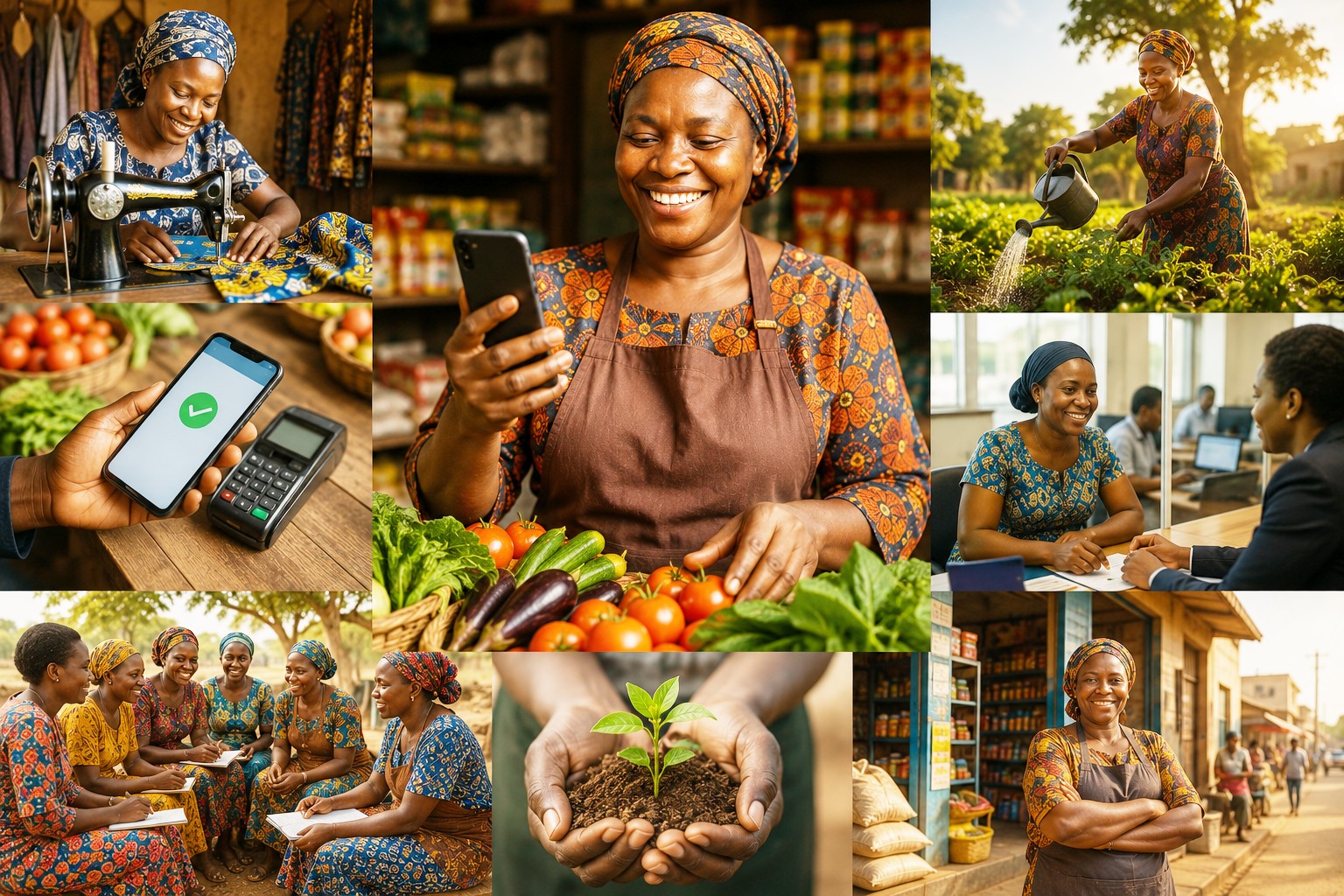
Now consider a woman selling vegetables in a rural market.

She buys stock every morning. She negotiates prices. She pays suppliers. She supports her family. She saves whenever she can. Customers trust her. Suppliers know her. She has years of experience.

Discipline. Judgement. Entrepreneurial skill.

Yet according to the formal financial system, she has almost no economic history. Not because she has done nothing. But because almost nothing has been recorded.

This is not a failure of entrepreneurship. It is a failure of infrastructure.

The European entrepreneur is not necessarily trusted because he is more capable.

He is trusted because every transaction leaves evidence. The financial system sees reliability.

The market woman may be just as reliable. Perhaps even more so.

But the system has never learned to see her.

That is where financial inclusion changes the equation.

Imagine that every payment she receives becomes part of a secure financial record. Every successful market day becomes evidence. Every month of careful trading becomes proof of reliability. Every customer contributes to a history of trust.

Suddenly lenders no longer need to ask whether she is poor. They can begin asking whether she is reliable.

That is a revolutionary change.

Reliable people become investable people.

For perhaps the first time in history, technology makes it possible to recognise economic reliability at extraordinary scale.

A woman who has never entered a bank may nevertheless have completed thousands of successful transactions. Those transactions tell a story. They reveal discipline.

Responsibility. Consistency. Trust.

Until now, the formal financial system has rarely been able to hear that story.

Rewarding productivity instead of need
Financial inclusion changes incentives as well.

Traditional development often focuses on need.

Financial inclusion rewards activity.

It rewards people who produce.

People who trade. Who save. Who repay. Who build.

Instead of creating beneficiaries, it recognizes participants. Instead of managing poverty, it enables productivity.

This distinction matters because people generally do not want dependency.

They want dignity. They want the ability to solve their own problems. To provide for their families.

To build something that belongs to them.

One of the greatest misunderstandings in development is the assumption that poverty reflects a shortage of ambition. Field experience suggests almost the opposite.

Some of the poorest communities in the world are among the most entrepreneurial.

Markets emerge wherever people are free to exchange.

Transport systems develop before formal planning. Savings groups exist without banks. Credit networks function without financial institutions. Businesses exist long before business registration.

The entrepreneurial instinct is already there.

The missing ingredient is often access.

Access to markets, payments, finance, insurance, information. Access to equal opportunity.

This is especially true for women.

Across much of the developing world, women already manage significant parts of the informal economy.

They trade. They farm. They manufacture. They transport. They provide services. They employ others.

Yet they continue to receive only a small fraction of the finance available to formal businesses.

Financial inclusion changes this because it changes the question.

Instead of asking “How much aid should we provide?” we begin asking, “How many entrepreneurs can we connect?”

That is a profound difference.

A grant can be spent once. A payment account can serve a business every day. A training course eventually ends. A financial identity continues growing. A project eventually closes.

An entrepreneur continues building.

Making development sustainable
This does not mean financial inclusion replaces humanitarian assistance. It cannot.

People facing war, famine, epidemics or natural disasters need immediate help.

Children still need schools. Communities still need roads. Hospitals still need equipment. Public institutions still matter.

Financial inclusion is not an alternative to development.

It is what allows development to become sustainable.

It connects people to systems that continue functioning long after a project has ended.

Perhaps the greatest development resource in the world has never been foreign aid.

It has always been human potential.

Every woman running a market stall. Every fisherman repairing his nets. Every tailor sewing clothes. Every farmer harvesting crops. Every mechanic repairing engines. Every young person starting a business.

Development begins when these people are no longer viewed primarily as recipients of assistance.

It begins when they are recognised as investors in their own future.

That is why financial inclusion represents more than technology.

More than digital payments. More than banking.

It represents a different philosophy of development.

Instead of asking how we can continue supporting people, it asks how people can continue supporting themselves. The difference appears small. In reality, it changes everything.

Because financial inclusion is not about giving people money.

It is about allowing their own work to create opportunity, to become visible.

It is about allowing their own success to finance tomorrow instead of beginning again from zero every morning. Once that happens, something remarkable follows.

Dependency gradually declines and enterprise begins to grow. Opportunity becomes permanent.

Development no longer belongs primarily to projects.

It belongs to the people creating value every single day.

The next question
The final article asks one final question.

Roads connect places. Electricity connects energy. Telecommunications connect information.

What connects people to opportunity?

Perhaps financial inclusion is not simply another development programme.

Perhaps it is something much more fundamental.

Perhaps it is the infrastructure of freedom.

Peter RInaldo

Facts behind this article

  • OECD – Official Development Assistance
  • World Bank – Global Findex Database
  • International Labour Organization – Informal Economy Reports
  • United Nations Development Programme
  • Paris Declaration on Aid Effectiveness (2005)

Newshub Editorial – Africa, 7 July 2026

No Result
View All Result

Recent Posts

  • 5. From beneficiaries to entrepreneurs
  • Are we heading towards a third world war?
  • SEC places crypto regulation at the heart of its 2026 agenda
  • AI accelerates product innovation at L’Oréal, Mondelez and Nestlé
  • India maintains growth momentum despite global uncertainty

Recent Comments

    Archives

    • July 2026
    • June 2026
    • May 2026
    • April 2026
    • March 2026
    • February 2026
    • January 2026
    • December 2025
    • November 2025
    • October 2025
    • September 2025
    • August 2025
    • July 2025
    • June 2025
    • May 2025
    • April 2025
    • March 2025
    • February 2025
    • January 2025
    • December 2024
    • November 2024
    • October 2024
    • September 2024
    • August 2024
    • July 2024
    • June 2024
    • May 2024
    • April 2024
    • March 2024
    • February 2024
    • January 2024
    • December 2023
    • November 2023
    • October 2023
    • September 2023
    • August 2023
    • July 2023
    • June 2023
    • May 2023
    • April 2023
    • March 2023
    • February 2023
    • January 2023
    • December 2022
    • November 2022
    • October 2022
    • September 2022
    • August 2022

    Categories

    • Africa
    • Africa finance
    • AI
    • An diesem Tag
    • Asia
    • Asia finance
    • Australia
    • Banking
    • Best chefs
    • Biden
    • Blockchain
    • Burundi
    • Business of the week
    • Carbon
    • Caribbean
    • Central America
    • Central Banks
    • China
    • Climate
    • Climate & Energy
    • Coal
    • Cocktail of the week
    • Commodities
    • Corporate
    • Deutsch
    • Deutsch PR
    • Digital Banking
    • DRC
    • English PR
    • Epstein
    • Europe
    • Financial inclusion
    • Financial insights
    • Focus on neobanking
    • Gambia
    • Gas
    • Ghana
    • Global news
    • Harris
    • History
    • India
    • India
    • Indonesia
    • Influential women
    • Invest and Rest
    • Investment
    • Italiano PR
    • Jamaica
    • Japan
    • Kenya
    • Kenya
    • Laos
    • Laos
    • LATAM
    • Lifestyle
    • Malaysia
    • Metaverse
    • MSTRpay
    • Neobanking
    • News
    • Newshub long-read
    • newshub special
    • newshub-special
    • NFT
    • Nobel Prizes 2024
    • Nuclear
    • Oil
    • Philippines
    • Press
    • Press releases
    • Pressroom
    • Renewable
    • Russia
    • Senegal
    • Senegal
    • Solar
    • South America
    • South East Asia
    • South Korea
    • South Korea
    • Stocks
    • Svensk PR
    • Tech
    • Trump
    • Trump trials
    • UFO
    • Uganda
    • UK
    • UK News
    • Ukraine
    • US
    • US politics
    • Vietnam
    • Vietnam
    • War
    • Waves
    • WEX
    • Wind
    • World safety

    Meta

    • Log in
    • Entries feed
    • Comments feed
    • WordPress.org

    Recent Posts

    • 5. From beneficiaries to entrepreneurs
    • Are we heading towards a third world war?
    • SEC places crypto regulation at the heart of its 2026 agenda
    • AI accelerates product innovation at L’Oréal, Mondelez and Nestlé
    • India maintains growth momentum despite global uncertainty

    Categories

    • Africa
    • Africa finance
    • AI
    • An diesem Tag
    • Asia
    • Asia finance
    • Australia
    • Banking
    • Best chefs
    • Biden
    • Blockchain
    • Burundi
    • Business of the week
    • Carbon
    • Caribbean
    • Central America
    • Central Banks
    • China
    • Climate
    • Climate & Energy
    • Coal
    • Cocktail of the week
    • Commodities
    • Corporate
    • Deutsch
    • Deutsch PR
    • Digital Banking
    • DRC
    • English PR
    • Epstein
    • Europe
    • Financial inclusion
    • Financial insights
    • Focus on neobanking
    • Gambia
    • Gas
    • Ghana
    • Global news
    • Harris
    • History
    • India
    • India
    • Indonesia
    • Influential women
    • Invest and Rest
    • Investment
    • Italiano PR
    • Jamaica
    • Japan
    • Kenya
    • Kenya
    • Laos
    • Laos
    • LATAM
    • Lifestyle
    • Malaysia
    • Metaverse
    • MSTRpay
    • Neobanking
    • News
    • Newshub long-read
    • newshub special
    • newshub-special
    • NFT
    • Nobel Prizes 2024
    • Nuclear
    • Oil
    • Philippines
    • Press
    • Press releases
    • Pressroom
    • Renewable
    • Russia
    • Senegal
    • Senegal
    • Solar
    • South America
    • South East Asia
    • South Korea
    • South Korea
    • Stocks
    • Svensk PR
    • Tech
    • Trump
    • Trump trials
    • UFO
    • Uganda
    • UK
    • UK News
    • Ukraine
    • US
    • US politics
    • Vietnam
    • Vietnam
    • War
    • Waves
    • WEX
    • Wind
    • World safety

    Archives

    • July 2026
    • June 2026
    • May 2026
    • April 2026
    • March 2026
    • February 2026
    • January 2026
    • December 2025
    • November 2025
    • October 2025
    • September 2025
    • August 2025
    • July 2025
    • June 2025
    • May 2025
    • April 2025
    • March 2025
    • February 2025
    • January 2025
    • December 2024
    • November 2024
    • October 2024
    • September 2024
    • August 2024
    • July 2024
    • June 2024
    • May 2024
    • April 2024
    • March 2024
    • February 2024
    • January 2024
    • December 2023
    • November 2023
    • October 2023
    • September 2023
    • August 2023
    • July 2023
    • June 2023
    • May 2023
    • April 2023
    • March 2023
    • February 2023
    • January 2023
    • December 2022
    • November 2022
    • October 2022
    • September 2022
    • August 2022
    • Global
    • Finance
    • Fintech
    • Financial inclusion
    • Editorial services
    • Press releases
    Legal - Disclosure - Cookies

    © 2022-2026
    MSTRpay/Newshub Finance

    Welcome Back!

    Login to your account below

    Forgotten Password?

    Retrieve your password

    Please enter your username or email address to reset your password.

    Log In

    Add New Playlist

    No Result
    View All Result
    • Global
      • Africa
        • Burundi
        • Ghana
        • Gambia
        • Senegal
      • Asia
        • Indonesia
        • Laos
        • Malaysia
        • South Korea
      • Caribbean
        • Central America
      • Climate & energy
        • Climate
        • Carbon
        • Coal
        • Disruptive
        • Gas
        • Nuclear
        • Oil
        • Solar
        • Water
        • Waves
        • Wind
        • Renewable
        • South America
      • Lifestyle
        • Best chefs
        • Cocktail of the week
        • History
        • Influential women
        • Newshub long-read
      • US politics
        • Epstein
      • War
    • Finance
      • Africa finance
      • Australia
      • Asia finance
      • Banking
      • Business of the week
      • Central Banks
      • China
      • Commodities
      • Corporate
      • Europe
      • Investment
      • Japan
      • MSTRpay
      • Neobanking
      • South East Asia
      • UK
      • US
    • Fintech
      • Tech
      • AI
      • Blockchain
    • Financial inclusion
    • Editorial services
    • Press releases

    © 2022-2026
    MSTRpay/Newshub Finance
