
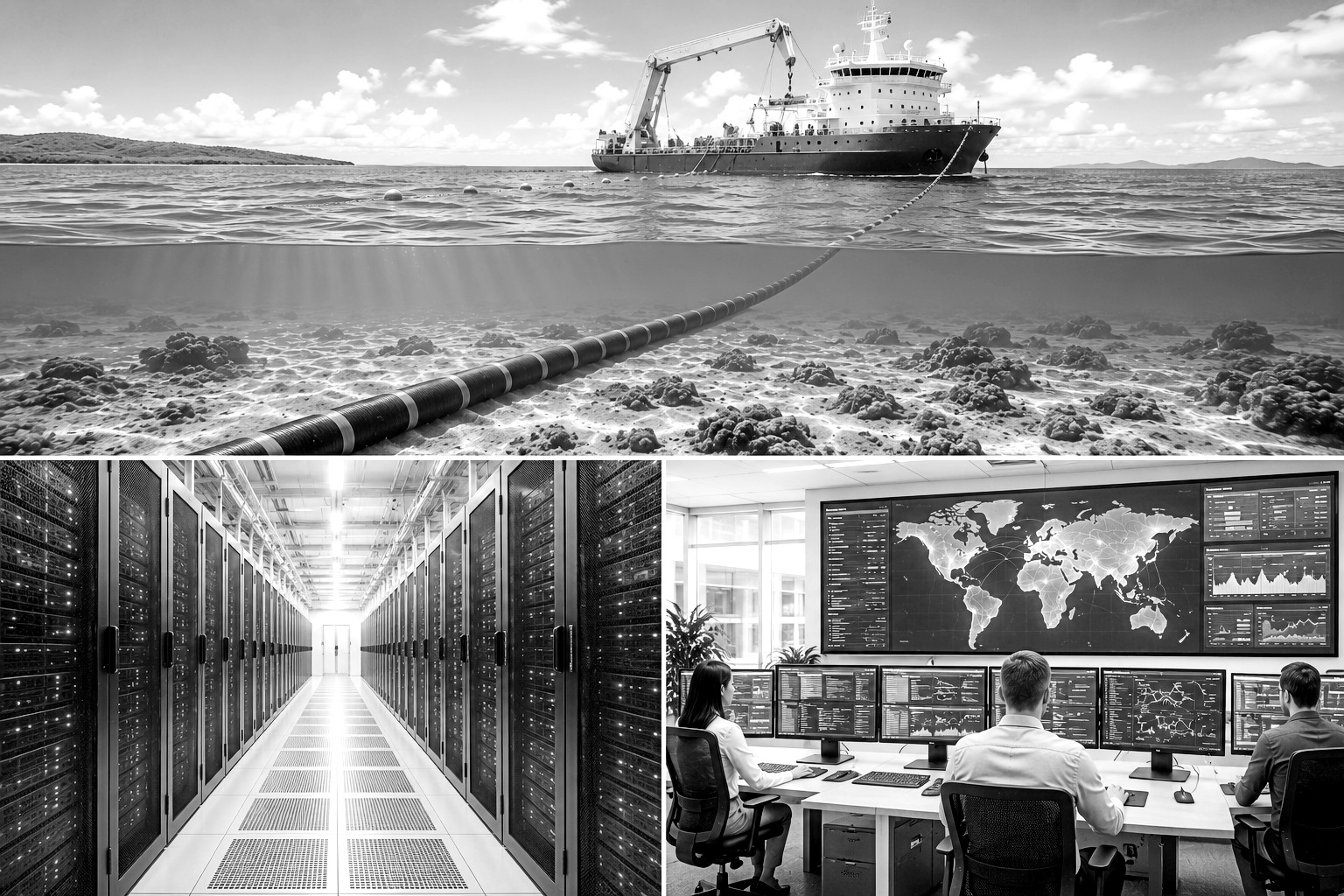
Every email sent, every video streamed, every online payment completed and every artificial intelligence query processed depends on an enormous physical infrastructure that most people never see. Hidden beneath oceans, buried under city streets, and housed inside highly secure facilities, the global internet relies on a vast network of cables, data centres, routers, switches, and power systems that quietly keep the digital world running twenty-four hours a day.
The cables beneath the oceans
Many people imagine the internet as something wireless and intangible. In reality, more than 95 percent of international internet traffic travels through fibre-optic cables laid across the ocean floor.

Thousands of kilometres of submarine cables connect continents, carrying trillions of dollars in financial transactions, business communications, and digital services every day. These cables form the backbone of the global digital economy.
A disruption to even a single major cable can affect internet performance across entire regions, highlighting how dependent modern society has become on this largely invisible network.
The rise of hyperscale data centres
Once data reaches land, it is routed through data centres that store and process enormous volumes of information. Some of the world’s largest facilities contain hundreds of thousands of servers operating around the clock.
These centres support cloud computing, streaming platforms, banking systems, government services, social media networks, artificial intelligence applications, and countless other digital tools used daily by billions of people.
The demand for computing power continues to rise rapidly as AI adoption accelerates, making data centres an increasingly important component of global infrastructure.
Powering the digital economy
Behind every data centre stands another critical infrastructure layer: electricity. Modern digital services require stable and uninterrupted power supplies, leading operators to invest heavily in backup generators, battery systems, and redundant power connections.
Some facilities consume as much electricity as small cities. As a result, energy availability has become a major factor influencing where new data centres are built.
Renewable energy is increasingly being integrated into operations as technology companies seek to reduce costs and lower carbon emissions.
Invisible but indispensable
Despite its importance, most people never encounter the infrastructure that enables their digital lives. The cables remain buried, the data centres are often located in remote industrial areas, and the complex systems that manage internet traffic operate silently in the background.
Yet without this infrastructure, modern commerce, communication, entertainment, healthcare, education, and government services would quickly grind to a halt.
As artificial intelligence, cloud computing, and digital services continue to expand, the world’s invisible internet infrastructure is becoming more critical than ever. It may remain out of sight, but it is among the most important systems supporting modern civilisation.
Newshub Editorial – 6 June 2026

If you have an account with ChatGPT you get deeper explanations,
background and context related to what you are reading.
Open an account:
Open an accountEvery email sent, every video streamed, every online payment completed and every artificial intelligence query processed depends on an enormous physical infrastructure that most people never see. Hidden beneath oceans, buried under city streets, and housed inside highly secure facilities, the global internet relies on a vast network of cables, data centres, routers, switches, and power systems that quietly keep the digital world running twenty-four hours a day.
Recent Comments