
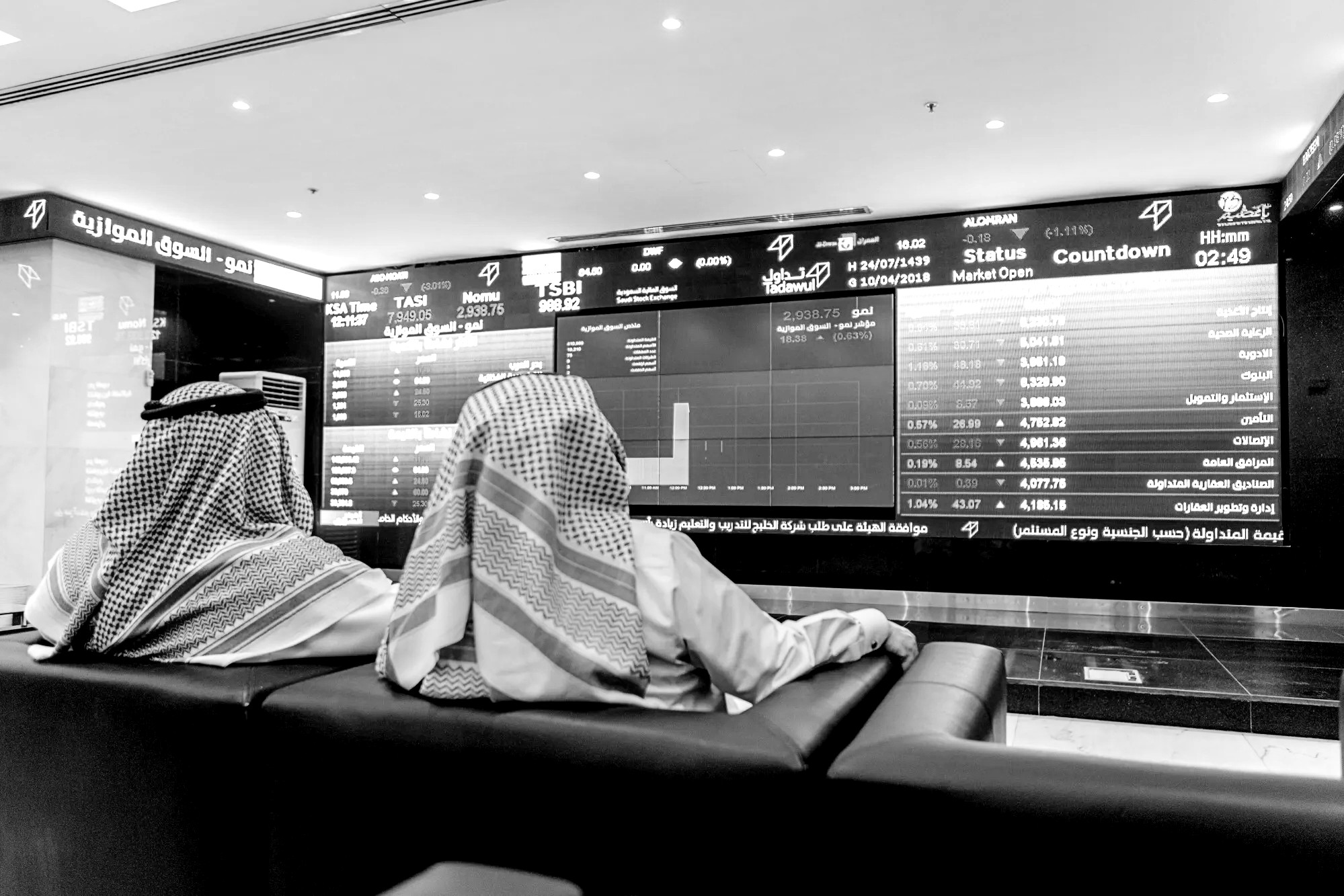
Markets across the Arab world, Africa and Europe began Monday under pressure as renewed fighting between the United States and Iran pushed Brent crude above $90 a barrel. Energy producers received some support from higher prices, but concerns over inflation, interest rates and disruption through the Strait of Hormuz weakened broader investor confidence.
Arab markets face direct conflict risk
Gulf markets entered Monday on a defensive footing after widespread losses during Sunday’s regional session. Qatar’s benchmark had fallen 1.5%, with Qatar National Bank losing approximately 3% and shipping company Nakilat declining around 2%.
Bahrain’s index dropped 1.2%, while Kuwait fell 0.4% after both countries reported Iranian missile or drone activity. The immediate security threat outweighed the potential financial benefit of higher energy prices.

Saudi Arabia’s Tadawul All Share Index proved more resilient, finishing Sunday approximately 0.2% higher near 10,720. Saudi Aramco gained as the rise in crude strengthened revenue expectations, while Saudi exports increasingly moved through the Red Sea port of Yanbu to reduce dependence on the Strait of Hormuz.
Egypt’s EGX30 declined around 0.7%, reflecting the pressure that higher oil and shipping costs place on energy-importing Arab economies.
Brent crude climbed approximately 3% to $90.87 a barrel after US forces launched a ninth consecutive night of strikes against Iran. Only a small number of commercial vessels passed through Hormuz on Sunday, increasing fears of a prolonged disruption.
African shares open cautiously
African markets began the session with a mixed but generally cautious tone. Johannesburg investors balanced weakness in global equities against potential support for selected resource companies.
South Africa’s market had ended Friday lower, with the FTSE/JSE All Share Index falling 0.7% to approximately 109,570. Monday’s opening remained sensitive to movements in mining companies, the rand and international bond yields.
Higher oil creates different outcomes across the continent. Producers such as Nigeria and Angola may benefit from increased export revenue, while import-dependent countries face more expensive fuel, transport and electricity.
Gold remained close to $4,000 an ounce, offering some support to African precious-metals producers. However, higher global borrowing costs and reduced demand for riskier assets limited enthusiasm across emerging and frontier markets.
European indices retreat
European shares opened lower as investors considered the inflationary impact of more expensive oil and natural gas. The Euro Stoxx 50 fell around 0.8% to approximately 6,216 during early trading.
Germany’s DAX declined about 0.3%, France’s CAC 40 lost nearly 0.5%, Spain’s IBEX 35 slipped 0.5% and Italy’s FTSE MIB fell close to 1%.
London’s FTSE 100 was expected to open around 0.3% lower after closing at 10,600 on Friday. Energy shares offered partial protection, but airlines, transport companies and other fuel-sensitive businesses came under pressure.
Ryanair reported a 34% decline in first-quarter profit as higher fuel costs and weaker travel demand affected performance. European technology shares also remained vulnerable after last week’s global semiconductor sell-off.
The European Central Bank’s approaching policy decision added to caution. Rising energy costs could delay inflation progress and strengthen the case for keeping interest rates elevated.
Monday’s opening therefore revealed a common concern across three regions: higher oil may benefit producers, but the economic and security consequences of a prolonged Hormuz disruption threaten a much wider range of companies and consumers.
Newshub Editorial in Global Markets – 20 July 2026

Ask NF GPT
If you have an account with ChatGPT you get deeper explanations,
background and context related to what you are reading.
Recent Comments