
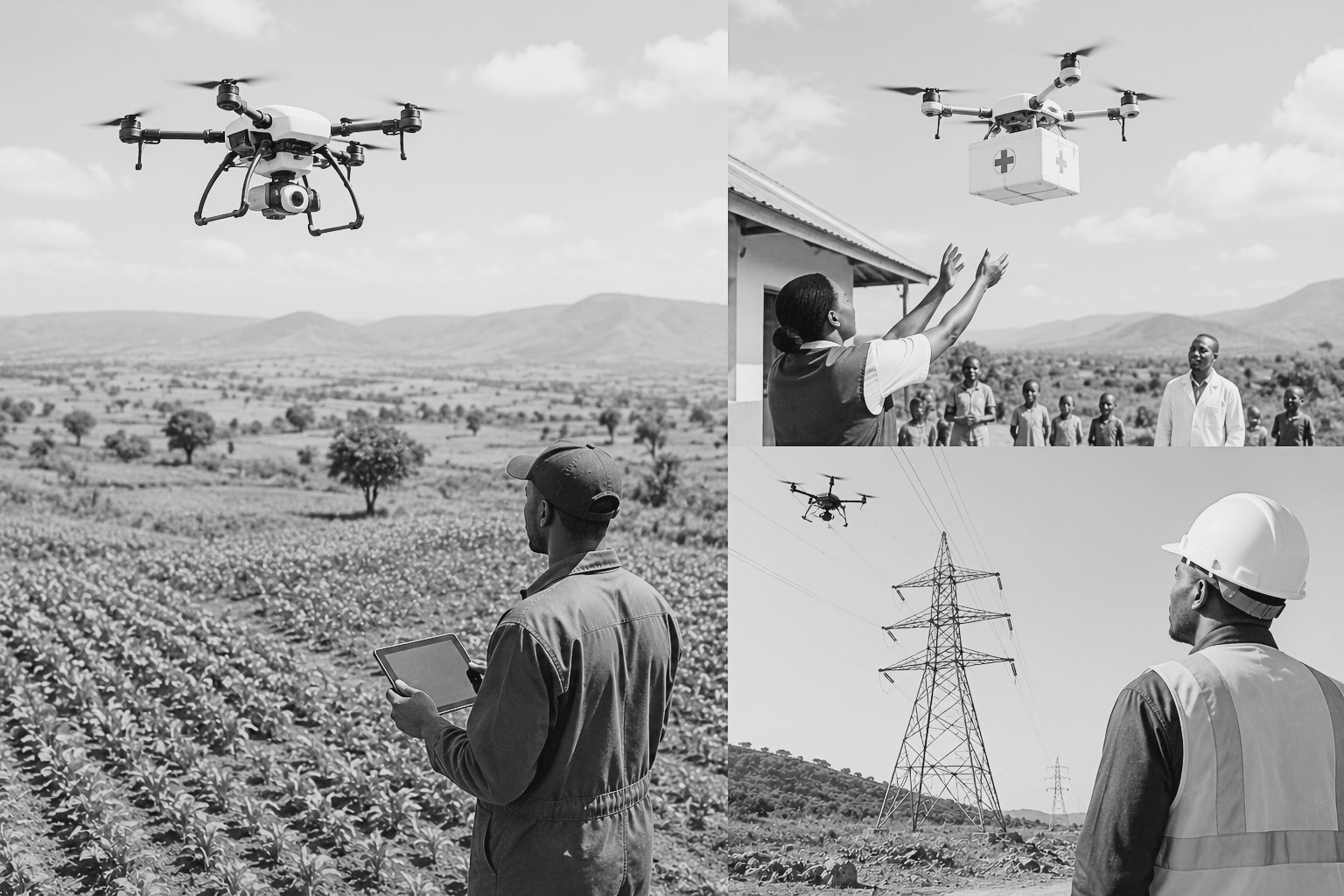
Drones are rapidly transforming industries across Africa, emerging as powerful tools for economic development, healthcare delivery, agriculture, infrastructure management, and disaster response. Once viewed primarily as military technology, unmanned aerial vehicles are increasingly becoming essential assets in efforts to improve productivity, expand services, and connect remote communities across the continent.
Revolutionising agriculture
Agriculture remains one of the sectors benefiting most from drone technology. Farmers are using drones to monitor crop health, identify pest outbreaks, assess irrigation needs, and optimise fertiliser application.

By providing detailed aerial imagery and real-time data, drones enable farmers to make more informed decisions, improve yields, and reduce operational costs. This is particularly important in regions where agriculture remains a major source of employment and economic activity.
As climate variability continues to affect farming conditions, drone-based monitoring is becoming an increasingly valuable tool for improving resilience and food security.
Improving healthcare access
Drones are also playing a growing role in healthcare logistics. In several African countries, medical drones are being used to transport blood supplies, vaccines, medicines, and laboratory samples to remote communities where road infrastructure may be limited or unreliable.
These services can significantly reduce delivery times, improve emergency response capabilities, and help healthcare providers reach populations that were previously difficult to serve.
Public health officials view drone networks as an important complement to traditional transportation systems, particularly in rural areas.
Supporting infrastructure and environmental management
Governments and private companies are increasingly deploying drones to inspect roads, bridges, power lines, pipelines, and construction projects. The technology allows operators to conduct surveys more quickly, safely, and cost-effectively than many traditional methods.
Environmental agencies are also using drones to monitor forests, wildlife habitats, water resources, and conservation areas. The aerial perspective provided by drones helps improve data collection and supports more effective resource management.
A growing technology sector
Africa’s drone ecosystem continues to expand as startups, universities, and technology companies develop new applications tailored to local needs. Several countries have introduced regulatory frameworks designed to encourage innovation while ensuring safe operations.
Industry observers believe the continent is well positioned to become a leader in practical drone deployment, particularly in sectors where infrastructure challenges create opportunities for technological solutions.
As investment and adoption continue to increase, drones are expected to play an increasingly important role in supporting economic growth, public services, and sustainable development across Africa.
Newshub Editorial in Africa – 6 June 2026

If you have an account with ChatGPT you get deeper explanations,
background and context related to what you are reading.
Open an account:
Open an account
Recent Comments