
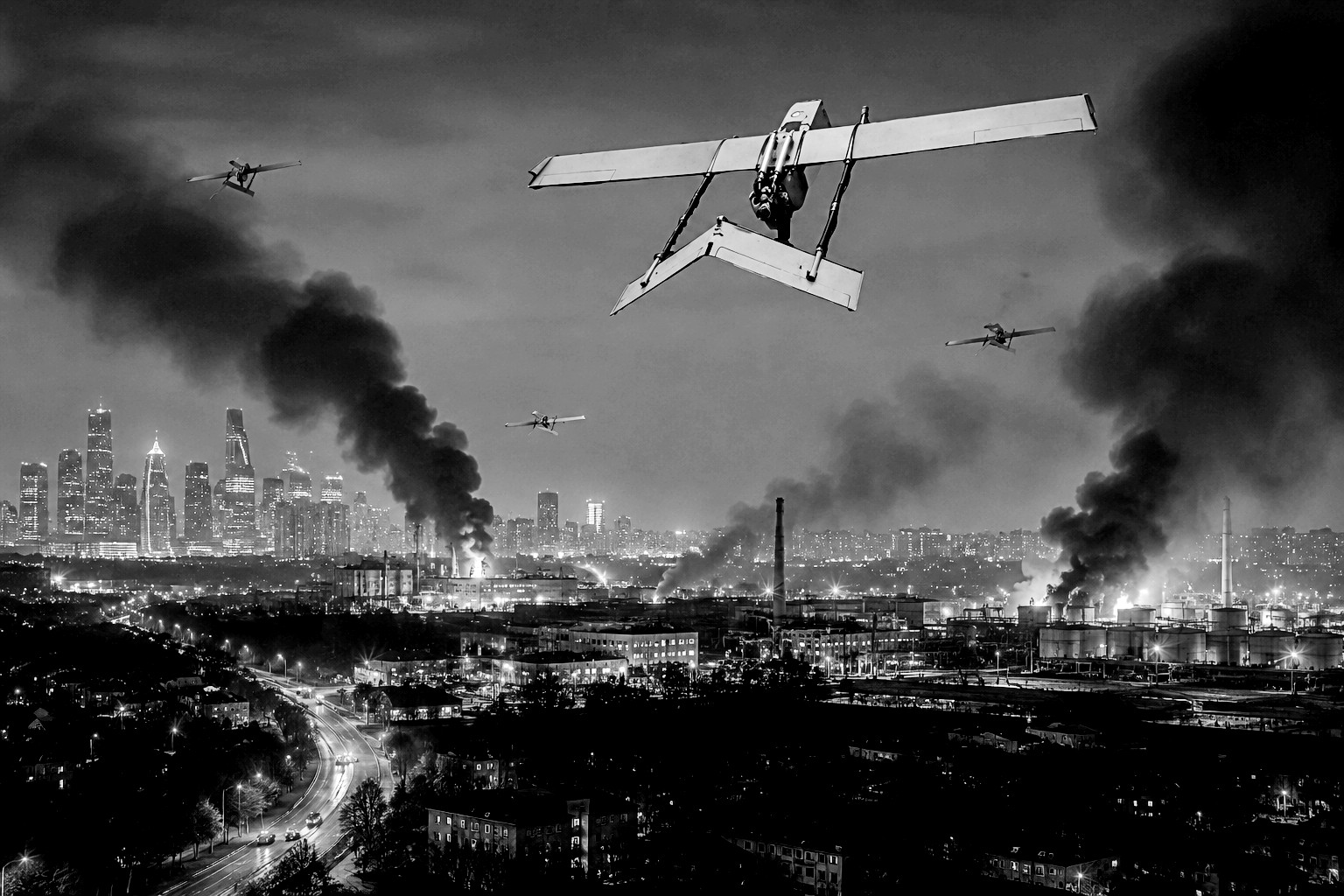
Ukraine has launched another wave of long-range drone attacks targeting the Moscow region and critical Russian infrastructure, with Kyiv claiming that electronics facilities connected to weapons production and strategic oil infrastructure were among the main targets. Ukrainian officials say the expanding drone campaign is designed to weaken Russia’s military-industrial capacity while demonstrating Kyiv’s growing technological reach deep inside Russian territory.
Strategic facilities reportedly targeted
Russian authorities reported multiple drone incursions across the Moscow region overnight, forcing temporary airspace restrictions and activating air defence systems around the capital. Ukrainian officials later indicated that the attacks focused on facilities linked to military electronics production and oil transportation infrastructure.
Among the reported targets was an electronics manufacturing plant allegedly involved in producing components for Russian weapons systems and military communications equipment. Ukrainian sources also claimed that a major oil pumping station connected to Russian energy logistics networks was struck during the operation.


While Moscow stated that many drones were intercepted, several regional officials acknowledged infrastructure disruptions and limited damage at industrial sites.
Kyiv intensifies long-range drone strategy
The latest strikes reflect Ukraine’s increasingly aggressive use of domestically developed long-range drones to pressure Russian logistics, energy systems and defence manufacturing deep behind the front lines.
President Volodymyr Zelenskyy said Ukraine is now “outstripping Russia” in several battlefield technologies, particularly in drone production and tactical innovation. Kyiv has dramatically expanded its unmanned aerial capabilities during the war, using drones not only for surveillance but also for precision strikes on military and industrial targets.
Military analysts note that Ukraine’s growing drone programme has become one of the most important strategic developments of the conflict, allowing Kyiv to strike Russian territory despite limitations in conventional missile capacity.
Russia faces growing pressure away from front lines
The attacks also highlight how the war is increasingly extending beyond traditional battlefield zones into industrial and logistical infrastructure across both countries.
Russian air defence systems have faced mounting pressure from frequent drone raids targeting refineries, fuel depots, transport hubs and military facilities. Several Russian energy sites have experienced disruptions in recent months, contributing to concerns over the long-term resilience of critical infrastructure.
At the same time, Russia continues carrying out extensive missile and drone strikes across Ukrainian cities and energy infrastructure, maintaining heavy pressure on Ukraine’s civilian and industrial systems.
Both sides are now engaged in what analysts increasingly describe as a technological attrition war involving drones, electronic warfare and industrial capacity.
Drone warfare reshapes modern conflict
The war between Ukraine and Russia has accelerated the evolution of drone warfare at an unprecedented pace. Cheap, mass-produced unmanned systems are increasingly capable of targeting strategic infrastructure hundreds of kilometres from active combat zones.
Military planners worldwide are closely monitoring the conflict as a potential blueprint for future warfare involving autonomous systems, AI-assisted targeting and decentralised strike capabilities.
The growing frequency of strikes inside Russian territory also carries political significance, demonstrating to both domestic and international audiences that Ukraine retains the capacity to project force despite ongoing battlefield pressures.
Conflict enters increasingly dangerous phase
The continued escalation of long-range attacks has raised concerns among international observers regarding the risk of broader regional instability. Infrastructure strikes involving energy systems and industrial production create growing fears of accidental escalation or disruptions extending beyond the immediate war zone.
Nevertheless, neither side currently shows signs of reducing military operations, and both Ukraine and Russia continue investing heavily in expanding drone manufacturing and counter-drone technologies.
As the conflict evolves, unmanned systems are becoming not only tactical weapons but also central instruments of economic and psychological warfare.
Newshub Editorial in Europe – May 18, 2026

If you have an account with ChatGPT you get deeper explanations,
background and context related to what you are reading.
Open an account:
Open an accountUkraine has launched another wave of long-range drone attacks targeting the Moscow region and critical Russian infrastructure, with Kyiv claiming that electronics facilities connected to weapons production and strategic oil infrastructure were among the main targets. Ukrainian officials say the expanding drone campaign is designed to weaken Russia’s military-industrial capacity while demonstrating Kyiv’s growing technological reach deep inside Russian territory.
Recent Comments