
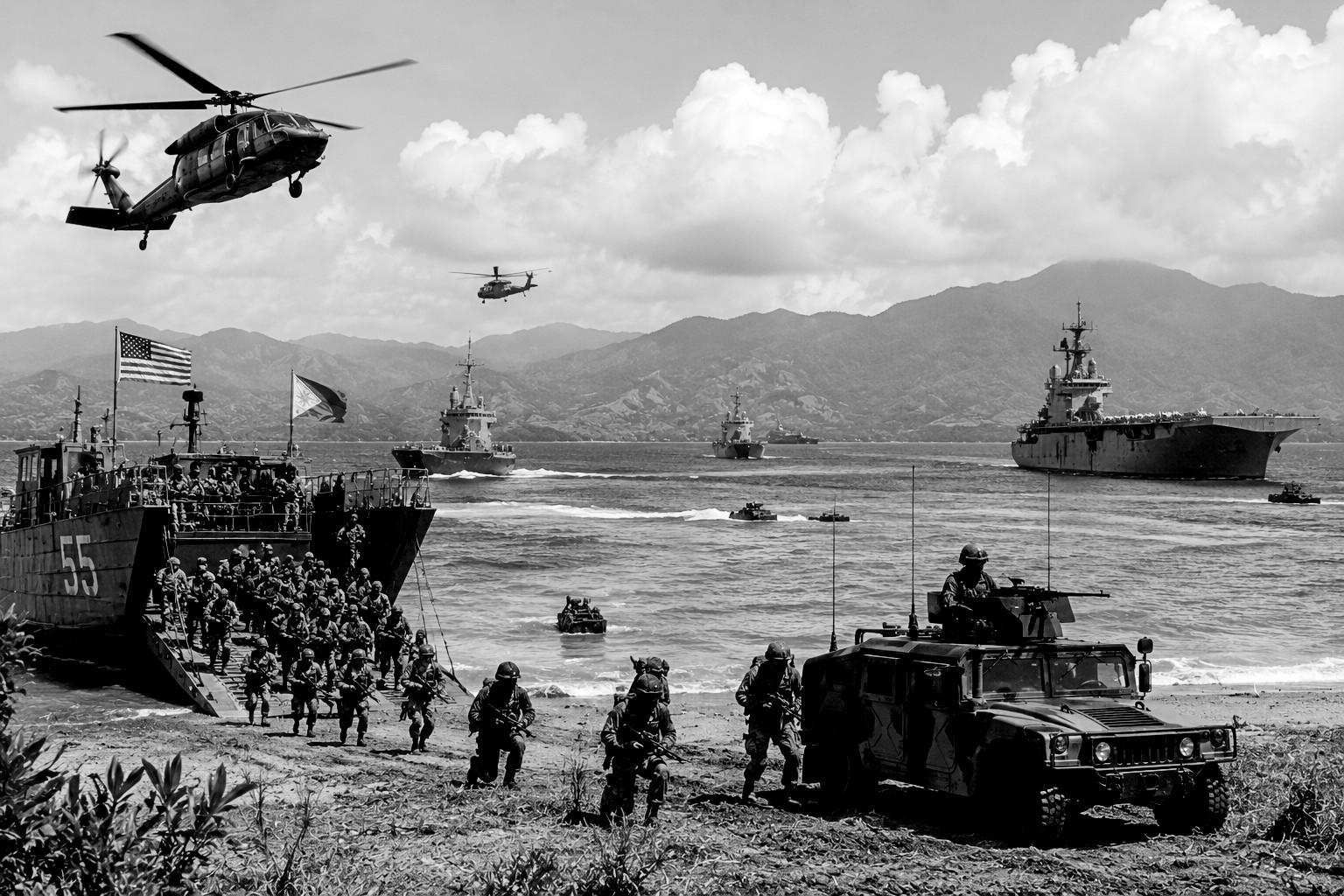
China has sharply criticised the latest joint military exercises between the United States and the Philippines, warning that the expanding Balikatan drills near Taiwan are escalating tensions across the Indo-Pacific region. The annual exercises, which have grown significantly in scale and strategic complexity, are increasingly viewed by Beijing as part of a broader American effort to contain China’s regional influence and strengthen military positioning around Taiwan and the South China Sea.
Military exercises expand in scale
The Balikatan exercises, conducted jointly by the armed forces of the United States and the Philippines, now involve thousands of troops, advanced missile systems, naval deployments and integrated air defence operations. Several training areas are located in northern Philippine regions facing Taiwan, drawing particular criticism from Beijing.
Chinese officials accused Washington of “provoking confrontation” and destabilising the regional security environment. Beijing stated that military cooperation targeting areas close to Taiwan risks undermining peace and increasing the possibility of miscalculation between major powers.

The exercises come amid rising military activity across the Taiwan Strait and the wider Indo-Pacific, where the United States and its allies are attempting to strengthen strategic deterrence against growing Chinese military capabilities.
Taiwan remains central flashpoint
Taiwan continues to represent the most sensitive geopolitical issue between China and the United States. Beijing considers Taiwan part of Chinese territory and has repeatedly warned against foreign military involvement near the island.
Washington officially maintains its “One China” policy while simultaneously expanding security cooperation with regional allies including Japan, South Korea, Australia and the Philippines. Analysts increasingly view the Balikatan drills as part of a broader strategy aimed at reinforcing regional military interoperability in the event of a future crisis involving Taiwan.
The Philippines has defended the exercises as essential for national security and disaster preparedness, particularly amid growing tensions in the South China Sea, where Manila and Beijing have clashed repeatedly over disputed maritime territory.
Regional powers face growing pressure
The latest military exercises highlight how Southeast Asian nations are increasingly caught between the strategic competition of the world’s two largest powers. Countries across the Indo-Pacific are attempting to balance economic ties with China against growing security cooperation with the United States.
China remains the largest trading partner for many regional economies, including the Philippines, yet concerns over maritime security and territorial disputes have pushed several governments closer toward Washington’s defence network.
Military analysts note that the Indo-Pacific is rapidly becoming one of the world’s most militarised regions, with expanding naval deployments, missile systems and surveillance operations contributing to an increasingly fragile strategic environment.
Risk of escalation concerns global markets
Beyond military implications, geopolitical tensions in the Taiwan Strait carry enormous economic consequences due to the region’s importance to global trade and semiconductor production. Any significant disruption could impact shipping routes, energy markets and technology supply chains worldwide.
Investors and governments are therefore closely monitoring developments surrounding Taiwan, particularly as military exercises, naval patrols and diplomatic confrontations become more frequent.
Despite the increasingly confrontational rhetoric, both Washington and Beijing continue publicly stating that they seek stability and wish to avoid direct military conflict. However, analysts warn that the combination of military expansion, political mistrust and nationalist pressure on all sides continues raising the risk of dangerous escalation.
Newshub Editorial in Asia – May 18, 2026

If you have an account with ChatGPT you get deeper explanations,
background and context related to what you are reading.
Open an account:
Open an accountChina has sharply criticised the latest joint military exercises between the United States and the Philippines, warning that the expanding Balikatan drills near Taiwan are escalating tensions across the Indo-Pacific region. The annual exercises, which have grown significantly in scale and strategic complexity, are increasingly viewed by Beijing as part of a broader American effort to contain China’s regional influence and strengthen military positioning around Taiwan and the South China Sea.
Recent Comments