
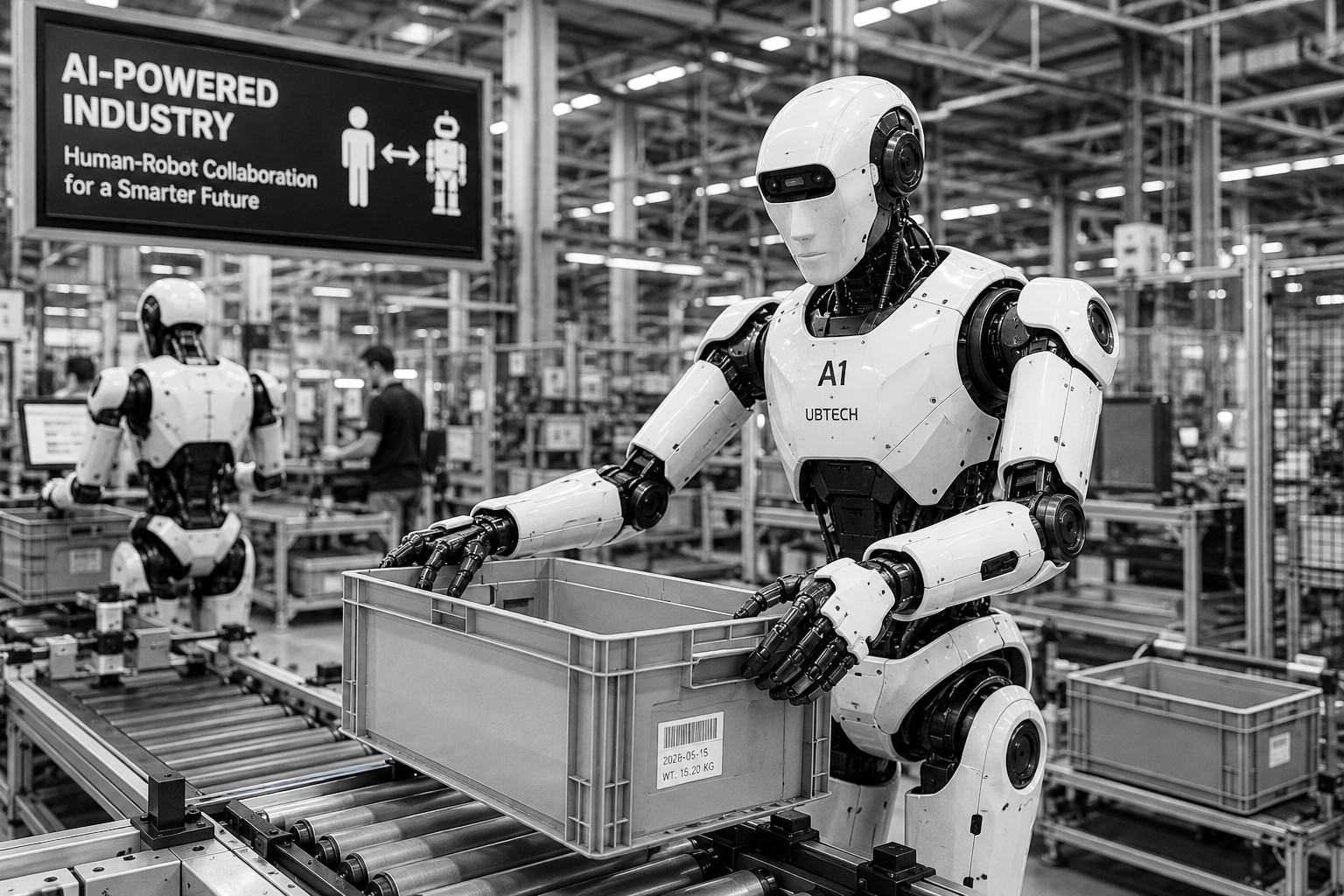
Humanoid robots powered by artificial intelligence are moving closer to real-world industrial deployment, as manufacturers and technology companies accelerate efforts to integrate so-called “physical AI” systems into warehouses, logistics hubs and factory environments. The shift marks a major step in the evolution of automation, potentially transforming how physical labour is performed across global industry.
From digital AI to physical machines
While recent years have been dominated by advances in generative AI software and large language models, attention is increasingly turning towards AI systems capable of interacting directly with the physical world.
Technology firms and industrial manufacturers are now testing humanoid robots designed to walk, lift objects, navigate factory environments and assist with repetitive operational tasks. These systems combine machine vision, real-time decision-making, sensor networks and advanced robotics to operate in spaces originally designed for humans.

Supporters argue that physical AI could help address labour shortages, improve industrial efficiency and reduce workplace injuries in sectors facing demographic and operational pressures.
Factories, warehouses and distribution centres are emerging as the first large-scale testing grounds for these next-generation robotic systems.
Manufacturing sector becomes key battleground
The race to commercialise humanoid robotics is rapidly intensifying across the United States, Europe and Asia. Major technology companies, automotive manufacturers and AI startups are investing heavily in robotics platforms capable of performing increasingly complex industrial tasks.
Automotive production facilities are among the most active early adopters due to their structured environments and heavy reliance on repetitive physical work. Logistics companies are also exploring how humanoid robots could support warehouse operations, inventory management and package handling.
Unlike traditional industrial robots, which typically perform highly specialised tasks inside controlled environments, physical AI systems are designed to adapt dynamically to changing conditions and work alongside human employees.
This flexibility is viewed as one of the technology’s most commercially important breakthroughs.
Challenges remain significant
Despite rapid advances, large-scale deployment still faces substantial obstacles. Battery life, movement stability, safety systems, processing power and real-world reliability remain major engineering challenges.
Cost is another critical factor. Many humanoid robotics systems remain extremely expensive, limiting immediate mass adoption outside high-value industrial environments.
Labour groups and policymakers are also closely monitoring the social implications of AI-driven automation. Concerns around workforce displacement, retraining needs and regulatory oversight are becoming increasingly central to discussions surrounding physical AI.
At the same time, supporters argue that automation may help offset labour shortages caused by ageing populations and declining workforce participation in several industrialised economies.
A defining moment for industrial automation
Analysts increasingly view physical AI as one of the next major frontiers in global technology development. If current testing programmes prove commercially viable, humanoid robotics could eventually reshape manufacturing, logistics, healthcare, construction and even domestic services.
The broader implications extend far beyond factory productivity. Physical AI may ultimately influence labour markets, urban planning, education systems and economic competitiveness across entire industries.
For now, however, most deployments remain experimental and carefully controlled. Yet with investment accelerating and technology improving rapidly, humanoid robots are moving steadily from science fiction towards everyday industrial reality.
Newshub Editorial in North America – May 15, 2026

If you have an account with ChatGPT you get deeper explanations,
background and context related to what you are reading.
Open an account:
Open an accountHumanoid robots powered by artificial intelligence are moving closer to real-world industrial deployment, as manufacturers and technology companies accelerate efforts to integrate so-called “physical AI” systems into warehouses, logistics hubs and factory environments. The shift marks a major step in the evolution of automation, potentially transforming how physical labour is performed across global industry.
Recent Comments