
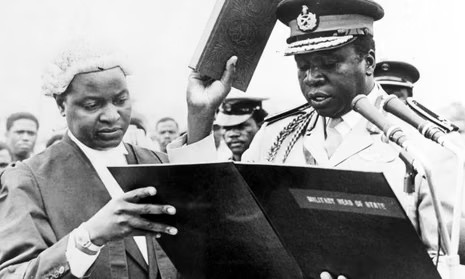
In January 1971, Uganda entered one of the darkest chapters in its modern history when army commander Idi Amin overthrew the elected government and declared himself president, setting the country on a path marked by violence, repression, and economic collapse.
The coup that reshaped Uganda
The seizure of power took place while President Milton Obote was abroad, attending a Commonwealth summit. In his absence, senior army officers loyal to Idi Amin launched a swift and decisive coup in the capital, Kampala. Radio broadcasts soon announced that the military had taken control “to restore order”, and within days Amin proclaimed himself president and commander-in-chief of the armed forces.
Initially, the coup was met with cautious optimism by parts of the Ugandan population. Obote’s rule had become increasingly authoritarian, and many hoped that the army takeover would be temporary or lead to reforms. Amin presented himself as a man of the people, promising to release political prisoners, restore democracy, and hold elections.


From popular general to absolute ruler
These early promises quickly proved hollow. Once firmly in power, Amin consolidated control by purging the military and state institutions of perceived opponents, particularly those loyal to Obote. Thousands of soldiers were killed in the first months alone, marking the beginning of a brutal reign.
Amin formally assumed the presidency in 1971, ruling by decree and dismantling constitutional checks on his authority. Uganda effectively became a military dictatorship, with power concentrated entirely in the hands of the president and his inner circle.
Rule by fear and violence
Over the following eight years, Amin’s regime became synonymous with terror. Human rights organisations estimate that between 200,000 and 300,000 Ugandans were killed during his rule. Arbitrary arrests, disappearances, and extrajudicial executions became routine, targeting political opponents, intellectuals, religious leaders, and ethnic groups perceived as disloyal.
The security forces operated with near-total impunity, and fear permeated daily life. State institutions collapsed as loyalty to Amin replaced competence as the primary criterion for office.
Economic destruction and international isolation
Amin’s policies also devastated Uganda’s economy. In 1972, he ordered the expulsion of tens of thousands of Asians, many of whom controlled key sectors of trade, manufacturing, and finance. Their assets were confiscated and redistributed to Amin’s supporters, leading to widespread mismanagement, shortages, and inflation.
Internationally, Uganda became increasingly isolated. While Amin courted attention through flamboyant rhetoric and self-awarded titles, diplomatic relations with Western countries deteriorated sharply. Sanctions and the withdrawal of foreign expertise further weakened the economy.
The fall of the regime
By the late 1970s, Amin’s grip on power began to weaken. A disastrous war with neighbouring Tanzania, combined with growing internal opposition, culminated in his overthrow in 1979. Tanzanian forces and Ugandan exiles captured Kampala, forcing Amin into exile, where he would live out the rest of his life.
A defining moment in Ugandan history
Idi Amin’s declaration of himself as president marked a turning point that left deep scars on Uganda. His rise to power serves as a stark reminder of how fragile political institutions can be, and how quickly military takeovers can descend into prolonged national tragedy.
Newshub Editorial in Africa – 2 February 2026

If you have an account with ChatGPT you get deeper explanations,
background and context related to what you are reading.
Open an account:
Open an accountIn January 1971, Uganda entered one of the darkest chapters in its modern history when army commander Idi Amin overthrew the elected government and declared himself president, setting the country on a path marked by violence, repression, and economic collapse.
Recent Comments