
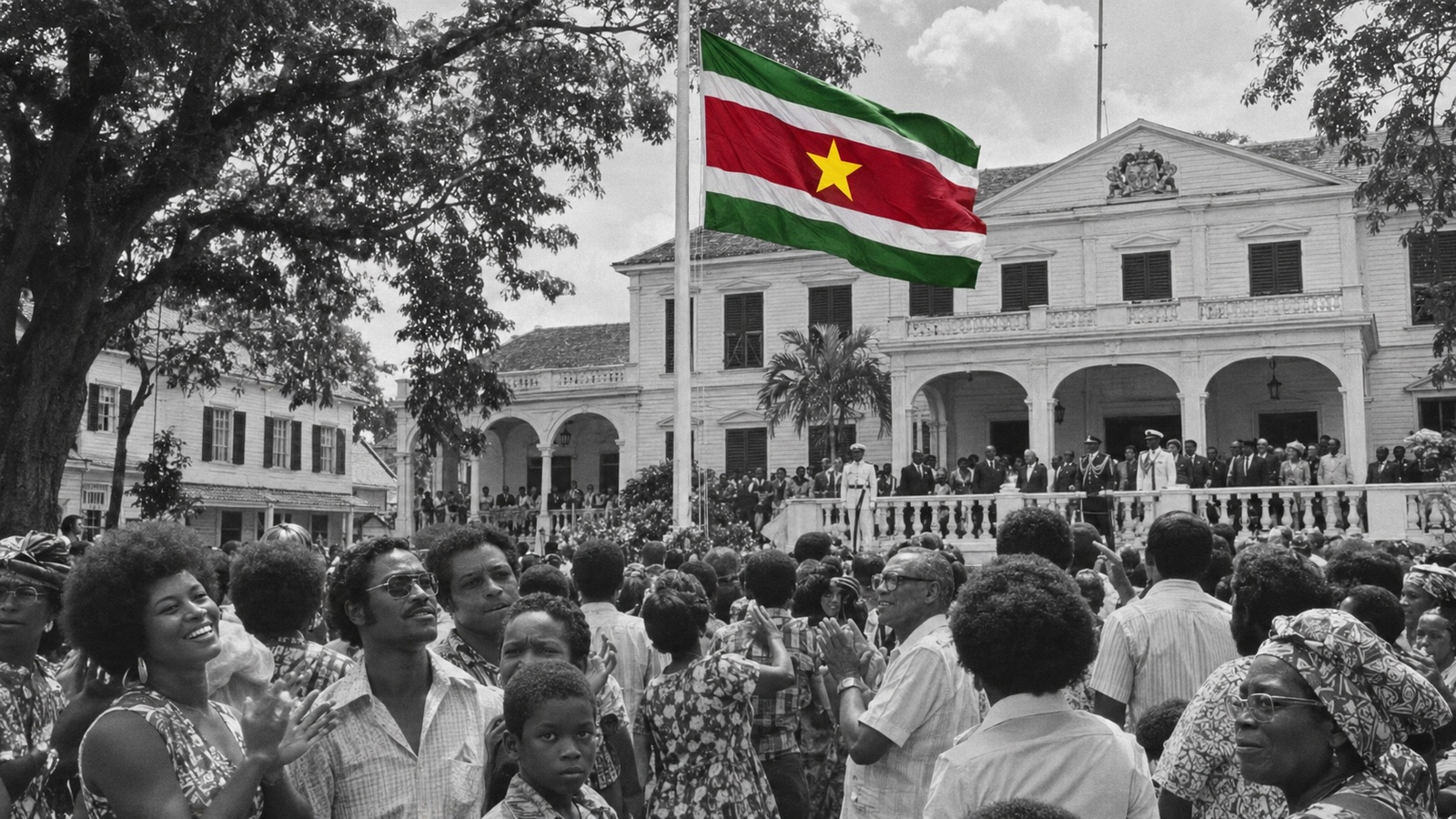
Suriname became an independent republic on 25 November 1975, leaving the Kingdom of the Netherlands after more than three centuries of Dutch colonial rule and two decades of internal self-government. In Paramaribo, Johan Ferrier took office as the country’s first president, while the Netherlands formally recognised the new state.
From self-government to sovereignty
The 1954 Charter for the Kingdom of the Netherlands gave Suriname control over its domestic affairs. Defence and foreign policy remained responsibilities of the kingdom. Calls for full independence grew during the 1960s, and Surinamese Prime Minister Henck Arron accelerated the process by setting a deadline of 1975. On independence day, Ferrier signed the act of sovereignty at a special sitting of parliament at the University of Suriname.
The two countries signed agreements on how they would work together after independence. Under a development co-operation treaty, the Netherlands committed 3.5 billion Dutch guilders in aid to Suriname. A separate agreement transferred Dutch military property in the country to the new republic. On 4 December 1975, nine days after independence, the United Nations General Assembly admitted Suriname as a member.


Migration before independence
The prospect of independence sharpened debate over citizenship and the right to settle in the Netherlands. As the handover approached, many Surinamese moved there amid uncertainty about the country’s future. Dutch population records show that arrivals from Suriname rose sharply in 1975, then fell in the years immediately after independence. Migration rose again towards the end of the decade, before the Netherlands introduced a visa requirement in 1980.
The movement around independence helped shape the Surinamese community in the Netherlands. Dutch official figures published in 2025 recorded that more than 250,000 people had moved from Suriname to the Netherlands in the half-century since independence. In Suriname itself, 25 November is a national holiday known as Srefidensi Dey, or Independence Day.
Newshub Editorial in South America – 25 November 2026
Suriname became an independent republic on 25 November 1975, leaving the Kingdom of the Netherlands after more than three centuries of Dutch colonial rule and two decades of internal self-government. In Paramaribo, Johan Ferrier took office as the country’s first president, while the Netherlands formally recognised the new state.

Recent Comments