
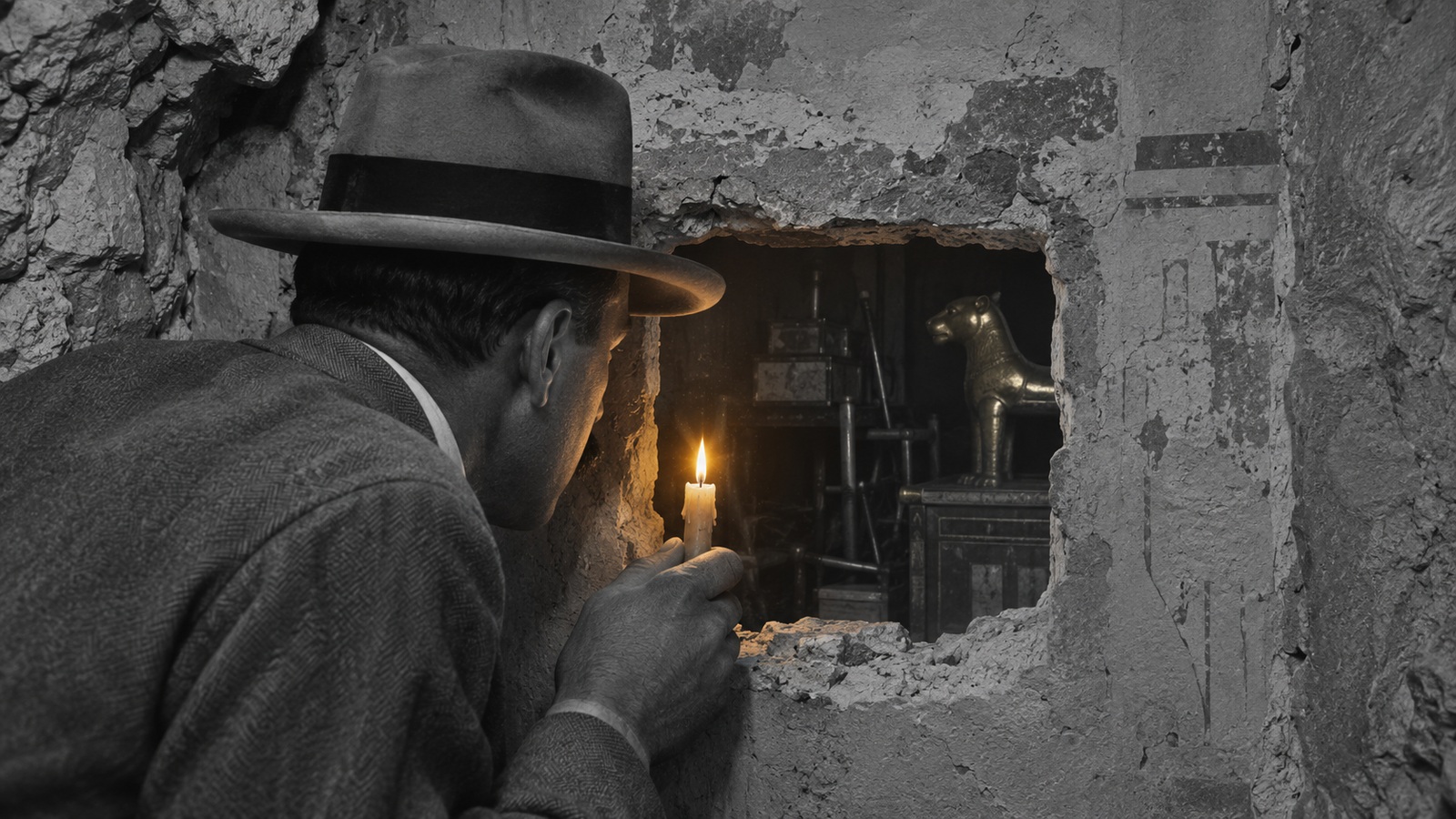
On 26 November 1922, British archaeologist Howard Carter held a candle to a small opening in a blocked doorway in Egypt’s Valley of the Kings. As his eyes adjusted, he made out gilded furniture, statues and other objects crowded into the antechamber. He was looking into the tomb of Tutankhamun, a pharaoh who had died more than 3,000 years earlier.
A staircase beneath the rubble
The excavation team had uncovered the first step of the staircase on 4 November, near the entrance to the tomb of Ramesses VI. Carter waited for his patron, Lord Carnarvon, to arrive from England before the team continued. Beyond the first doorway lay a passage filled with rubble. At its far end, a second blocked doorway concealed the chamber Carter would glimpse by candlelight.


There were signs that ancient intruders had already breached the tomb, giving the excavators reason to wonder how much had survived. Inside, pieces of disassembled chariots, gilded couches and boxes were packed together. The burial chamber itself lay beyond another doorway and was opened the following February.
What the tomb revealed
Tutankhamun came to the throne as a child and died in his late teens. The objects buried with him gave researchers a remarkably detailed record of royal life during Egypt’s 18th Dynasty. Furniture showed how royal households were furnished, while clothing, jewellery and chariots revealed the skills of the craftspeople who made them. The nested coffins and shrines documented the elaborate preparations Egyptians made for a king’s burial.
The glimpse by candlelight began a decade of work. Egyptian workers helped excavate and clear the tomb, while the team photographed, catalogued and conserved thousands of objects, many of them fragile after centuries underground. Tutankhamun’s gold funerary mask became the discovery’s most recognisable object. The surviving excavation records preserve details as revealing as the mask itself, including where everyday objects were placed and how they were stored alongside the treasures made for the king’s burial.
NewsHub Finance | History | 26 November 2026
On 26 November 1922, British archaeologist Howard Carter held a candle to a small opening in a blocked doorway in Egypt’s Valley of the Kings. As his eyes adjusted, he made out gilded furniture, statues and other objects crowded into the antechamber. He was looking into the tomb of Tutankhamun, a pharaoh who had died more than 3,000 years earlier.

Recent Comments