
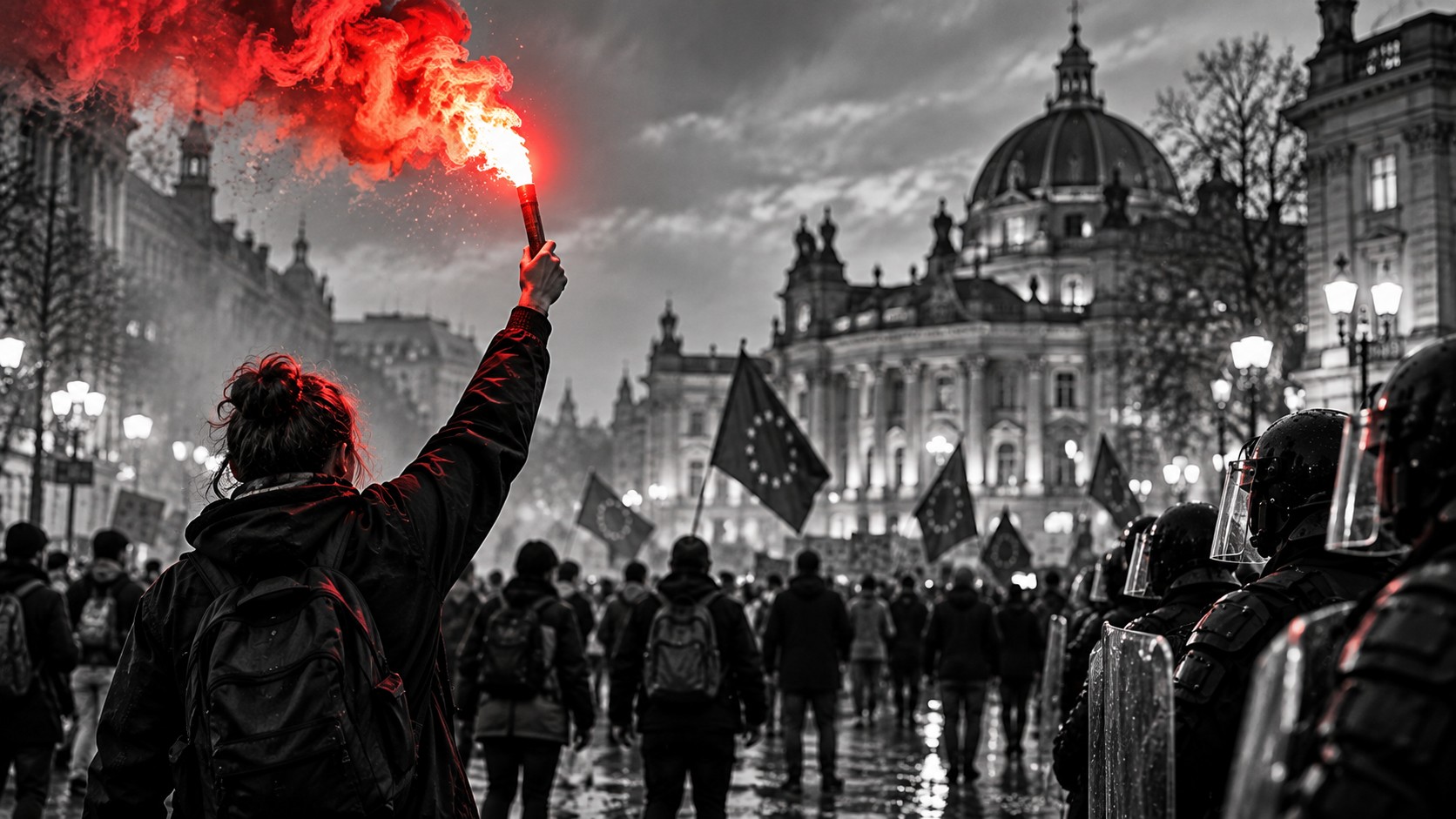
As governments deploy riot police and political leaders condemn violence, a more uncomfortable question is emerging across Europe: have decades of economic inequality, declining public services and political detachment created a generation that no longer believes democratic institutions can deliver meaningful change?
BRUSSELS, 31 October 2026 – Burning vehicles, smashed windows and confrontations with police dominate international coverage of Europe’s growing unrest. Yet behind the dramatic images lies a potentially more consequential story: millions of Europeans increasingly question whether the economic and political systems governing their lives still work in their interests.
From France and Italy to Belgium, Spain, Portugal and Albania, demonstrations have different immediate causes but reveal overlapping grievances involving housing, wages, education and institutional accountability.


The economic contract is breaking down
For decades, European governments promoted an implicit promise: education, employment and responsible financial behaviour would lead to economic security.
For many younger Europeans, that promise appears increasingly difficult to fulfil.
Rising rents, expensive housing and pressure on public services have weakened the relationship between employment and financial independence.
The issue is not simply poverty. It is the perception that opportunities available to previous generations are disappearing.
Why the cameras focus on violence
In France, hundreds of thousands have participated in demonstrations, the overwhelming majority peacefully. Nevertheless, images of burning buildings and clashes frequently define international headlines.
Violence is unquestionably newsworthy, particularly when businesses are destroyed or police officers and demonstrators are injured.
But focusing almost exclusively on disorder risks overlooking the grievances that brought peaceful participants onto the streets.
The distinction matters because protesters, organised violent groups and opportunistic looters do not necessarily share the same objectives.
Police deployment does not resolve political legitimacy
France has mobilised tens of thousands of officers to contain unrest, while Belgium has faced complaints concerning police conduct during youth demonstrations.
Authorities have a responsibility to protect public safety. Equally, the proportionality of their response deserves independent scrutiny.
When governments measure success primarily through arrests and restored public order, they risk confusing control of the streets with resolution of the crisis.
Who benefits from the confrontation?
Political movements can exploit unrest to reinforce existing narratives, while social media amplifies emotionally charged images.
However, allegations that foreign actors orchestrated Europe’s riots remain unsupported by conclusive evidence.
The more revealing investigation concerns domestic policy: who benefits from rising property values, who carries the burden of public spending cuts and whose interests shape economic decisions?
Europe faces a choice beyond restoring order
The central question is not whether violence should be tolerated. It should not.
It is whether governments can address the structural grievances that survive long after the streets have been cleared.
Europe’s unrest may ultimately reveal something more troubling than a temporary breakdown in public order: a widening distance between democratic institutions and the people they are supposed to represent.
NewsHub Finance | Investigative Desk | 31 October 2026
As governments deploy riot police and political leaders condemn violence, a more uncomfortable question is emerging across Europe: have decades of economic inequality, declining public services and political detachment created a generation that no longer believes democratic institutions can deliver meaningful change?

Recent Comments