
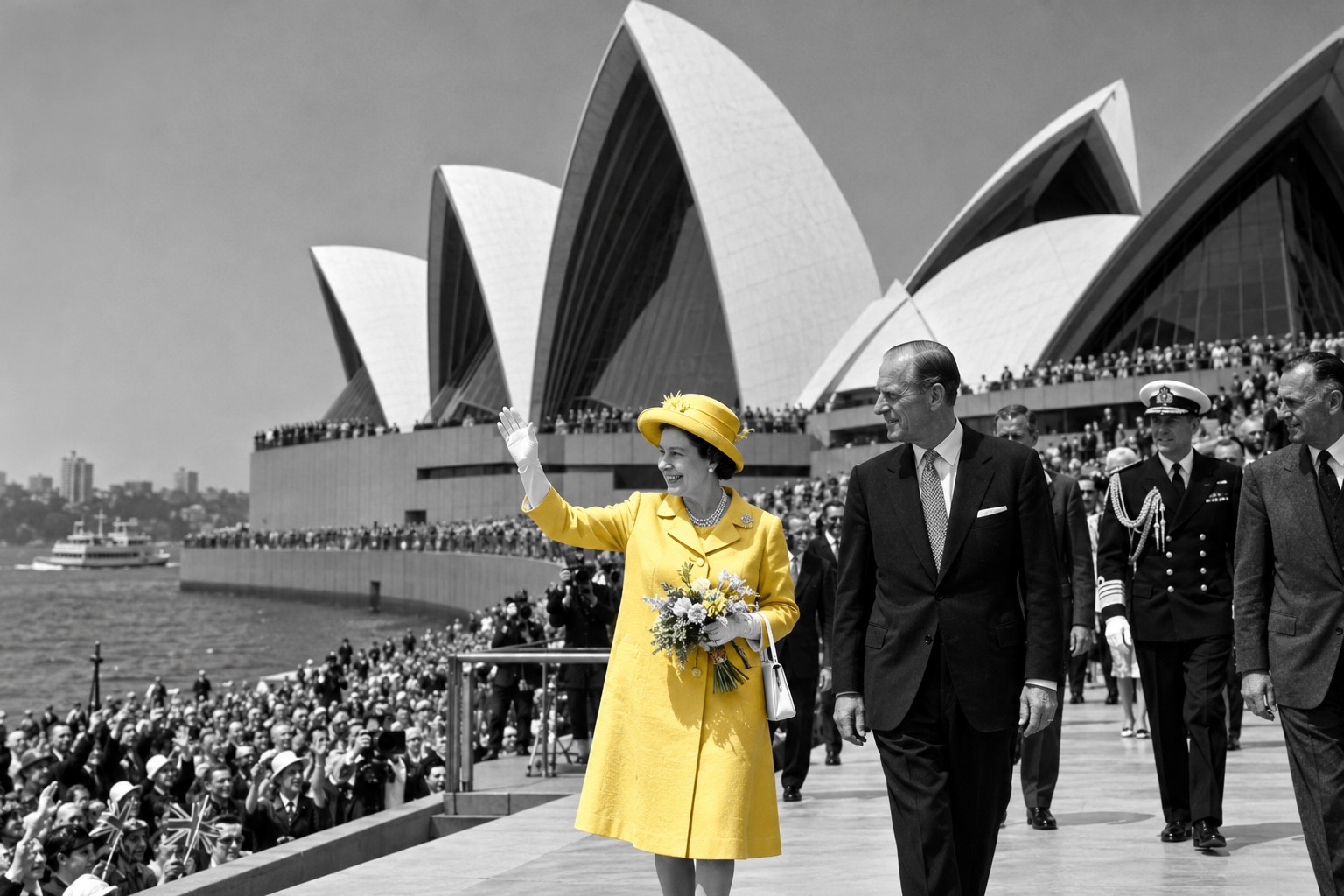
On 20 October 1973, Queen Elizabeth II officially opened the Sydney Opera House, marking the completion of one of the most ambitious and controversial construction projects of the 20th century. Fifty-three years later, the building remains one of Australia’s most recognisable landmarks and a global symbol of architectural innovation.
A historic day on Sydney Harbour
Thousands of spectators gathered around Bennelong Point as Queen Elizabeth II, accompanied by Prince Philip, inaugurated the spectacular waterfront building. The celebrations included fireworks, military bands and a performance of Beethoven’s Ninth Symphony.
Millions watched the ceremony on television, witnessing the conclusion of a project that had challenged architects, engineers and politicians for almost two decades.


The building’s distinctive white, sail-shaped roofs immediately transformed Sydney’s skyline, creating an architectural identity that would become inseparable from the city itself.
A Danish architect’s extraordinary vision
The story began in 1957 when Danish architect Jørn Utzon won an international competition to design a new performing arts centre for Sydney.
His revolutionary proposal featured a series of enormous curved concrete shells, inspired by natural forms and the surrounding harbour.
Construction began in 1959, but the engineering challenges proved considerably greater than anticipated.
Political disputes, technical complications and escalating expenditure eventually forced Utzon to resign in 1966. He never returned to Australia to see his completed masterpiece.
A construction project that broke the budget
Originally expected to cost approximately A$7 million, the Opera House ultimately required A$102 million, around fourteen times its initial budget.
Completion also came roughly a decade later than planned.
The extraordinary expense became a national political controversy, raising questions about government spending, public accountability and the financial risks of ambitious infrastructure projects.
Yet what critics once condemned as an expensive architectural experiment gradually became one of Australia’s greatest cultural and economic assets.
From controversy to world heritage
The Sydney Opera House developed into an internationally celebrated performing arts centre, hosting opera, theatre, orchestral performances and major cultural events.
In 2007, UNESCO designated the building a World Heritage Site, recognising its exceptional architectural significance.
Today, its influence extends far beyond the performing arts. It attracts visitors from across the world, strengthens Sydney’s international reputation and demonstrates how visionary public investment can create lasting cultural value.
The opening on 20 October 1973 was therefore more than the inauguration of a building. It marked the moment when a troubled construction project became an enduring national symbol.
NewsHub Finance | History & Culture | 20 October 2026
On 20 October 1973, Queen Elizabeth II officially opened the Sydney Opera House, marking the completion of one of the most ambitious and controversial construction projects of the 20th century. Fifty-three years later, the building remains one of Australia's most recognisable landmarks and a global symbol of architectural innovation.
Recent Comments