
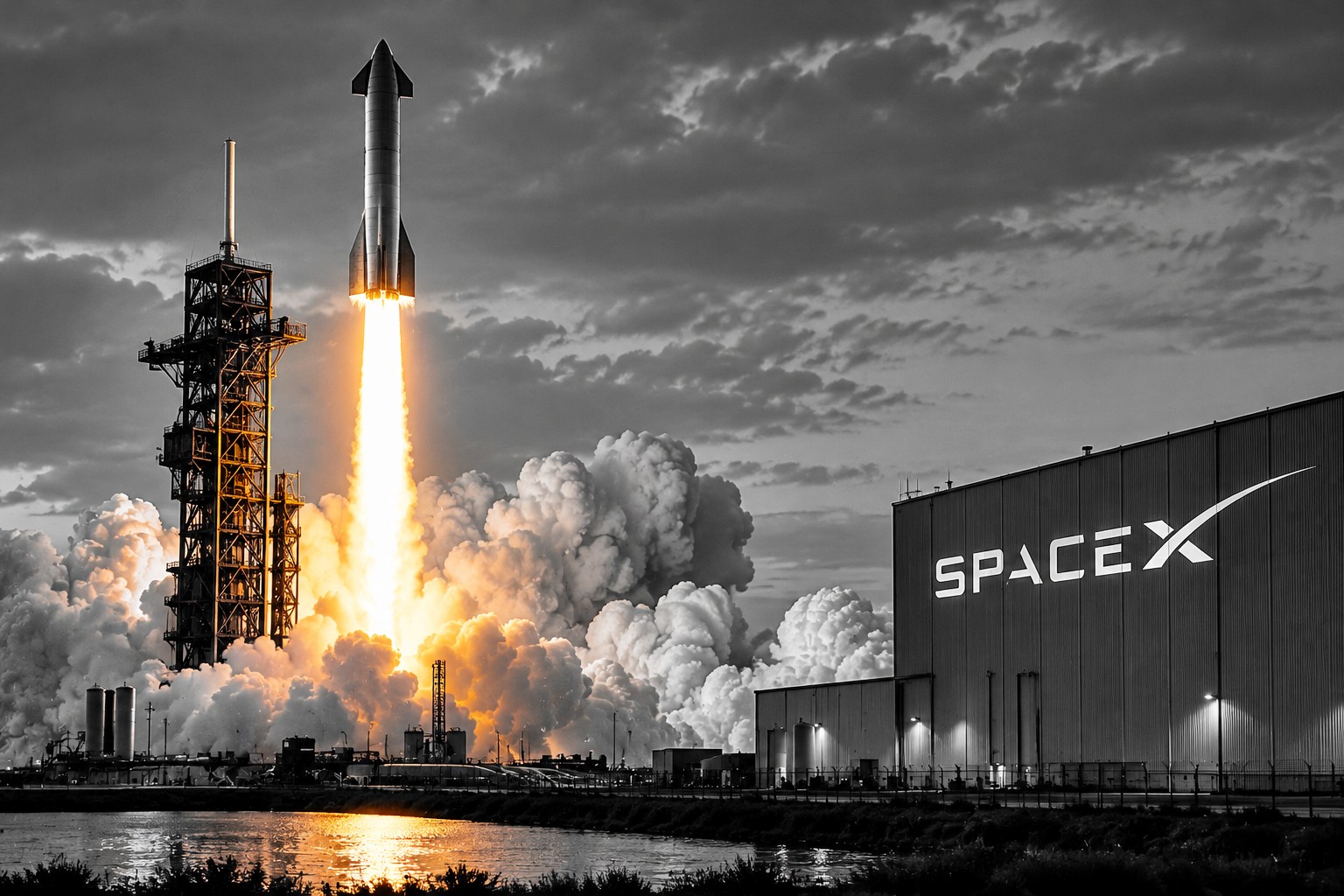
Elon Musk’s SpaceX has reported a remarkable financial turnaround, with third-quarter revenue surging 161% to $14.6 billion and net profit reaching $4.4 billion. The results, released on 20 October 2026, reveal how the publicly listed aerospace company is rapidly transforming into a major artificial intelligence and satellite communications business, raising new questions about its long-term strategy and valuation.
Revenue surges as profitability returns
SpaceX reported revenue of $14.6 billion for the three months ending 30 September, compared with $5.6 billion a year earlier.
Net income reached $4.4 billion, reversing a $1.1 billion loss in the corresponding period of 2025.


Adjusted EBITDA climbed 306% to $8.8 billion, significantly exceeding market expectations.
The figures represent the company’s first profitable quarter since its stock market debut earlier this year.
Artificial intelligence becomes the largest business
The most striking development came from SpaceX’s Super Intelligence division, which generated $7.56 billion in quarterly revenue.
The division includes AI infrastructure, computing services and software operations.
Revenue from AI solutions and infrastructure expanded rapidly as demand for computing capacity continued to outpace available supply.
However, analysts caution that exceptionally high demand for computing resources may not translate into permanently elevated profitability.
Starlink continues its global expansion
SpaceX’s satellite communications division generated approximately $5.25 billion in revenue, an increase of 69% year-on-year.
Starlink reported 13.6 million consumer subscribers at the end of September, compared with 12 million three months earlier.
Enterprise and government services contributed approximately $2.13 billion, reflecting growing demand from aviation, commercial and public-sector customers.
The satellite network remains a major source of recurring revenue.
Rocket operations become a smaller contributor
Space operations generated approximately $1.8 billion during the quarter.
Although the business continued to secure commercial and government contracts, its financial contribution was substantially smaller than those of AI and connectivity.
SpaceX also reported its first revenue-generating orbital Starship mission, deploying 26 next-generation Starlink satellites.
Enormous investment requirements
Despite the strong earnings, SpaceX continues to face extraordinary capital expenditure demands.
Quarterly investment reached approximately $19.6 billion, including $16.4 billion directed towards AI infrastructure.
This creates a significant distinction between accounting profitability and the cash required to finance expansion.
A new identity for SpaceX
The results suggest SpaceX is evolving beyond its origins as a rocket manufacturer.
Its future increasingly depends on satellite connectivity, artificial intelligence and capital-intensive infrastructure.
For investors, the central question is whether the company can sustain its exceptional growth while generating sufficient cash to support its ambitious expansion.
NewsHub Finance | Space & Business | 21 October 2026
Elon Musk's SpaceX has reported a remarkable financial turnaround, with third-quarter revenue surging 161% to $14.6 billion and net profit reaching $4.4 billion. The results, released on 20 October 2026, reveal how the publicly listed aerospace company is rapidly transforming into a major artificial intelligence and satellite communications business, raising new questions about its long-term strategy and valuation.
Recent Comments