
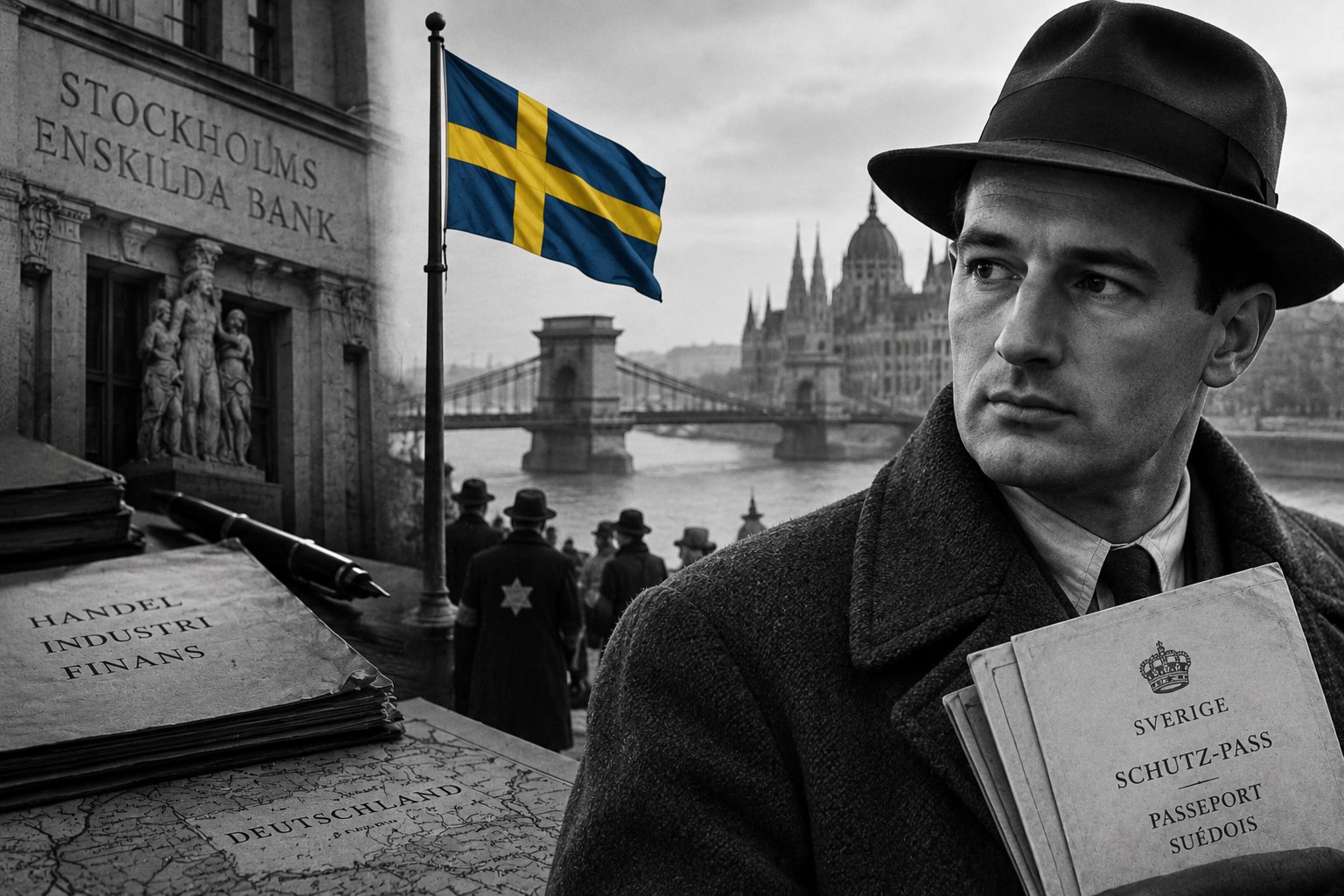
The Wallenberg name appears in two very different chapters of Second World War history. One concerns the commercial activities of Sweden’s powerful banking and industrial network and its relationships with Nazi Germany. The other concerns Raoul Wallenberg, the Swedish diplomat who helped save thousands of Hungarian Jews from persecution and deportation in 1944. Both stories belong to history, but they must be examined separately, without confusing commercial responsibility with individual humanitarian action.
The Wallenberg business network during the war During the Second World War, Sweden maintained commercial relations with Germany despite its declared neutrality. Swedish banks, industrial companies and exporters operated within a European economy increasingly shaped by German military expansion.
The Wallenberg sphere, centred on Stockholms Enskilda Bank and an extensive industrial network, occupied an influential position in this economic system.


Its wartime activities have attracted historical scrutiny, particularly regarding financial transactions, German commercial relationships and the handling of assets connected to Nazi-controlled Europe.
Some transactions involving German securities and assets subsequently became subjects of Allied investigations and post-war negotiations.
However, a crucial distinction must be maintained between documented transactions, allegations investigated by Allied authorities and conclusions supported by surviving evidence.
Commercial connections with Germany do not, by themselves, establish participation in Nazi crimes.
A different mission begins in Budapest In 1944, as Hungary’s Jewish population faced systematic deportation and mass murder, another member of the Wallenberg family entered the historical record for entirely different reasons.
Raoul Wallenberg, a Swedish businessman with international experience, was recruited for a humanitarian mission supported by the American War Refugee Board.
Working through the Swedish Ministry for Foreign Affairs, he was appointed to the Swedish diplomatic mission in Budapest and arrived in July 1944.
His assignment was to help protect Jews threatened by Nazi persecution.
Protective passports and safe houses Wallenberg and his colleagues developed an extensive rescue operation using Swedish protective documents, diplomatic intervention and buildings placed under Swedish protection.
The documents, commonly known as Schutz-Pässe, were intended to identify their holders as people under Swedish diplomatic protection.
Their effectiveness depended on negotiation, diplomatic pressure and the willingness of Hungarian and German authorities to recognise or tolerate them.
Wallenberg also intervened directly when Jews faced deportation or violence.
His work formed part of a wider international rescue effort involving Swedish diplomats, other neutral representatives, Jewish organisations and local volunteers.
Historians differ over the precise number of people saved directly through his actions, but his contribution to the survival of thousands is firmly established.
Two histories, not one collective responsibility The distinction matters. Raoul Wallenberg’s rescue mission was not an operation conducted by Stockholms Enskilda Bank, nor does his humanitarian work resolve questions concerning the bank’s wartime transactions.
Conversely, evidence concerning commercial dealings by companies associated with the Wallenberg sphere cannot establish Raoul’s personal involvement or responsibility.
Historical accountability requires identifying specific individuals, institutions, decisions and documented actions.
The disappearance of Raoul Wallenberg In January 1945, Wallenberg was detained by Soviet authorities and disappeared into Soviet custody.
A Soviet account subsequently claimed that he died in Moscow’s Lubyanka prison in July 1947, although the full circumstances of his fate remain unresolved.
His rescue work has since received international recognition.
History demands separate judgements The Wallenberg wartime record cannot responsibly be reduced to a single narrative of either commercial controversy or humanitarian achievement.
The banking and industrial relationships require examination through financial records, diplomatic correspondence and contemporary investigations.
Raoul Wallenberg’s mission must be understood through the documented rescue operations in Budapest.
Both histories deserve scrutiny. Neither should be used to erase, excuse or distort the other.
Newshub Editorial in Europe – 14 October 2026
The Wallenberg name appears in two very different chapters of Second World War history. One concerns the commercial activities of Sweden's powerful banking and industrial network and its relationships with Nazi Germany. The other concerns Raoul Wallenberg, the Swedish diplomat who helped save thousands of Hungarian Jews from persecution and deportation in 1944. Both stories belong to history, but they must be examined separately, without confusing commercial responsibility with individual humanitarian action.
Recent Comments