
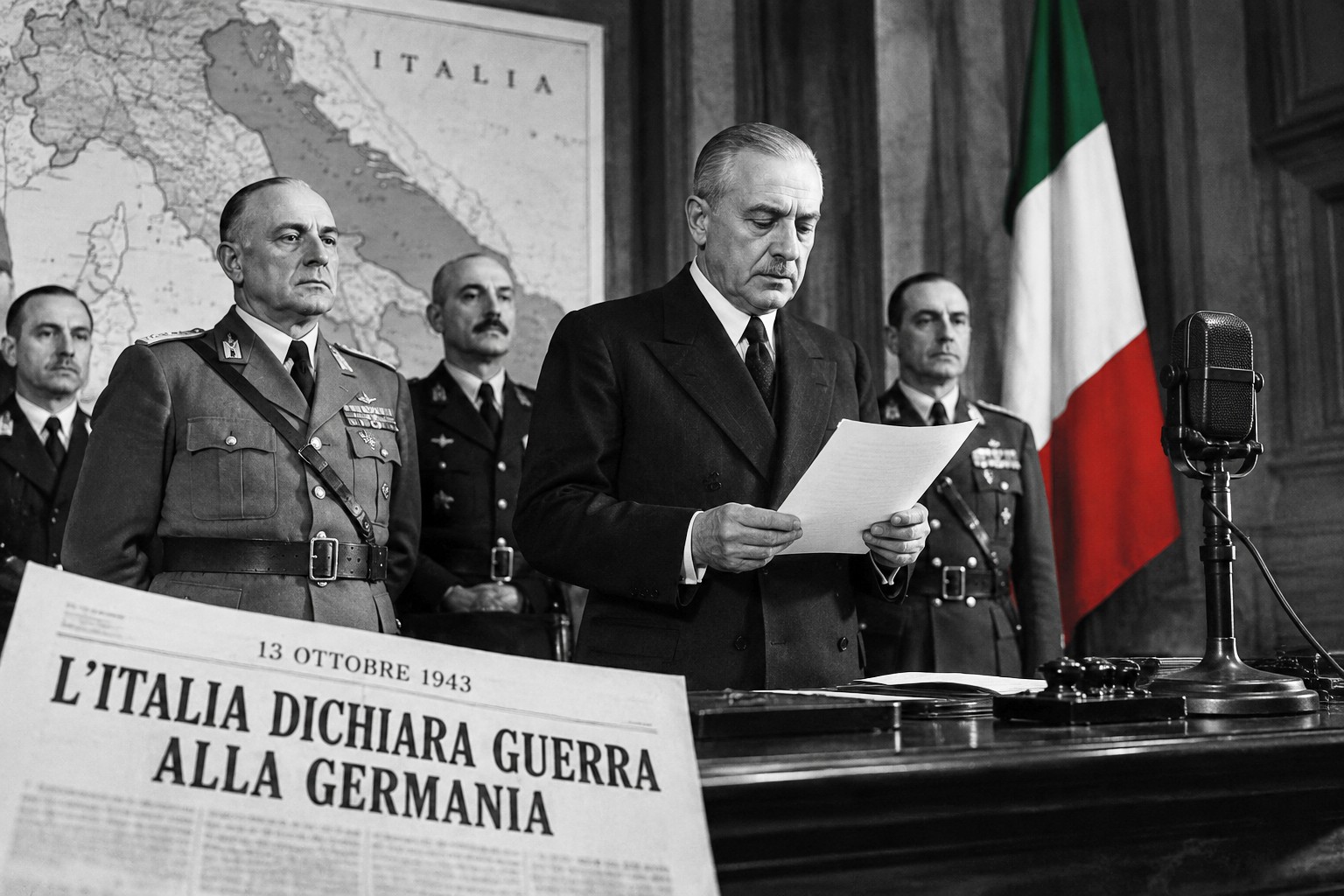
On 13 October 1943, Italy formally declared war on Nazi Germany, turning against its former ally in one of the most dramatic political reversals of the Second World War. The decision came just weeks after Italy surrendered to the Allied powers and marked the beginning of a new phase in the struggle to liberate the country from German occupation.
The collapse of Mussolini’s regime Italy had entered the Second World War alongside Germany in June 1940 under the Fascist dictator Benito Mussolini. However, successive military defeats, economic hardship and growing public opposition gradually undermined his government.
On 25 July 1943, Mussolini was removed from power and arrested. King Victor Emmanuel III appointed Marshal Pietro Badoglio to lead a new government, which secretly negotiated an armistice with the Allies.


The agreement was announced on 8 September 1943, effectively ending Italy’s participation in the Axis alliance. Germany responded by occupying large parts of the country, disarming Italian troops and establishing military control over Rome and northern Italy.
Former allies become enemies On 13 October, Badoglio formally announced that Italy was at war with Germany. The declaration was communicated through diplomatic channels in Madrid, while the Italian government committed its forces to fighting alongside the Allied armies.
The United States, Britain and the Soviet Union recognised Italy as a co-belligerent rather than a full Allied power. This distinction allowed Italian forces to participate in operations against Germany without cancelling the terms of Italy’s earlier surrender.
A country divided by war The declaration did not immediately reunify Italy. German forces continued to occupy much of the peninsula, while Mussolini, rescued by German commandos, headed a German-backed Fascist state in the north.
Italian soldiers, resistance fighters and Allied troops fought against German occupation and Fascist forces. The resulting conflict combined an international military campaign with an increasingly bitter struggle between Italians.
Rome was liberated in June 1944, but fighting continued until the final collapse of German forces in Italy in spring 1945.
A turning point in Italian history Italy’s declaration of war against Germany represented more than a change in military allegiance. It accelerated the collapse of Fascist rule and opened the way towards the country’s post-war political transformation.
In 1946, Italians voted to abolish the monarchy and establish a republic.
The events of 13 October 1943 remain a defining moment in modern Italian history: the day a former partner of Nazi Germany formally became its enemy.
On 13 October 1943, Italy formally declared war on Nazi Germany, turning against its former ally in one of the most dramatic political reversals of the Second World War. The decision came just weeks after Italy surrendered to the Allied powers and marked the beginning of a new phase in the struggle to liberate the country from German occupation.
Recent Comments