
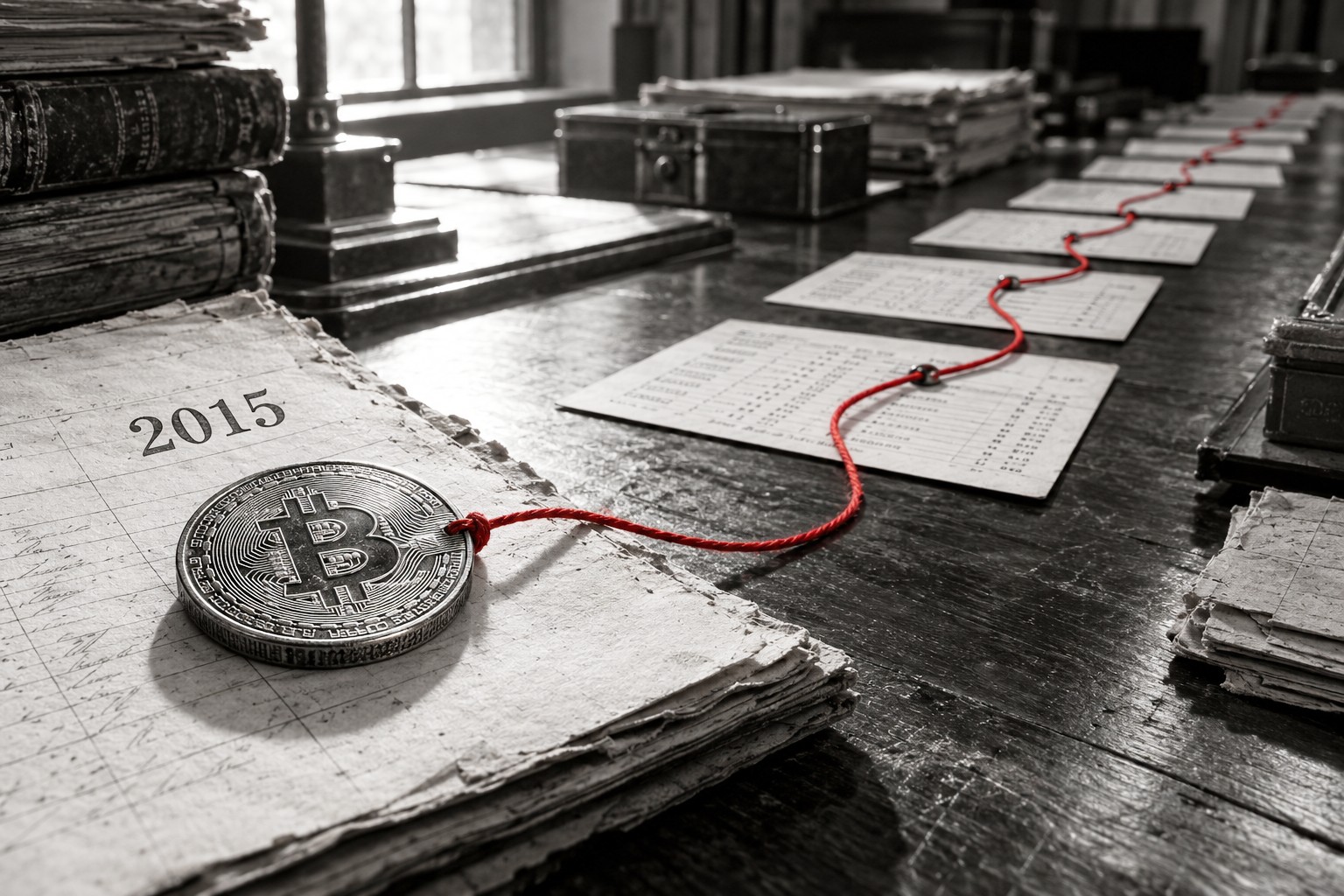
A Bitcoin transaction recorded in 2015 can still be examined today. Its public blockchain record does not disappear with age, and information discovered years later can help investigators connect old transfers to identifiable people or businesses. However, tracing funds and proving ownership are different tasks.
Bitcoin operates through a public ledger that records confirmed transactions. These records show how previously received funds are spent and where new transaction outputs are directed.
Names, passport details and bank accounts are not automatically included. Bitcoin is therefore pseudonymous: activity is visible, but the people controlling the addresses may remain unknown.


How an old transaction becomes identifiable
Investigators can start with a transaction identifier or known address and follow connected transfers through the blockchain.
Specialist software maps these connections and groups addresses that appear to share control. For example, addresses used together to fund a transaction may belong to the same wallet. Analysts also examine patterns in funds returned to the sender as change.
These techniques require caution. Collaborative transactions can involve several owners, meaning an apparent connection is not necessarily proof that one person controls every address.
Identification often depends on evidence outside the blockchain. Exchange customer records, seized devices, published addresses and financial documents can connect digital activity with a real identity.
A wallet unidentified in 2015 could therefore become attributable years later if relevant evidence emerges.
A trail that survived nearly a decade
The James Zhong investigation demonstrates the longevity of these records. Zhong unlawfully obtained approximately 50,000 Bitcoin from Silk Road in 2012. US authorities seized more than 50,676 Bitcoin at his home in November 2021.
Investigative material described the use of blockchain analysis alongside computer records and other evidence. The case illustrates how historical transactions can remain useful long after the original activity.
What tracing cannot guarantee
Mixing services, collaborative transactions and transfers through exchanges can complicate reconstruction. Internal exchange trades are not individually recorded on Bitcoin’s public blockchain, and missing customer records can leave important gaps.
A visible transfer also does not establish its purpose, prove criminal conduct or determine whether tax was owed.
For investors, businesses and authorities, the central lesson is straightforward: an old transaction may remain visible indefinitely, while the evidence needed to understand it can improve over time. The digital record persists; certainty about the people behind it must still be established.
A Bitcoin transaction recorded in 2015 can still be examined today. Its public blockchain record does not disappear with age, and information discovered years later can help investigators connect old transfers to identifiable people or businesses. However, tracing funds and proving ownership are different tasks.
Recent Comments