
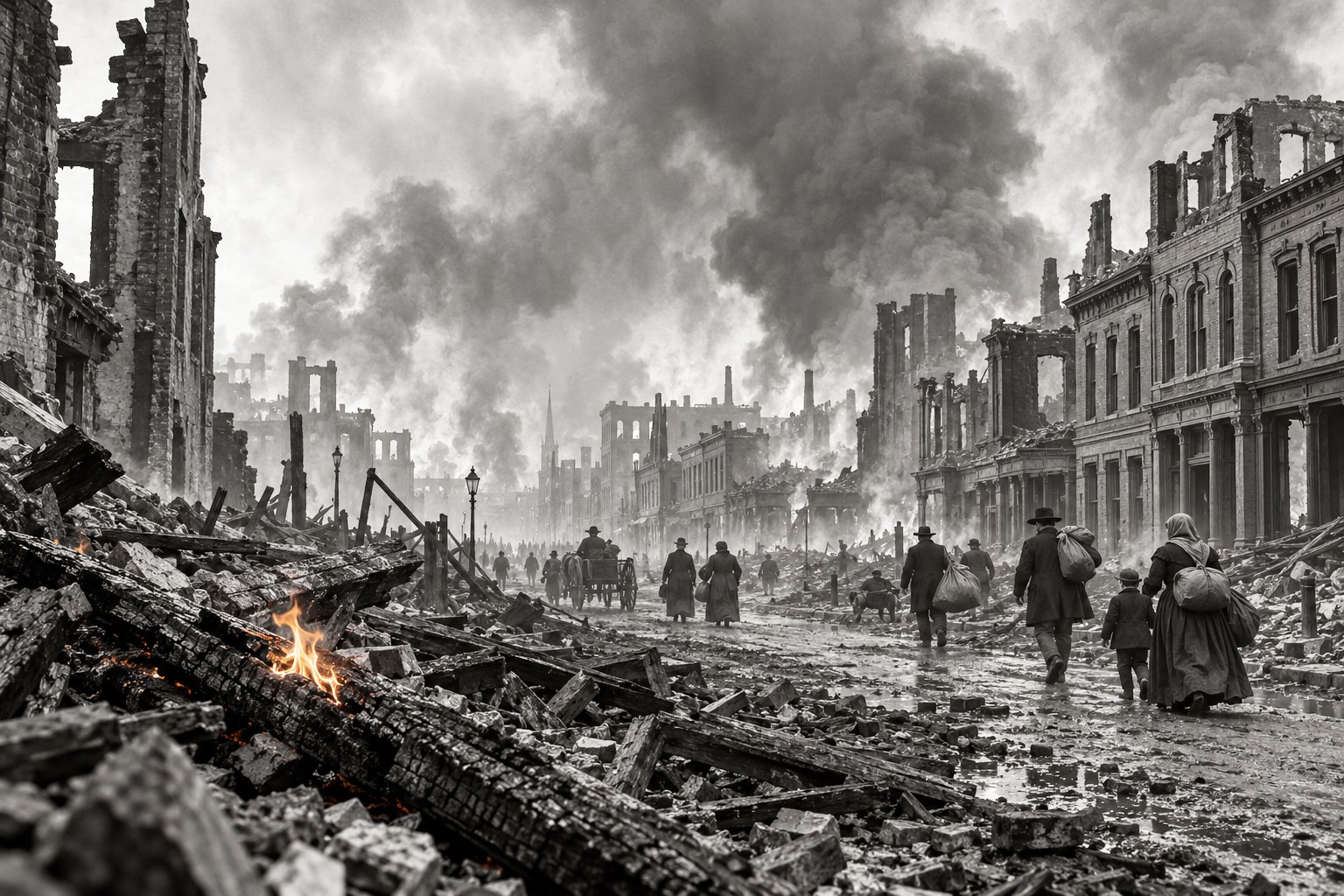
The Great Chicago Fire: remembering the disaster of 8 October 1871
On 8 October 1871, a fire broke out in Chicago that would kill an estimated 300 people and leave more than 100,000 homeless. Today marks 155 years since the beginning of a disaster that destroyed much of the city’s centre and prompted reconstruction on an extraordinary scale.
The blaze began on a Sunday evening near a barn belonging to Patrick and Catherine O’Leary. Exceptionally dry conditions, strong winds and the widespread use of timber in buildings created conditions in which flames could spread rapidly.


Chicago’s river offered little protection. Wind carried burning debris across the water, spreading the fire into the central business district and subsequently through much of the city’s North Division. Wooden docks and vessels along the riverbanks contributed to the combustible surroundings.
Destruction across the city
By the time rain helped extinguish the final flames on 10 October, more than 17,000 structures had been destroyed across an area exceeding three square miles. Around one-third of Chicago’s residents had lost their homes.
The damage extended beyond housing. Businesses and workplaces disappeared, leaving survivors facing the simultaneous challenges of finding shelter and restoring their livelihoods. The scale of destruction made recovery a question of resources as well as physical reconstruction.
An accusation that outlasted the evidence
The fire became associated with the story that Catherine O’Leary’s cow had kicked over a lantern. The precise cause, however, remains unknown, and that familiar account should not be presented as established fact.
The Irish immigrant family nevertheless became a focus of blame. Their experience remains an important part of the disaster’s history, illustrating how a simple explanation can dominate public memory despite the absence of conclusive evidence.
Reconstruction and unequal recovery
Chicago rebuilt rapidly, but the recovery was uneven. Wealthier residents had greater means to replace property, while poorer households faced deeper difficulties recovering their homes and incomes. Reconstruction also encouraged changes in fire safety intended to reduce the danger of another major conflagration.
The anniversary recalls both a defining urban disaster and the social divisions revealed by its aftermath. Behind Chicago’s reputation for recovery were thousands of families whose ability to rebuild depended heavily on the resources available to them.
Newshub Editorial in North America – 8 October 2026
The Great Chicago Fire: remembering the disaster of 8 October 1871
Recent Comments