
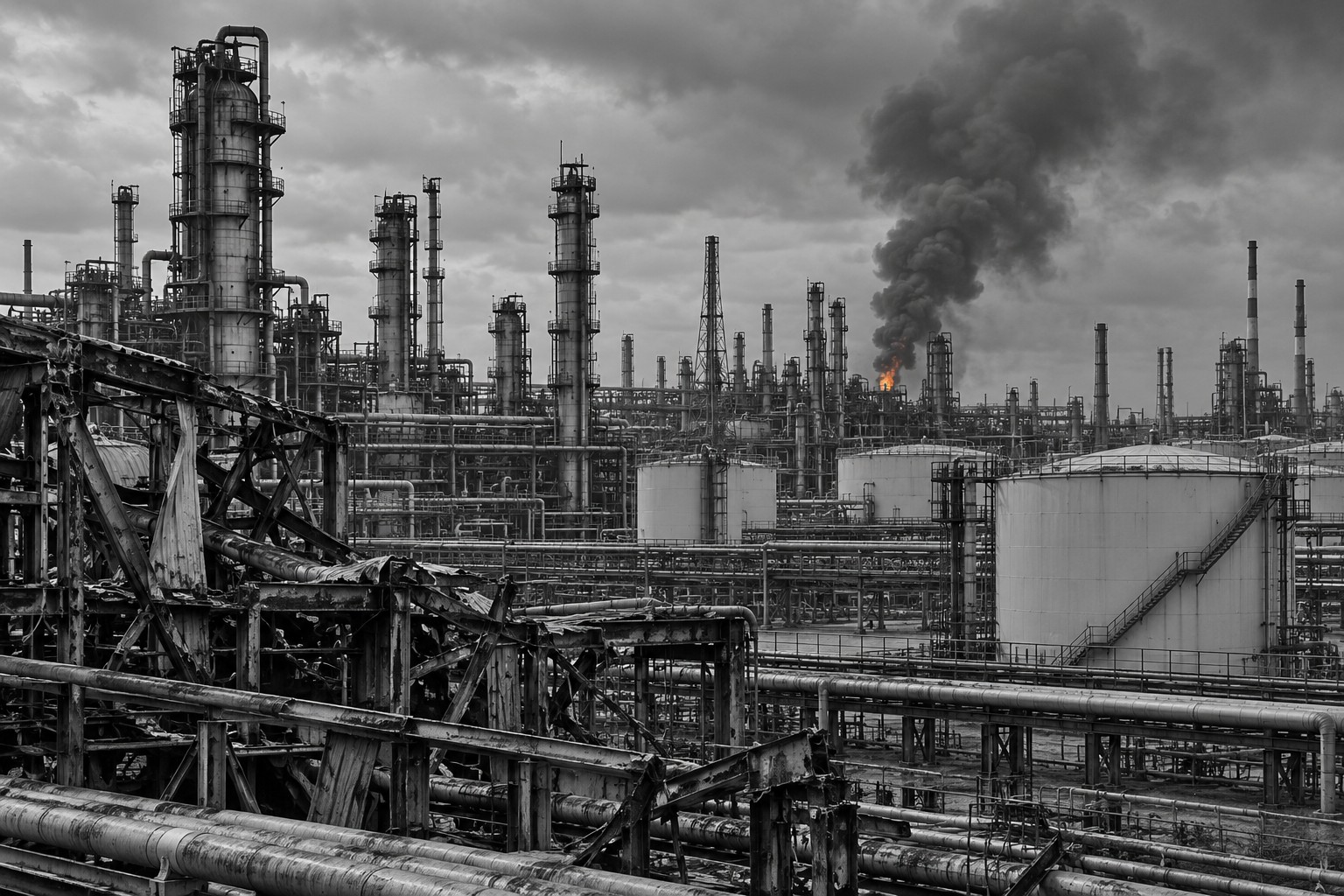
Ukraine says its long-range attacks have disabled more than half of Russia’s oil refining capacity, intensifying economic pressure on Moscow as the war continues. Russian President Vladimir Putin has separately acknowledged that strikes on refineries have cost the country roughly 1% of gross domestic product, although the scale of physical damage remains independently unverified.
Kyiv reports widening disruption
Ukraine’s defence ministry said on 4 October that its assessment showed 51% of Russian refining capacity had been disabled. It cited analysis by military intelligence, the General Staff and defence officials, following attacks on installations including those in Moscow, Yaroslavl, Perm, Saratov and Syzran.
The figure represents Kyiv’s assessment and should not be interpreted as independently established evidence that half of Russia’s refining infrastructure has been permanently destroyed. Capacity affected by attacks can include facilities undergoing repairs or operating below normal output.


Ukraine considers the campaign a means of disrupting fuel supplies and weakening the economic resources supporting Russia’s invasion. Its defence ministry also reported that production and procurement of long-range strike drones had tripled during 2026.
Putin acknowledges economic losses
Speaking at the Valdai discussion forum on 1 October, Putin conceded that Ukraine had partially achieved its objective of damaging Russia’s economy. His estimate of losses equivalent to approximately 1% of GDP was a notable acknowledgement of the campaign’s economic consequences.
Russian authorities have not published a comprehensive account of damage to oil infrastructure. Repeated attacks have nevertheless been accompanied by fuel shortages and restrictions on petrol sales, adding pressure on domestic distribution.
Infrastructure war strains both economies
The refinery campaign forms part of an expanding conflict over industrial capacity, transport and energy infrastructure. Russia’s attacks on Ukrainian factories, ports and railways have also disrupted production and exports, weakening revenues while military expenditure remains substantial.
Ukraine is seeking additional external financing as these disruptions increase pressure on its budget. The economic effects therefore extend beyond individual facilities: prolonged interruptions can constrain supply chains, reduce earnings and raise repair costs.
For Russia’s refining sector, the central unanswered questions remain how much capacity is currently unavailable, how quickly damaged equipment can be restored and whether further strikes will prevent a sustained recovery.
Newshub Editorial in Europe – 6 October 2026
Ukraine says its long-range attacks have disabled more than half of Russia’s oil refining capacity, intensifying economic pressure on Moscow as the war continues. Russian President Vladimir Putin has separately acknowledged that strikes on refineries have cost the country roughly 1% of gross domestic product, although the scale of physical damage remains independently unverified.
Recent Comments