
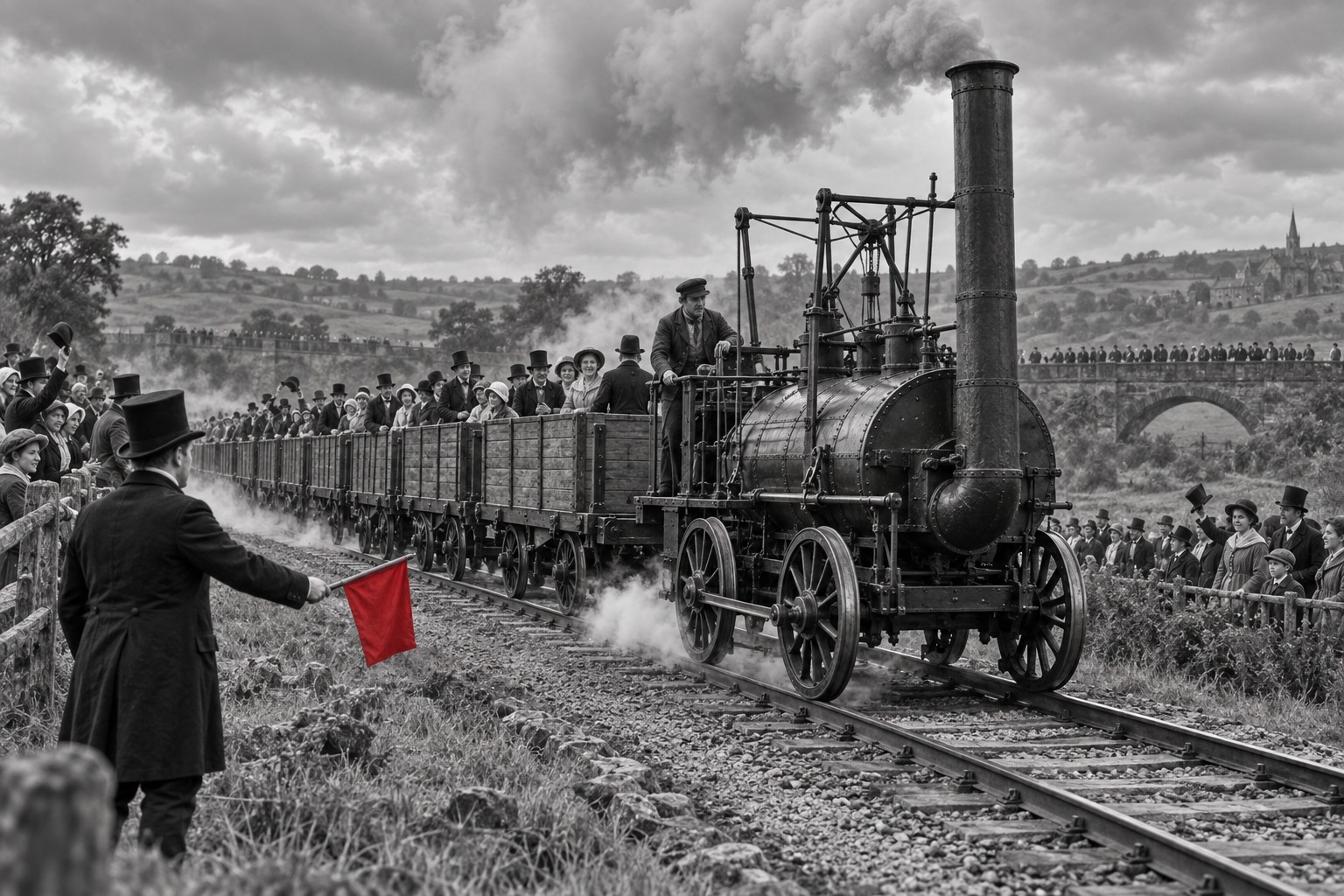
On this day in 1825, the Stockton and Darlington Railway opened in north-east England, marking a turning point in transport history. What began as a practical effort to move coal more cheaply helped establish the railway as an engine of economic change.
A journey into the industrial age
On 27 September, George Stephenson drove Locomotion No. 1 on the inaugural journey from Shildon towards Stockton, via Darlington. The train hauled coal, flour and passengers, bringing industrial freight and public spectacle together.
Around 600 people travelled aboard, many in wagons rather than comfortable passenger carriages. Crowds gathered along the route to watch a technology that would eventually reshape how people worked, travelled and traded.

The journey was slow by modern standards. Its significance lay in demonstrating what steam traction could achieve on a public railway.
Coal was the commercial driver
The railway’s original purpose was primarily economic. Collieries inland needed a cheaper way to transport coal to Darlington, Stockton and the River Tees.
Moving heavy goods over land was expensive. A railway offered the prospect of lowering transport costs and allowing producers to reach markets more efficiently.
Historic England notes that demand for passenger services initially surprised the company. The business opportunity extended beyond the freight traffic around which the line had been planned.
A milestone with an important distinction
The Stockton and Darlington was the world’s first public railway to use steam locomotives. It was not, however, the first railway ever built, nor did its opening immediately introduce a fully steam-operated passenger service.
During its early years, regular passengers travelled in horse-drawn coaches operated by private contractors. The company took over steam passenger operations in 1833.
That distinction matters: the railway revolution emerged through successive improvements, rather than one invention transforming transport overnight.
The wider economic legacy
The opening demonstrated how infrastructure could expand the possibilities of an existing technology. Locomotives needed tracks, investment and commercial organisation before their potential could translate into everyday economic activity.
Railways subsequently helped connect industrial centres, ports and communities, changing the relationship between distance, time and cost.
Two hundred and one years after that inaugural journey, its relevance remains clear. Infrastructure creates lasting value when it makes movement easier, lowers barriers to trade and opens access to markets.
On 27 September 1825, a railway built largely for coal helped point towards that much larger future.
Newshub Editorial in Europe – 27 September 2026

Ask NF GPT
If you have an account with ChatGPT you get deeper explanations,
background and context related to what you are reading.
Recent Comments