
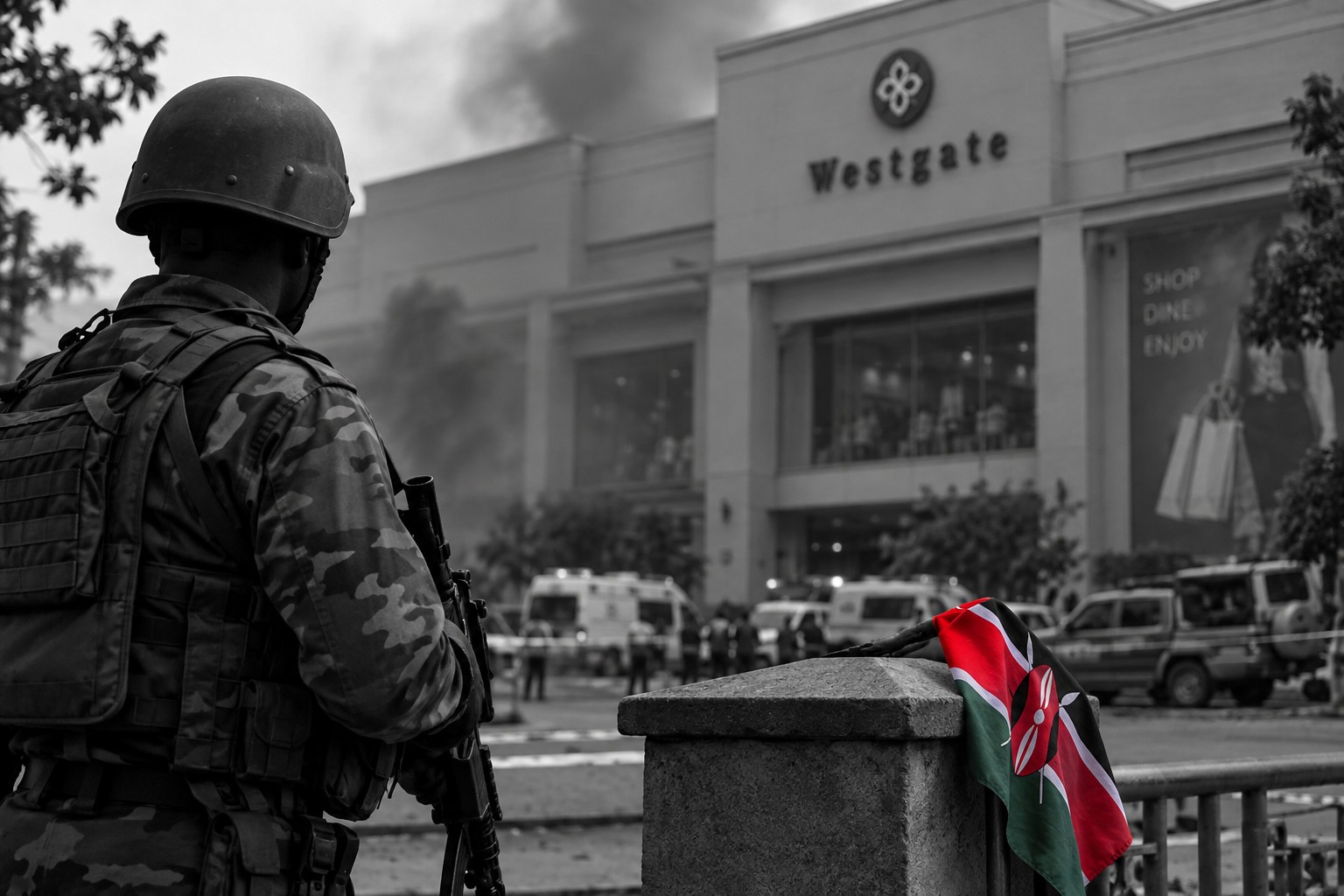
On 21 September 2013, armed militants from the Somalia-based extremist group al-Shabaab attacked the Westgate shopping centre in Nairobi, beginning a four-day siege that killed 67 people and wounded scores more. The assault became one of the deadliest terrorist attacks in Kenya’s modern history.
A Saturday turned into a siege
The attack began around midday when gunmen entered the busy Westgate complex, using firearms and grenades as shoppers and employees attempted to escape or hide. Kenyan police and security forces surrounded the building, while civilians remained trapped inside stores, corridors and other parts of the complex.
What initially appeared to be a shooting rapidly developed into a prolonged security operation. The confrontation continued until 24 September, with parts of the shopping centre damaged by fire and explosions during the effort to regain control. Contemporary official reporting put the death toll at 67, while almost 200 people were wounded.


Al-Shabaab claims responsibility
Al-Shabaab claimed responsibility for the attack. The militant organisation, based primarily in neighbouring Somalia and linked to al-Qaeda, said the assault was retaliation for Kenya’s military intervention in Somalia. Kenyan forces had entered Somalia in 2011 as part of operations against al-Shabaab.
The Westgate attack demonstrated how instability and armed conflict in Somalia could spill across national borders. Kenya had already faced terrorist violence, including the 1998 bombing of the US embassy in Nairobi, but Westgate brought the threat into one of the capital’s most prominent civilian locations.
A lasting impact on Kenya
The siege triggered scrutiny of Kenya’s intelligence, emergency response and counter-terrorism capabilities. It also highlighted the challenge faced by East African governments attempting to contain militant organisations capable of operating across borders.
Thirteen years later, Westgate remains a significant event in Kenya’s recent history. The shopping centre eventually reopened, but 21 September continues to mark the anniversary of an attack that profoundly affected Nairobi and reinforced the regional consequences of the conflict with al-Shabaab.
Newshub Editorial in Africa – 21 September 2026

Ask NF GPT
If you have an account with ChatGPT you get deeper explanations,
background and context related to what you are reading.
On 21 September 2013, armed militants from the Somalia-based extremist group al-Shabaab attacked the Westgate shopping centre in Nairobi, beginning a four-day siege that killed 67 people and wounded scores more. The assault became one of the deadliest terrorist attacks in Kenya’s modern history.
Recent Comments