
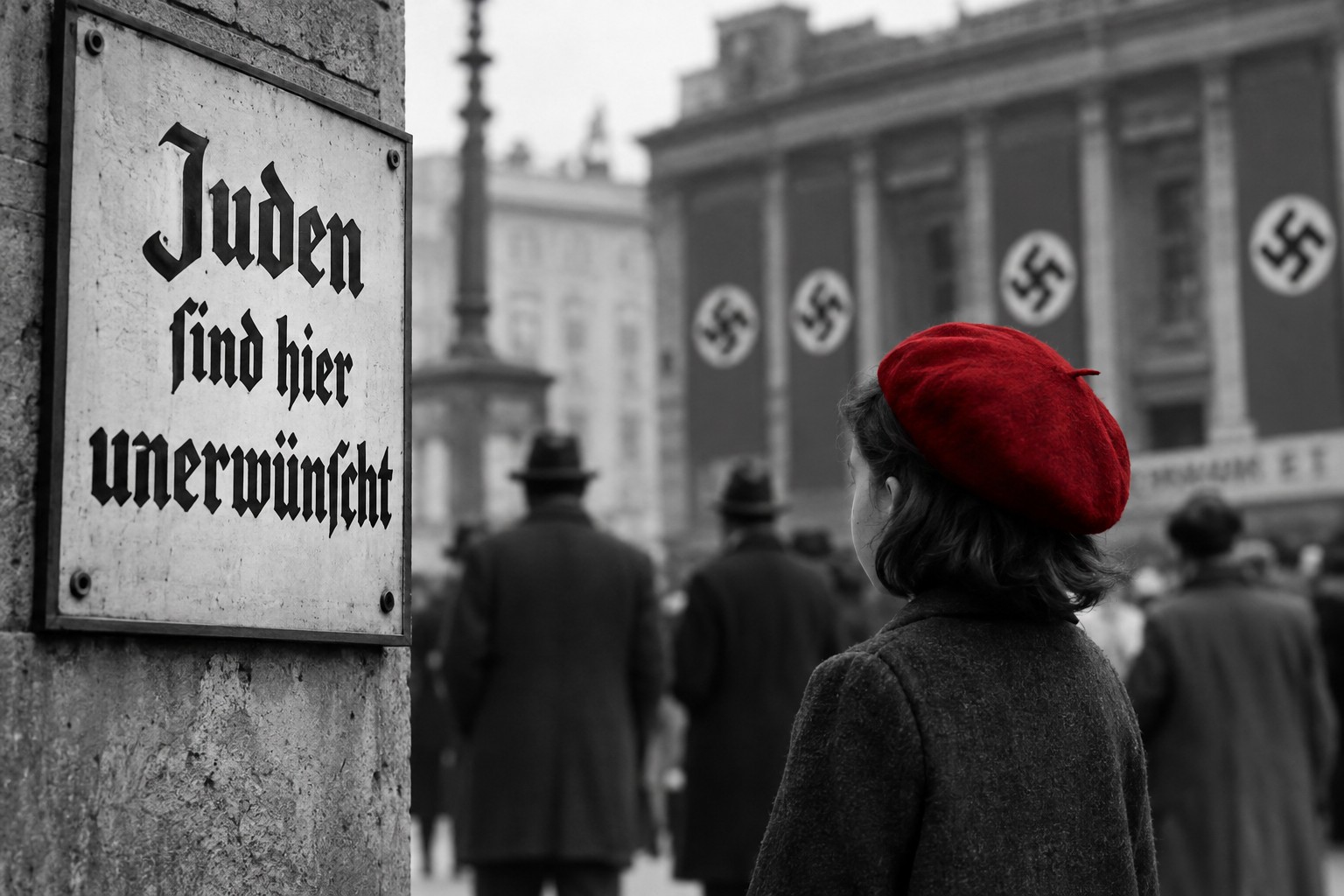
On 15 September 1935, Nazi Germany transformed racial ideology into national law. The Nürnberg Laws stripped German Jews of fundamental rights and created a legal system based on ancestry and supposed racial purity. They did not begin the persecution of Jews in Germany, but they marked a decisive step towards the systematic exclusion, dispossession and ultimately mass murder that culminated in the Holocaust.
Racism written into law
The laws were adopted by a special session of the Reichstag during the Nazi Party rally in Nürnberg. Two measures formed their core: the Reich Citizenship Law and the Law for the Protection of German Blood and German Honour.
The Citizenship Law established that full political citizenship belonged only to people considered to be of “German or related blood”. German Jews were consequently deprived of full citizenship and political rights.

The second law prohibited marriages and sexual relationships between Jews and people classified by the regime as German or related blood. Nazi racial doctrine had therefore moved beyond propaganda and discrimination: intimate relationships and family life were now regulated by the state according to racist criteria.
Ancestry determined identity
One of the most consequential aspects of the system was that Jewish identity was increasingly determined through ancestry rather than an individual’s religious practice.
Implementing regulations classified people according to the number of Jewish grandparents they had. Someone with three or four Jewish grandparents was generally defined as Jewish, while people with one or two could fall into categories described by the Nazis as Mischlinge, or people of “mixed” ancestry.
This meant that people who considered themselves Christian, or whose families had converted generations earlier, could nevertheless be legally classified as Jews.
A machinery of exclusion
The Nürnberg Laws were not isolated legislation. During the first six years of Hitler’s dictatorship, more than 400 decrees and regulations restricted Jewish life in Germany. Jews were progressively excluded from professions, education, public institutions and economic activity.
The significance of the Nürnberg Laws was that they provided a systematic legal foundation for this persecution. Discrimination was no longer merely encouraged by Nazi ideology. It had become embedded in the machinery of government.
The racial framework was subsequently applied beyond Jews. Nazi authorities also used racial legislation against Roma and Sinti and Black people, while the regime persecuted numerous other groups for political, racial, religious or social reasons.
From exclusion to destruction
The laws did not themselves order the Holocaust, and mass extermination was still years away. But they helped create the administrative and legal infrastructure through which an entire population could first be identified, separated and deprived of rights.
By 1938, persecution had intensified further. Jewish property was increasingly seized, professional restrictions expanded and identification requirements tightened. After Kristallnacht in November 1938, Jews faced still broader exclusion from German public life.
During the Second World War, Nazi persecution developed into systematic mass murder. Six million Jewish men, women and children were ultimately murdered in the Holocaust.
The Nürnberg Laws therefore remain one of history’s starkest examples of how a modern state can use legislation not to protect citizens from discrimination, but to institutionalise it.
The road to genocide did not begin with extermination camps.
It also passed through parliament, government offices, official documents — and laws.
Newshub Editorial in Europe – 15 September 2026

Ask NF GPT
If you have an account with ChatGPT you get deeper explanations,
background and context related to what you are reading.
Recent Comments