
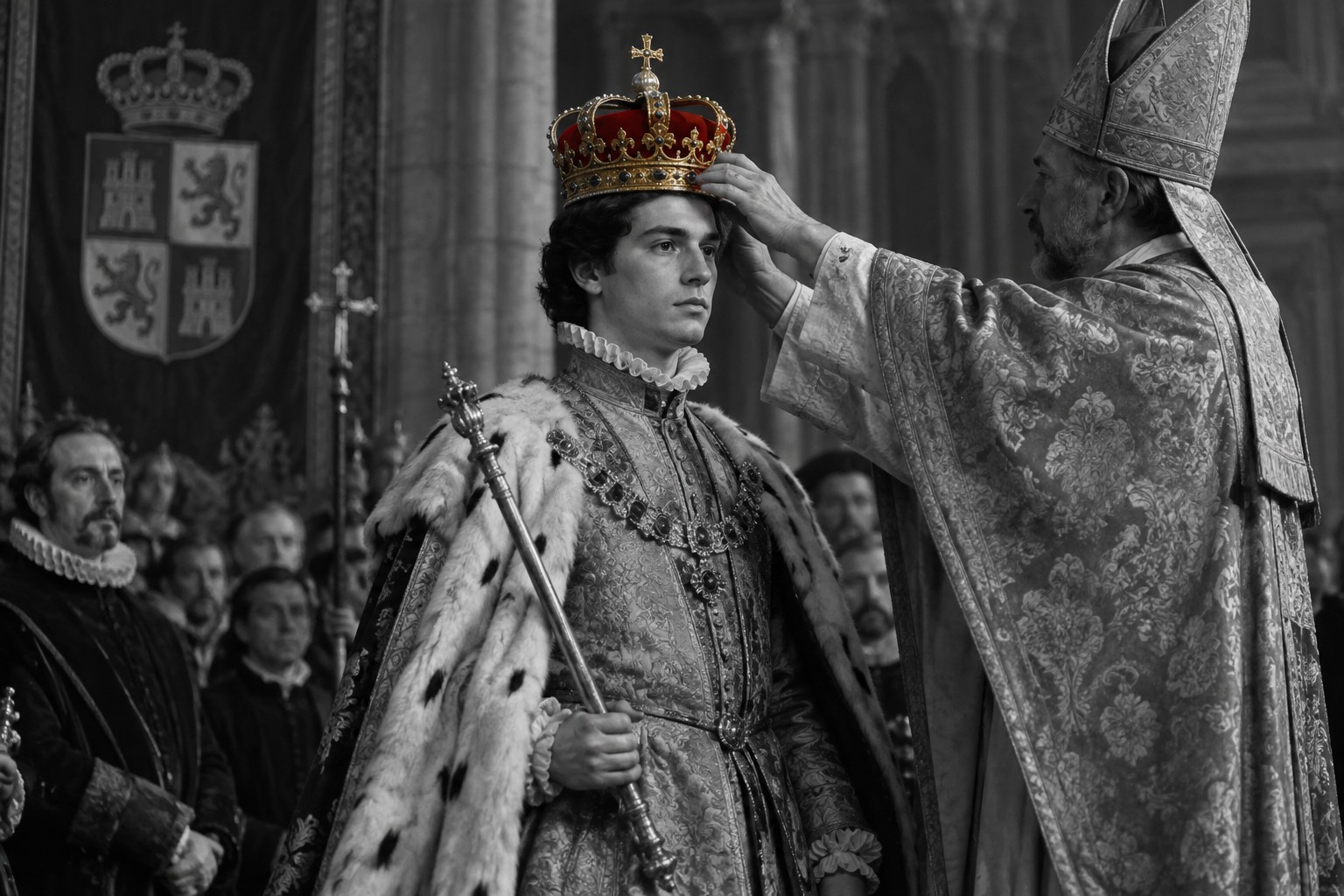
On 13 September 1598, Philip III succeeded his father as ruler of one of the largest empires on Earth, becoming king of Spain and Portugal at the age of just 20. His accession placed an enormous global empire in the hands of a monarch who would increasingly leave government to powerful advisers.
MADRID — 13 September 1598
Philip III succeeded to the Spanish and Portuguese crowns following the death of his father, Philip II, at El Escorial on 13 September 1598. His reign would continue until 1621.

The young monarch inherited territories stretching far beyond the Iberian Peninsula. Spain controlled extensive possessions in the Americas, Europe and Asia, while Portugal brought its own network of territories and trading posts across Africa, Brazil and Asia.
Portugal remained a separate kingdom under the arrangement known as the Iberian Union. Philip III was therefore Philip III of Spain but Philip II of Portugal. The two crowns shared a monarch while retaining separate institutions and legal structures.
An empire inherited
Philip III was born in Madrid on 14 April 1578, the son of Philip II and Anna of Austria.
His father had been one of the dominant European rulers of the 16th century. Under Philip II, Spanish power reached across continents, but the enormous empire also carried substantial military commitments and financial pressures.
The new king inherited both.
Philip III, however, would govern very differently from his father. Philip II had been famous for personally examining enormous quantities of government correspondence and involving himself deeply in administration.
His son showed far less interest in the daily machinery of government.
Instead, political authority increasingly passed to Francisco Gómez de Sandoval y Rojas, the Duke of Lerma, who became Philip III’s principal favourite and effectively controlled much of the administration.
Portugal and the Iberian Union
Portugal had been united under the Spanish monarchy since 1580–81 following a succession crisis after the death of the Portuguese king Sebastian and subsequently Cardinal Henry.
Philip II of Spain successfully claimed the Portuguese throne.
But Portugal was not formally absorbed into Spain.
Under agreements established at the Cortes of Tomar in 1581, Portugal retained its own laws, administration and overseas possessions while sharing its monarch with Spain.
When Philip III inherited the throne in 1598, he therefore became ruler of two kingdoms whose combined overseas reach was extraordinary.
From Mexico and Peru to Brazil, Angola, Goa, Macau and the Philippines, territories connected to the Iberian crowns stretched around much of the globe.
A different style of rule
Philip III’s reliance on Lerma represented an important change in Spanish government.
Rather than personally dominating administration, the king delegated considerable authority to his favourite. The system of powerful royal favourites, or validos, would become an important feature of 17th-century Spanish politics.
Lerma accumulated extraordinary political influence and personal wealth while controlling access to the monarch.
Yet Philip III’s reign also produced a period of relative diplomatic calm.
Spain concluded peace with England in 1604 and agreed the Twelve Years’ Truce with the Dutch Republic in 1609. The period has sometimes been described as the Pax Hispanica, when Spain temporarily reduced several of the conflicts that had consumed enormous resources during the previous century.
The cost of empire
Peace did not solve Spain’s deeper economic problems.
Maintaining a global monarchy remained enormously expensive, while government finances continued to face serious pressures.
One of the most controversial decisions of Philip III’s reign came in 1609, when the monarchy ordered the expulsion of the Moriscos — descendants of Muslims who had converted to Christianity.
Hundreds of thousands were eventually forced to leave Spain, removing communities that played significant roles in agriculture and regional economies. The policy contributed to economic disruption in several areas.
Portugal meanwhile increasingly suffered from being connected to Spain’s international conflicts.
Portuguese possessions and trading networks became targets for Dutch and English expansion, particularly in Asia and the Atlantic. The Iberian Union had effectively drawn Portugal into the geopolitical rivalries of the Spanish monarchy.
A global monarchy at its height
When Philip III took the crowns on 13 September 1598, the scale of the monarchy he inherited was remarkable.
Spanish and Portuguese ships connected Europe with the Americas, Africa and Asia. Silver crossed the Atlantic from Spanish America. Portuguese merchants operated across the Indian Ocean. Manila connected Spanish America with Asian trade.
Few rulers in history had inherited authority over territories spread across such enormous distances.
Yet the accession of Philip III also marked the beginning of a different phase in Spanish history.
The empire remained formidable, but economic weakness, costly military commitments and increasing competition from England and the Dutch Republic were becoming harder to ignore.
Philip III died in Madrid on 31 March 1621, aged 42. His son succeeded him as Philip IV of Spain and Philip III of Portugal.
Portugal would remain under the Spanish Habsburg monarchy for another 19 years.
In 1640, a Portuguese revolt placed John IV of the House of Braganza on the throne, beginning the process that restored Portugal as an independent monarchy.
The crowns that Philip III inherited together in 1598 would never again be permanently united.
Newshub Editorial in Europe – 13 September 2026
Recent Comments