
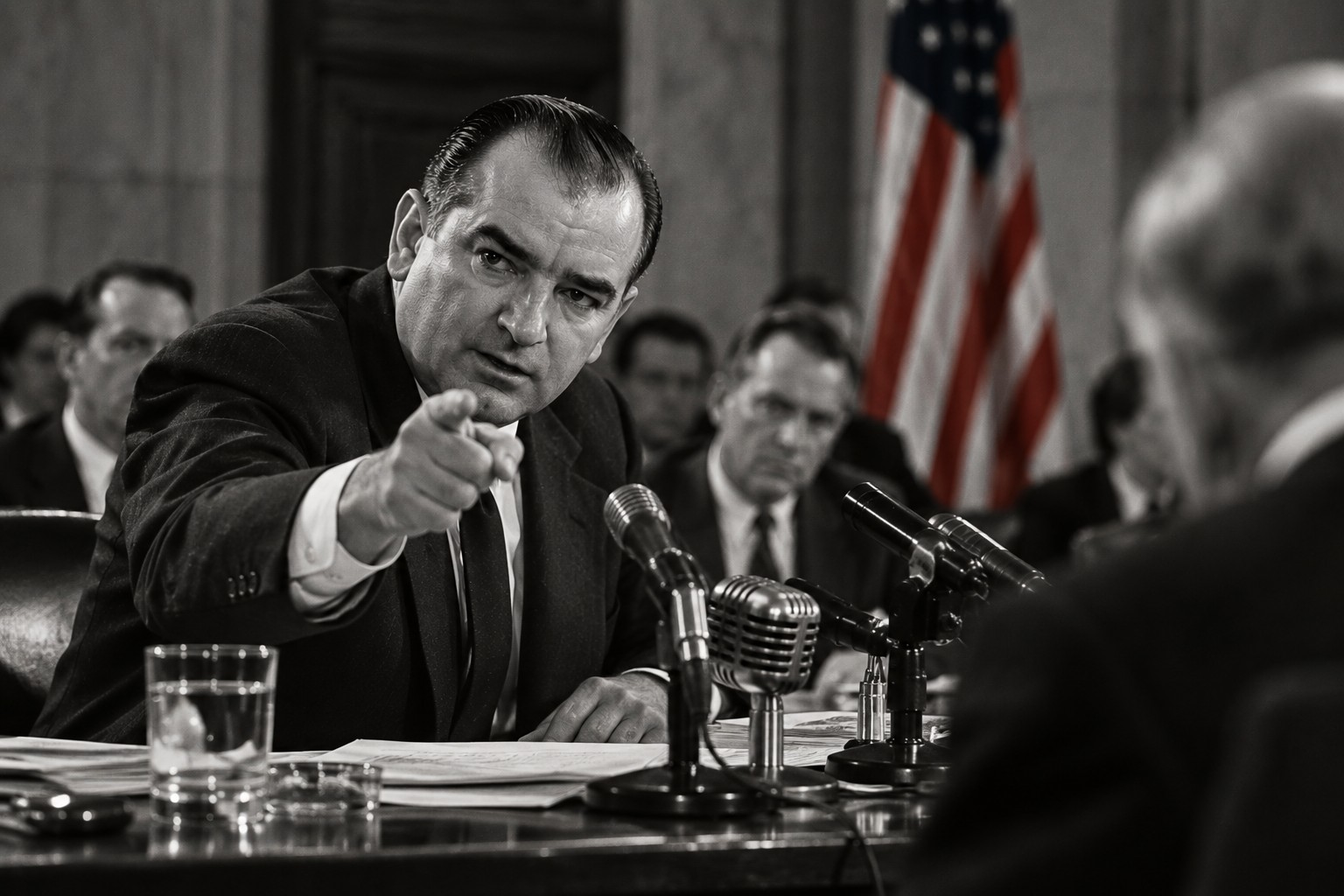
For four extraordinary years, a senator from Wisconsin held Washington in his grip. Joseph McCarthy accused officials, diplomats, soldiers and intellectuals of helping America’s communist enemy. Careers were destroyed, institutions intimidated and politicians learned that challenging him could carry a price. Then television allowed millions of Americans to watch him work. The fear began to disappear – and McCarthy’s power collapsed with astonishing speed.
The senator nobody expected to matter
When Joseph Raymond McCarthy arrived in the United States Senate in 1947, there was little reason to believe that his name would eventually become a word in the political vocabulary.

He was 38 years old, a Republican from Wisconsin and a former judge who had served in the Marine Corps during the Second World War.
He was ambitious, energetic and skilled at attracting attention.
But Washington was filled with ambitious politicians.
McCarthy needed something that could separate him from them.
He eventually found it in fear.
America after the Second World War was extraordinarily powerful, but it was not particularly secure in its own confidence.
The wartime alliance with the Soviet Union had collapsed. Eastern Europe was increasingly dominated by Moscow. Communist forces won the Chinese Civil War in 1949. That same year, the Soviet Union successfully tested an atomic bomb.
Then came another shock.
Alger Hiss, a former senior State Department official, was convicted of perjury in a case involving allegations of Soviet espionage.
There really had been Soviet espionage in the United States. Communist intelligence networks were not simply inventions of paranoid politicians.
That fact mattered.
It created fertile ground for something much larger: the belief that America’s institutions themselves might have been penetrated by an invisible internal enemy.
McCarthy understood the political potential.
The speech that changed everything
On 9 February 1950, McCarthy travelled to Wheeling, West Virginia, to address a Republican women’s organisation.
It should have been an ordinary political speech.
Instead, it transformed his career.
McCarthy announced that communists had infiltrated the US government and suggested that he possessed a list of people within the State Department who were known to be members of the Communist Party or otherwise considered security risks.
Exactly what number McCarthy claimed that evening became disputed. Different accounts and subsequent statements referred to different figures.
But politically, the precise number hardly mattered.
The essential message was explosive.
Communists were inside the American government.
And Joseph McCarthy claimed to know who they were.
Newspapers carried the allegation. Radio amplified it. Politicians demanded answers.
Suddenly, an obscure senator from Wisconsin had become a national figure.
Investigators subsequently examined McCarthy’s allegations and found that his sweeping claims were not supported in the manner he had suggested.
But McCarthy had discovered something important about political communication.
The accusation travelled faster than the correction.
And a question could sometimes be almost as destructive as an allegation.
Was this official a communist?
Had that diplomat once attended a suspicious meeting?
Did someone know somebody who belonged to a left-wing organisation?
Could a government employee be trusted?
The questions created doubt.
And doubt created fear.
America enters the Red Scare
McCarthy did not create America’s fear of communism.
He exploited an atmosphere that already existed.
The Soviet Union was a genuine strategic adversary. Nuclear weapons had fundamentally changed international security. Communist governments were expanding their influence, and the Korean War began only months after McCarthy’s Wheeling speech.
For many Americans, the possibility of communist penetration did not seem absurd.
That distinction is essential to understanding McCarthyism.
The controversy was never simply about whether Soviet espionage existed.
It did.
The question was how a democratic society should identify genuine security threats without abandoning evidence, proportionality and due process.
McCarthy increasingly blurred those boundaries.
Association could become suspicion.
Suspicion could become accusation.
And accusation could become punishment.
The process affected government employees, academics, writers, journalists and people working in entertainment.
Some had been members of communist organisations.
Some had held radical political opinions.
Others had attended meetings years earlier or associated with people who later became politically controversial.
And some had done virtually nothing at all.
Yet once someone’s loyalty was publicly questioned, the burden frequently shifted.
Instead of the accuser proving guilt, the accused found themselves trying to prove innocence.
McCarthy discovers the power of the hearing
In January 1953, Republicans regained control of the Senate and McCarthy acquired the position that would give him his greatest institutional power.
He became chairman of the Senate Permanent Subcommittee on Investigations.
The committee had broad investigative authority.
Under McCarthy, its emphasis increasingly moved towards alleged communist infiltration and subversion.
Hundreds of witnesses appeared in public and closed sessions.
The hearings were political theatre before political theatre became an everyday feature of television.
McCarthy could dominate a room.
He interrupted witnesses.
He demanded names.
He moved rapidly from one allegation to another.
Documents could be mentioned without being fully disclosed. Information could be presented as evidence even when its significance was uncertain.
The resulting newspaper headline was frequently more important than what the complete record eventually demonstrated.
McCarthy had grasped a principle that remains recognisable in modern politics:
Attention itself is power.
If he accused someone on Tuesday, the accusation might dominate Wednesday’s newspapers.
If investigators established months later that the allegation was exaggerated or unsupported, the correction rarely received comparable attention.
McCarthy’s critics struggled with this asymmetry.
To challenge him risked becoming his next target.
To ignore him allowed his accusations to stand.
The people behind the names
The historical discussion of McCarthyism often revolves around Washington institutions and famous personalities.
But its consequences were experienced by individuals.
A person’s name appearing in an investigation could affect employment, friendships and reputation.
Government workers faced loyalty investigations.
People in entertainment could find themselves unable to obtain work.
The wider anti-communist campaign in America included Hollywood blacklists and congressional investigations separate from McCarthy’s Senate committee, but the atmosphere became so closely associated with him that his name eventually came to represent the era.
McCarthyism became larger than McCarthy.
It described a method.
Identify an enemy.
Suggest that the enemy exists inside society.
Question the loyalty of people associated with that enemy.
Demand that institutions prove they are clean.
Treat reluctance to cooperate as evidence of suspicion.
And make the political cost of defending the accused greater than the cost of joining the accusation.
Fear did the rest.
Not everyone remained silent
McCarthy had critics from the beginning.
One of the most important was a fellow Republican.
On 1 June 1950, Senator Margaret Chase Smith of Maine delivered what became known as her Declaration of Conscience.
She did not mention McCarthy by name.
She did not need to.
Smith condemned the political use of character assassination and warned against exploiting fear, ignorance, bigotry and smear for electoral advantage.
Six other Republican senators joined her declaration.
It was an extraordinary challenge.
But it did not stop McCarthy.
He mocked Smith and her supporters.
And for several more years, many politicians remained reluctant to confront him directly.
The reason was simple.
McCarthy could hurt them.
A politician who criticised him risked being portrayed as soft on communism.
In the political climate of the early 1950s, that could be dangerous.
McCarthy’s power therefore depended on more than his own popularity.
It depended upon the reluctance of other people to become his target.
Then he chose the Army
Political movements built around permanent confrontation face a structural problem.
They continually need another enemy.
Eventually McCarthy turned his attention towards one of America’s most respected institutions.
The United States Army.
McCarthy alleged security failures and communist infiltration within the military establishment.
But the Army fought back.
Military officials accused McCarthy and his staff of attempting to obtain preferential treatment for G. David Schine, a former committee consultant who had been drafted into military service.
McCarthy and his chief counsel, Roy Cohn, rejected the allegations and accused the Army of using the dispute to obstruct investigations into communist activity.
The confrontation escalated.
A Senate investigation followed.
It became known as the Army–McCarthy hearings.
And then something happened that fundamentally changed the balance of power.
Television cameras arrived.
America watches McCarthy
The Army–McCarthy hearings began in April 1954 and were broadcast nationally.
For weeks, Americans could watch the proceedings.
Until then, many people knew McCarthy primarily through newspaper reports, radio broadcasts, photographs and carefully selected public appearances.
Television was different.
Television showed behaviour.
It showed interruptions.
It showed facial expressions.
It showed hesitation.
It showed aggression.
It showed the senator when he was not delivering a prepared speech or a dramatic accusation from a podium.
Millions could now judge McCarthy themselves.
The hearings became one of the first great political television spectacles in American history.
And what many viewers saw was not the fearless communist hunter they had imagined.
They saw a politician who could appear bullying, impatient and reckless.
The medium that would later transform politics was helping to destroy one of America’s most effective practitioners of political spectacle.
McCarthy had mastered headlines.
Television exposed the spaces between them.
“Have you no sense of decency?”
The defining moment came on 9 June 1954.
Representing the Army was Joseph N. Welch, a distinguished Boston lawyer.
During an exchange, McCarthy attacked Fred Fisher, a young lawyer at Welch’s firm, by raising Fisher’s previous association with the National Lawyers Guild, an organisation that had been accused of communist connections.
Welch reacted.
He asked McCarthy not to destroy the young man’s reputation.
Then came the words that entered American political history:
“Have you no sense of decency, sir, at long last?”
The exchange was devastating partly because Welch expressed something millions of viewers were beginning to feel.
The issue was no longer simply communism.
It was McCarthy himself.
His methods were now on trial in America’s living rooms.
The political spell was breaking.
McCarthy continued speaking.
But the atmosphere had changed.
That is one of the most remarkable aspects of political power.
It can appear permanent until the moment it disappears.
The Senate finally acts
By the summer of 1954, senators who had previously tolerated McCarthy were increasingly prepared to confront him.
Republican Senator Ralph Flanders of Vermont pushed for formal action.
The Senate established a bipartisan committee to examine allegations concerning McCarthy’s conduct.
Importantly, the eventual case against McCarthy was not simply a declaration that his anti-communist beliefs were wrong.
The Senate focused on his conduct as a senator and his treatment of Senate institutions.
On 2 December 1954, the Senate voted 67 to 22 to condemn McCarthy.
The resolution concerned his refusal to cooperate with an earlier Senate investigation and his abuse of the committee subsequently examining his conduct.
The political effect was enormous.
McCarthy remained a senator.
He had not been expelled.
He could still speak.
He could still introduce legislation.
But the power was gone.
Journalists who had once rushed towards him increasingly ignored him.
Politicians no longer feared him in the same way.
The institution he had used to build his influence had finally imposed a boundary.
McCarthy had spent years questioning other people’s loyalty.
Now the Senate had judged his own conduct.
The extraordinary speed of the fall
Perhaps the most striking element of McCarthy’s story is how quickly his political position collapsed.
In the early 1950s, he had been one of the most feared figures in Washington.
By 1955, he was increasingly marginal.
The machinery remained.
The Senate chamber remained.
The microphones remained.
McCarthy remained.
But attention had moved elsewhere.
This was not simply a personal defeat.
It demonstrated how much of his authority had depended upon perception.
McCarthy had possessed institutional power as a senator and committee chairman, but his greater power came from something less tangible.
People believed he could destroy them.
Politicians believed confronting him was dangerous.
Journalists believed his accusations were news.
Officials believed appearing on one of his lists could end their careers.
Once that collective belief weakened, McCarthy’s political leverage weakened with it.
Fear had created power.
When the fear diminished, so did the power.
The final years
McCarthy’s health deteriorated.
He was a heavy drinker, and accounts of his final years describe increasingly serious alcohol-related health problems.
On 2 May 1957, Joseph McCarthy died at Bethesda Naval Hospital in Maryland.
He was 48 years old.
Only seven years had passed since the Wheeling speech that transformed him into a national political force.
Only three years had passed since the televised hearings that helped destroy that force.
His political career had risen and fallen within less than a decade.
His name, however, did not disappear.
It became permanent.
McCarthyism without McCarthy
Today, the word McCarthyism is used far beyond the specific historical circumstances of America’s anti-communist investigations.
It generally describes the reckless or politically motivated accusation of disloyalty, subversion or dangerous association, particularly when evidence is weak and the accusation itself becomes a form of punishment.
That legacy makes the McCarthy story more complicated than a simple tale about one demagogue.
McCarthy succeeded because the conditions around him allowed him to succeed.
There was a real external threat.
There had been genuine espionage.
There was widespread public anxiety.
There was partisan competition.
There was a rapidly developing mass-media environment hungry for dramatic allegations.
There were institutions reluctant to challenge a politician who could turn accusations against his opponents.
And there were audiences willing to believe that hidden enemies might explain national setbacks.
McCarthy connected all of those elements.
That is why simply describing him as a liar or bully misses the larger historical lesson.
A politician cannot create a national political phenomenon alone.
McCarthy required an ecosystem.
The uncomfortable question of whether he was entirely wrong
Historical accuracy also requires acknowledging an uncomfortable fact.
The Soviet Union did conduct espionage against the United States.
Communist intelligence networks existed.
Individuals within Western governments did provide information to Moscow.
Documents and intelligence released decades later confirmed that Soviet espionage during the period was a genuine national-security issue.
But that does not vindicate McCarthy’s methods.
It illustrates why those methods were so politically effective.
The strongest political fear campaigns often begin with something real.
A genuine threat provides credibility.
The danger comes when the existence of that threat is used to justify accusations that no longer require adequate evidence.
McCarthy’s central failure was not that communism was imaginary.
It was that the existence of communism became a licence to treat suspicion as proof.
That distinction remains fundamental to democratic government.
A media story before the social-media age
Seen from the twenty-first century, McCarthy’s rise also looks remarkably modern.
He understood repetition.
He understood outrage.
He understood that accusations attract more attention than corrections.
He understood that attacking the institution investigating you could be more effective than answering the investigation.
He understood how to transform criticism into evidence that powerful enemies were trying to silence him.
Above all, he understood the news cycle.
But McCarthy lived before social media.
There was no X, Facebook, TikTok or YouTube.
There were no smartphones capable of transmitting an accusation to millions of people within seconds.
Yet the basic dynamics are familiar.
Make the claim dramatic enough and the media must report it.
Make enough claims and opponents spend their time responding.
Force every debate onto your chosen territory.
Turn complexity into loyalty tests.
Friend or enemy.
Patriot or traitor.
Us or them.
McCarthy’s political technique belonged to the age of radio, newspapers and early television.
Its underlying psychology did not.
The camera that changed the balance
There is an irony at the centre of McCarthy’s story.
Media helped create him.
Media also helped destroy him.
Newspapers and radio carried the accusations that made him famous.
But television revealed something those media could not fully convey.
It allowed Americans to observe the process rather than merely hear the result.
During the Army–McCarthy hearings, viewers watched hours of questioning and confrontation.
They could evaluate tone as well as words.
The difference mattered.
McCarthy’s method worked particularly well when compressed into headlines.
It worked less effectively when Americans watched it unfold in real time.
The same technology that offered politicians unprecedented access to the public also offered the public unprecedented access to politicians.
McCarthy discovered both sides of that revolution.
Could another McCarthy happen?
The obvious question is whether the McCarthy story belongs safely to history.
It does not.
The circumstances would be different today.
The ideological enemy might be different.
The accusations might concern national security, immigration, terrorism, corruption, foreign influence, technology or political extremism.
The media environment is radically different.
But the underlying mechanism remains available.
Fear can compress complicated political questions into simple choices.
An external threat can become an internal loyalty test.
Association can become evidence.
Political opponents can become enemies rather than competitors.
Institutions can become reluctant to defend unpopular individuals.
And an accusation repeated often enough can become more memorable than its eventual correction.
The defence against that process is not pretending that threats do not exist.
It is insisting that evidence matters precisely when fear is greatest.
The man and the warning
Joseph McCarthy did not become historically important because he discovered a secret communist government inside Washington.
He became important because he demonstrated how quickly democratic politics can change when fear becomes a political instrument.
For several years, a senator from Wisconsin made some of the most powerful people in America hesitate before challenging him.
Government officials worried about their careers.
Politicians calculated the danger of opposition.
Institutions struggled to respond.
The press amplified allegations that were sometimes easier to publish than to verify.
And ordinary Americans were asked to consider whether enemies might be hiding among them.
Then the country watched McCarthy operate.
The illusion of invincibility disappeared.
The Senate acted.
His power collapsed.
But the political mechanism he demonstrated did not disappear with him.
Joseph McCarthy died in 1957.
McCarthyism survived.
That may be the most important reason his story still matters.
Not because history necessarily repeats itself with the same names, the same ideology or the same accusations.
But because fear remains powerful.
Accusations remain powerful.
Media attention remains powerful.
And democracies still depend on people and institutions being willing to ask a simple question when political certainty becomes more important than evidence:
Where is the proof?
Newshub Editorial in North America – 13 September 2026
For four extraordinary years, a senator from Wisconsin held Washington in his grip. Joseph McCarthy accused officials, diplomats, soldiers and intellectuals of helping America's communist enemy. Careers were destroyed, institutions intimidated and politicians learned that challenging him could carry a price. Then television allowed millions of Americans to watch him work. The fear began to disappear – and McCarthy's power collapsed with astonishing speed.
Recent Comments