
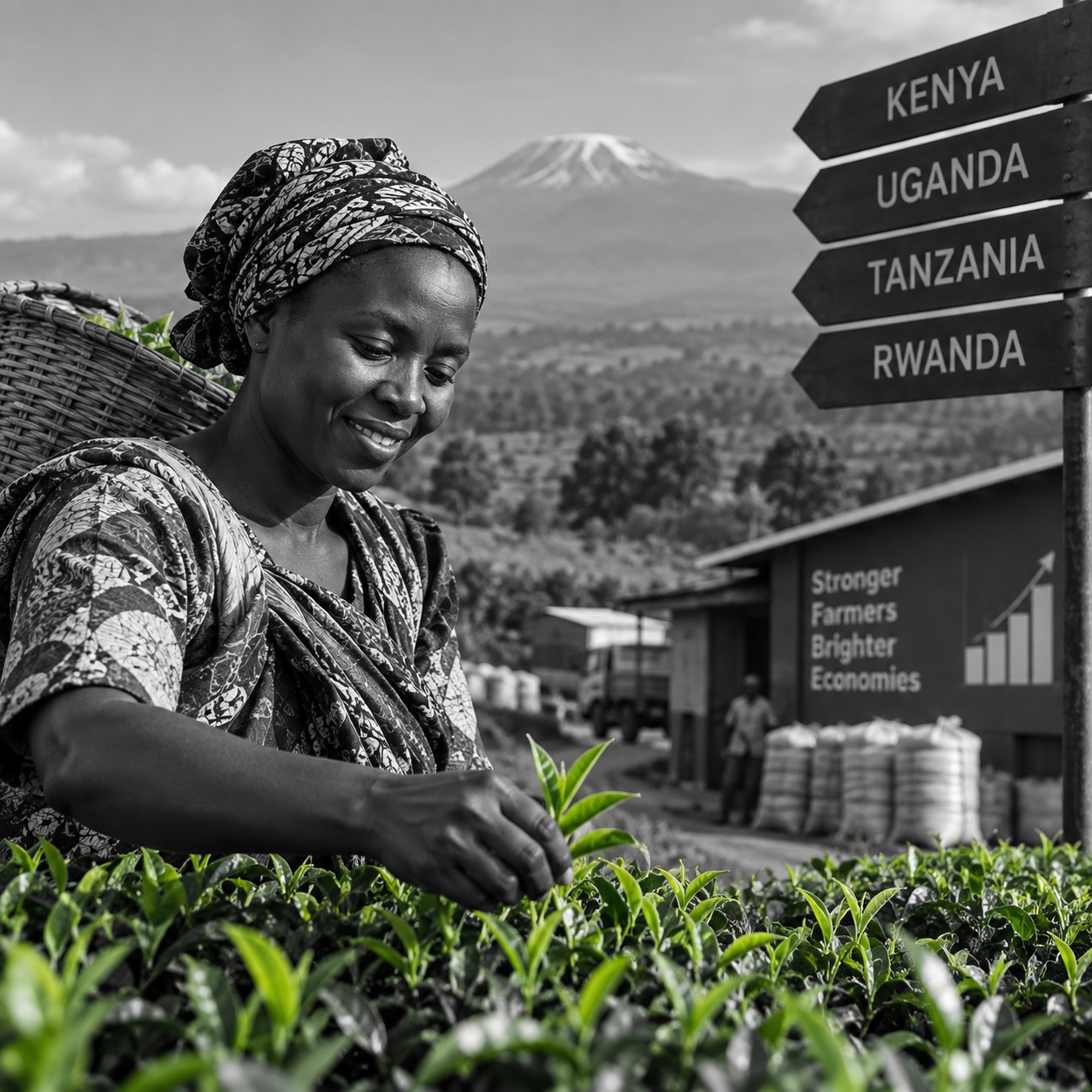
A new $200 million financing mechanism is targeting one of East Africa’s largest underserved economic sectors, with capital set to reach smallholder farmers and rural businesses across Kenya, Uganda, Tanzania and Rwanda through a combination of private banking capital and international development finance.
A new model for rural finance
The Africa Rural Climate Adaptation Finance Mechanism, known as ARCAFIM, has been launched by the International Fund for Agricultural Development and Equity Group, with backing from international climate and development partners.
The 12-year programme is designed to provide financing to approximately 260,000 smallholder producers and 500 rural micro, small and medium-sized enterprises across the four East African markets.

Unlike conventional development programmes based primarily on grants, ARCAFIM uses blended finance to reduce risk and encourage commercial banks to lend directly into rural economies.
Equity puts its own capital to work
Of the programme’s $180 million lending base, Equity Group will contribute $90 million from its own balance sheet, matching concessional capital on a one-to-one basis.
A further approximately $20 million will support technical assistance.
Because lending capital can be recycled through several investment cycles, the mechanism is expected to generate around $266 million in loans during its lifetime.
The structure is significant for East African finance because the participating commercial bank retains part of the risk. The objective is therefore not simply to distribute development funding, but to demonstrate that climate-resilient agricultural lending can become commercially sustainable.
Capital reaches the real economy
Agriculture remains fundamental to employment and household incomes across East Africa, yet smaller producers frequently struggle to obtain affordable financing for irrigation, equipment, storage, resilient crops and other investments.
ARCAFIM is designed to address that financing gap while strengthening food production and protecting rural businesses against increasingly unpredictable weather conditions.
At least half of the targeted beneficiaries are expected to be women, while 30 per cent will be young people.
A potential model beyond East Africa
The programme could have implications well beyond agriculture. If successful, it would demonstrate how international concessional capital can absorb part of the initial risk while local financial institutions provide capital, distribution networks and knowledge of borrowers.
That could create a replicable financing model for other underserved sectors and emerging markets.
Southern and West Africa have already been identified as potential regions for future expansion.
For East Africa, however, the immediate significance is straightforward: $200 million is being mobilised with the explicit objective of moving capital from financial institutions into businesses and communities where access to conventional finance remains limited.
Newshub Editorial in Africa – 8 September 2026

Ask NF GPT
If you have an account with ChatGPT you get deeper explanations,
background and context related to what you are reading.
Recent Comments