
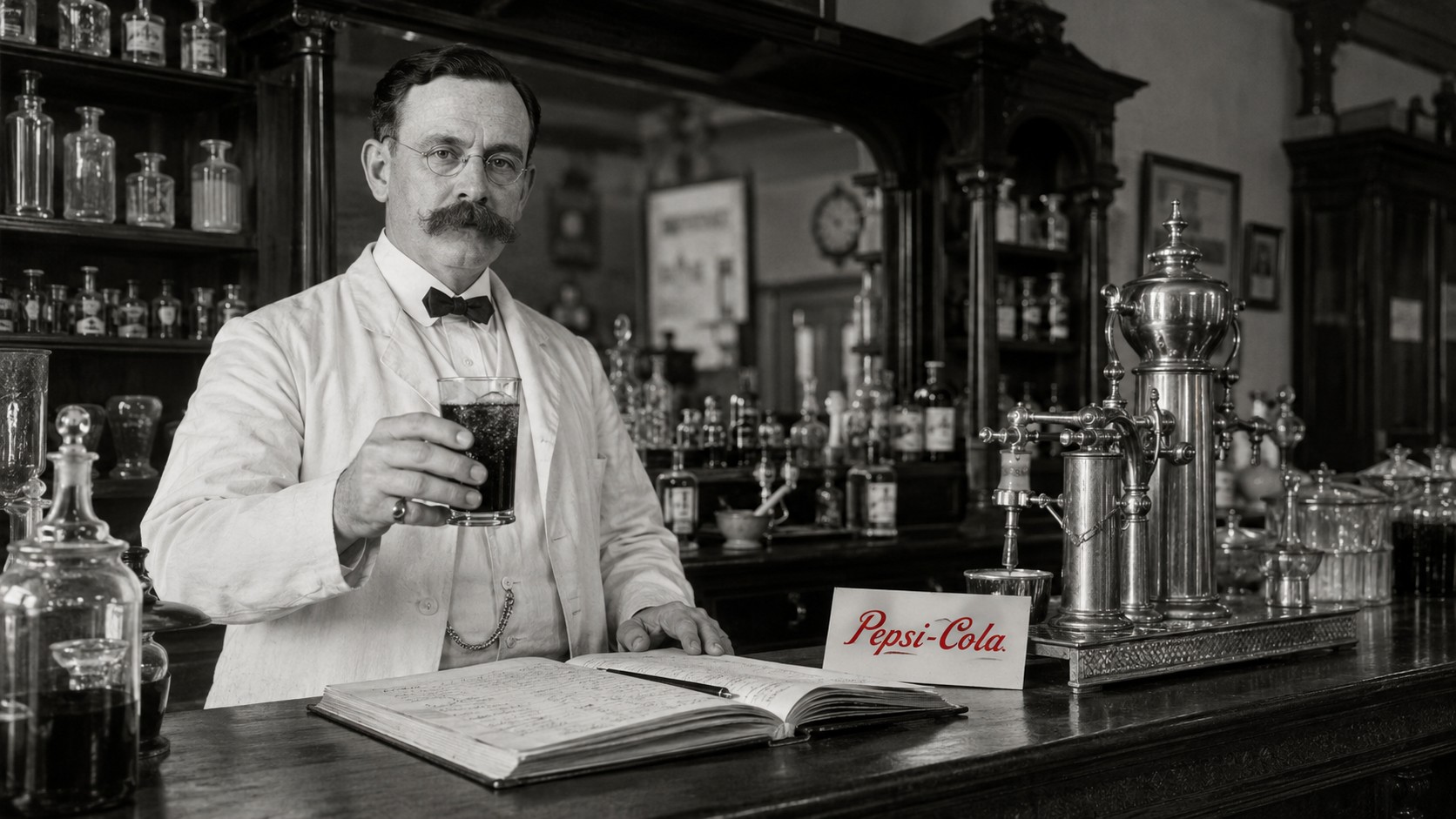
On this day in 1898, pharmacist Caleb Bradham began marketing his popular fountain drink under a new name: Pepsi-Cola. The decision transformed a locally successful beverage from New Bern, North Carolina, into a brand capable of travelling far beyond the counter of Bradham’s pharmacy.
A pharmacist’s formula
Bradham began serving the carbonated beverage in 1893 at his pharmacy on the corner of Pollock and Middle Streets. Customers initially knew the mixture simply as “Brad’s Drink”, a practical name that connected it directly to its creator.
The drink combined carbonated water, sugar, flavourings and kola nut ingredients. Like many pharmacy beverages of the period, it was presented as more than a refreshment. Bradham believed his formula could provide energy and support digestion, claims that became an important part of its early marketing.

A new name for a growing drink
On 28 August 1898, Bradham renamed the beverage Pepsi-Cola. The word Pepsi is generally associated with dyspepsia, the medical term for indigestion, while Cola referred to the kola nut used in the formula.
The name is sometimes linked to pepsin, a digestive enzyme, although Pepsi-Cola did not contain pepsin. What mattered commercially was that the new identity sounded modern, distinctive and suitable for a product that Bradham hoped to sell outside his home town.
Changing the name also separated the drink from its inventor. Brad’s Drink sounded like a local pharmacy speciality; Pepsi-Cola sounded like a brand.
From soda fountain to company
Demand increased sufficiently for Bradham to devote more of his attention to the beverage business. The first Pepsi-Cola Company was formed in 1902, with Bradham serving as its president, and the Pepsi-Cola trademark was registered in 1903.
Production moved from the pharmacy into a rented warehouse as sales expanded. During 1903, the company reportedly sold almost 8,000 gallons of syrup. Bottling and franchise agreements subsequently helped Pepsi-Cola reach customers across a growing number of American states.
Early advertising retained the product’s pharmacy origins, presenting the drink as exhilarating, invigorating and helpful to digestion.
Success followed by financial collapse
Bradham’s first Pepsi-Cola business did not survive permanently. After the First World War, volatile sugar prices created serious financial problems. Bradham purchased large quantities of sugar when prices were unusually high, only to see the market fall sharply afterwards.
The company declared bankruptcy in 1923, and Bradham eventually returned to operating his pharmacy. The brand, however, passed through new owners and continued to develop.
A local name becomes a global brand
Pepsi-Cola later emerged as one of Coca-Cola’s principal competitors, supported by national advertising, competitive pricing and increasingly ambitious international expansion.
The consumer-facing name was shortened to Pepsi in 1961. Four years later, the Pepsi-Cola Company merged with Frito-Lay to create PepsiCo, establishing a diversified food and beverage group with operations around the world.
The foundation of that global business can be traced back to one deceptively simple decision made on 28 August 1898: replacing Brad’s Drink with a name that could become far bigger than the pharmacy where it began.
Newshub Editorial in North America – 28 August 2026

Ask NF GPT
If you have an account with ChatGPT you get deeper explanations,
background and context related to what you are reading.
Recent Comments