
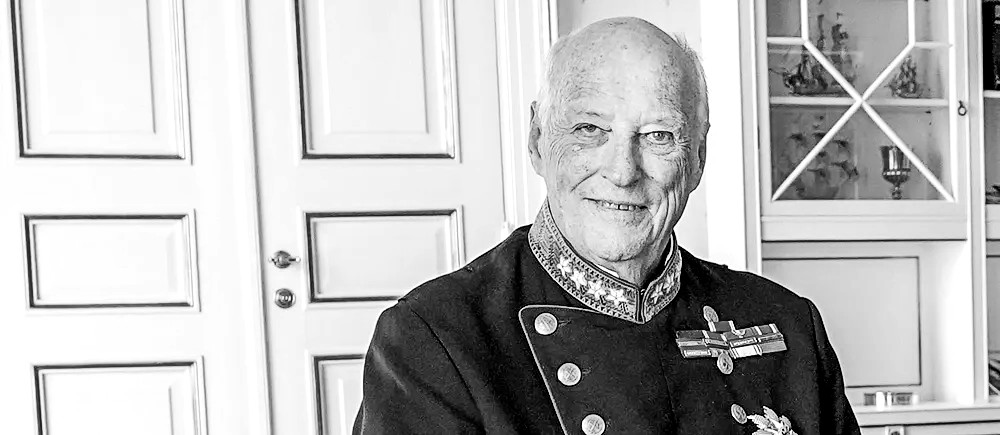
Norway’s King Harald V has died at the age of 89, ending a reign that lasted more than 35 years. The Royal House announced that the monarch died peacefully at Oslo University Hospital, Rikshospitalet, at 06.35 on Friday morning. Crown Prince Haakon succeeds his father as Norway’s head of state.
Final days in hospital
King Harald had been admitted to hospital on 17 August while receiving treatment connected to haemolytic anaemia. His condition deteriorated after he developed a bacterial infection in his blood, and the Royal House described his health as very serious on Thursday.
Queen Sonja, Crown Prince Haakon and other members of the royal family gathered at the hospital. Crowds also assembled outside the Royal Palace in Oslo, where people laid flowers and sang Norway’s national anthem.


The palace did not immediately provide a formal cause of death beyond confirming that the King had passed away peacefully.
A childhood shaped by war
Harald was born at Skaugum in Asker on 21 February 1937, the son of Crown Prince Olav and Crown Princess Märtha. He was the first prince born in Norway for 567 years.
His childhood was interrupted by the German invasion in April 1940. Crown Princess Märtha escaped with Harald and his sisters, first to Sweden and later to the United States at the invitation of President Franklin D. Roosevelt.
The family returned to Norway in June 1945 following the end of the occupation. Harald later completed military training and studied social science, history and economics at Balliol College, Oxford.
A marriage that changed the monarchy
Harald’s determination to marry Sonja Haraldsen, a commoner, challenged established royal expectations. The couple had known each other for nine years before King Olav V approved their marriage following consultations with the government and parliamentary leaders.
They married in Oslo Cathedral on 29 August 1968. The marriage helped establish a more modern and accessible image for the Norwegian monarchy.
Harald and Sonja had two children, Princess Märtha Louise and Crown Prince Haakon.
More than three decades on the throne
Harald became King following the death of his father, King Olav V, on 17 January 1991. Four days later, he took the constitutional oath before the Storting and adopted the traditional royal motto “Alt for Norge” – All for Norway.
Although the monarch’s political authority was limited, Harald became an important national figure during periods of tragedy and uncertainty. He was widely respected for his ability to address a changing Norwegian society with warmth and inclusive language.
The King was also closely associated with sailing and represented Norway at several Olympic Games. He carried the Norwegian flag at the 1964 Tokyo Olympics and became a sailing world champion with his crew in 1987.
Haakon succeeds his father
Crown Prince Haakon, born in 1973, now succeeds Harald under Norway’s hereditary succession rules. The palace had not formally announced his regnal title or number when this article was prepared, although he is widely expected to become King Haakon VIII.
The new monarch is a trained naval officer and has studied political science at the University of California, Berkeley, and development studies at the London School of Economics. He has repeatedly acted as regent during his father’s illnesses, including during the King’s final hospital stay.
Haakon’s eldest child, Princess Ingrid Alexandra, now moves into the position of heir to the Norwegian throne.
King Harald leaves behind a monarchy that changed considerably during his reign while retaining broad public support. His death closes an important chapter in modern Norwegian history and begins the country’s first royal transition since 1991.
Newshub Editorial in Europe – 28 August 2026

Ask NF GPT
If you have an account with ChatGPT you get deeper explanations,
background and context related to what you are reading.
Norway’s King Harald V has died at the age of 89, ending a reign that lasted more than 35 years. The Royal House announced that the monarch died peacefully at Oslo University Hospital, Rikshospitalet, at 06.35 on Friday morning. Crown Prince Haakon succeeds his father as Norway’s head of state.
Recent Comments