
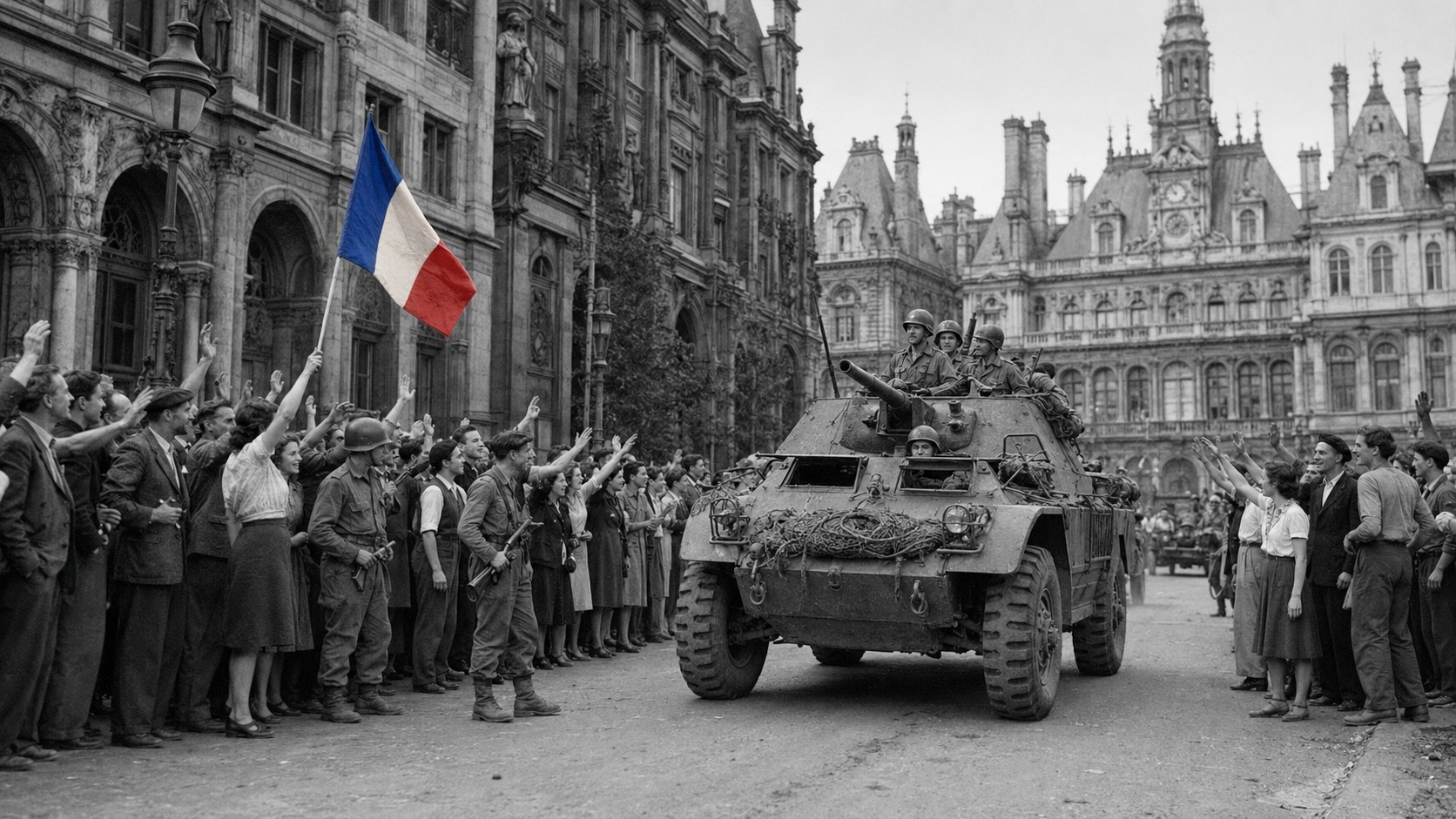
On 25 August 1944, Paris was liberated after more than four years of German occupation. French Resistance fighters, General Philippe Leclerc’s 2nd Armoured Division and the US 4th Infantry Division brought the battle for the capital to an end, forcing the German garrison to surrender and restoring French authority over one of Europe’s most important cities.
An uprising from within
The final struggle for Paris began on 19 August, as the French Resistance launched an uprising against the occupying forces. Police officers, railway workers, postal employees and other public servants had already begun striking, while armed Resistance groups seized government buildings and constructed barricades across the city.
Fighting broke out around strategic locations, including the police headquarters, government offices and major road junctions. Men, women and children helped build barricades from paving stones, vehicles and timber as German troops attempted to maintain control.

Allied plans change
The Allied high command had initially intended to bypass Paris. Commanders feared that fighting inside the densely populated capital would cause heavy civilian casualties and create a major logistical burden at a time when Allied forces were pursuing retreating German armies across France.
General Charles de Gaulle, however, pressed for immediate action. He feared that the Resistance could be crushed and understood the political importance of liberating the capital with French forces at the forefront. General Dwight D. Eisenhower ultimately approved the advance.
French armour enters the capital
On the evening of 24 August, an advance unit from Leclerc’s 2nd Armoured Division entered Paris. Among the first troops to reach the Hôtel de Ville were soldiers of La Nueve, a company largely composed of Spanish Republicans who had continued their fight against fascism after fleeing Spain.
Church bells rang across Paris as news of their arrival spread. Crowds entered the streets, although German positions remained active and the battle was not yet over.
The main body of the French division entered the following morning, supported by the US 4th Infantry Division. French tanks and infantry moved through the capital as Resistance fighters attacked remaining German strongpoints.
The German surrender
General Dietrich von Choltitz, the German military governor of Paris, surrendered on 25 August. Formal surrender documents were signed, ending organised German resistance in the capital.
Adolf Hitler had ordered that Paris should not be allowed to fall intact, but the destruction of its bridges, monuments and historic centre was never carried out. Historians continue to debate whether this reflected deliberate restraint, military reality or the German garrison’s rapidly collapsing position.
France reclaims its capital
De Gaulle arrived in Paris and delivered a powerful address at the Hôtel de Ville, presenting the liberation as a triumph of France, its people and its armed forces. The following day, he walked down the Champs-Élysées before immense crowds, reinforcing the authority of the provisional French government.
The liberation did not end the war. Fighting continued across France, Belgium, the Netherlands and Germany for months. Yet the fall of Paris carried enormous symbolic weight. A capital associated with culture, republican government and European identity had emerged from occupation.
On this day in 1944, Paris was not merely recaptured. It reclaimed its place as the political and emotional heart of a free France.
Newshub Editorial in Europe – 25 August 2026

Ask NF GPT
If you have an account with ChatGPT you get deeper explanations,
background and context related to what you are reading.
Recent Comments