
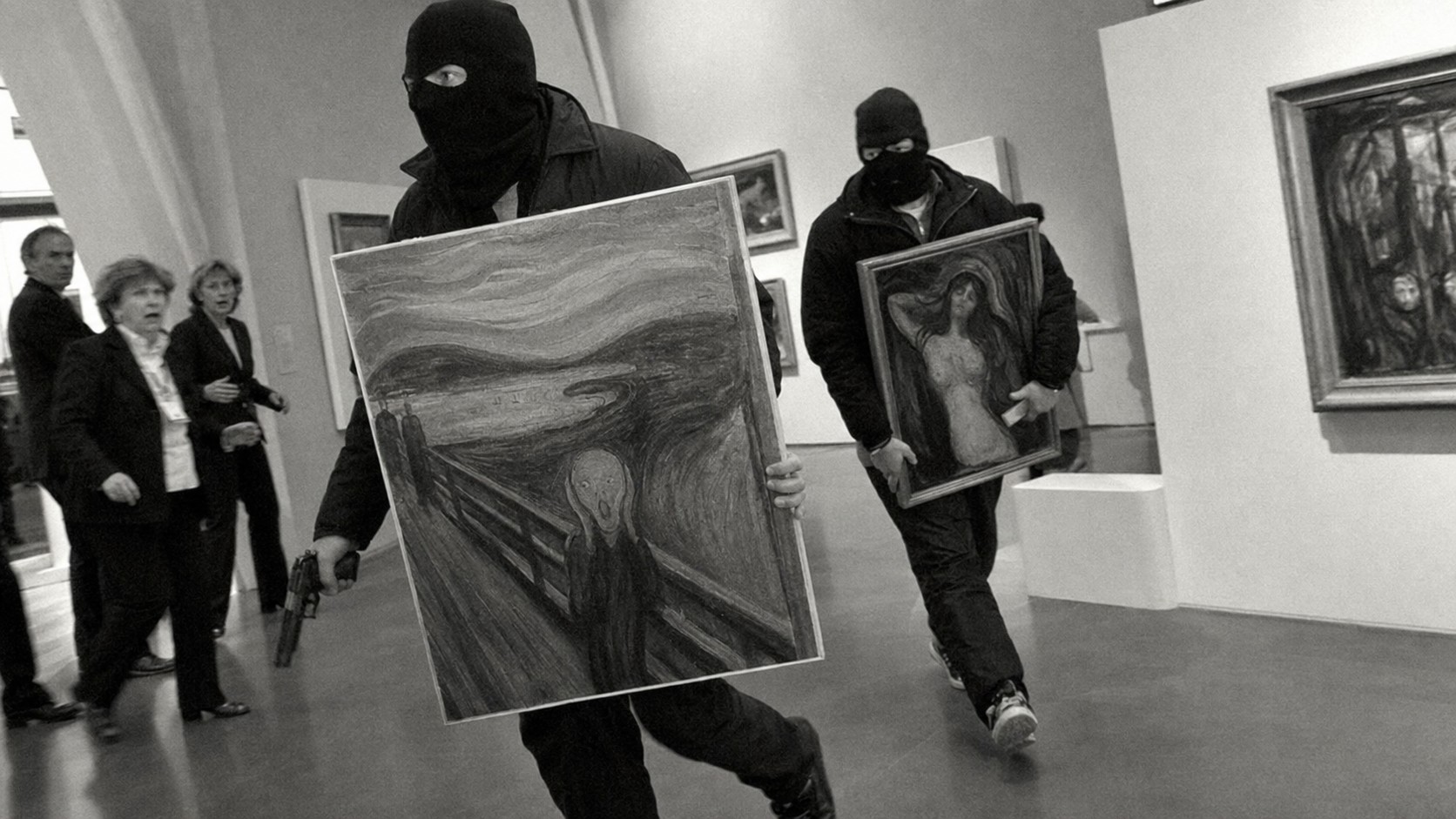
Masked gunmen walked into an Oslo museum in broad daylight and escaped with two of Norway’s most important cultural treasures.
A robbery witnessed by the public
On 22 August 2004, two masked and armed men stormed the Munch Museum in Oslo while it was open to visitors. Museum employees were threatened at gunpoint as the robbers tore Edvard Munch’s The Scream and Madonna from the walls and carried them towards a waiting getaway car.
An attack in broad daylight
The robbery took place at approximately 11.30 on a Sunday morning. Visitors watched in disbelief as the gunmen moved through the museum, seized the paintings and escaped with the assistance of a third man waiting outside. The entire operation was completed within minutes.

Norway’s most famous painting
The Scream is one of the most recognisable images in modern art. Munch first developed the motif in 1893, depicting a distorted figure standing beneath a turbulent, blood-red sky. The image became an international symbol of fear, anxiety, loneliness and psychological distress.
Several versions of the masterpiece
Munch created several versions of The Scream using paint, pastel, drawing and lithography. The version stolen from the Munch Museum was painted in tempera and pastel on cardboard and is now generally dated to around 1910. The better-known 1893 painted version belongs to Norway’s National Museum.
The Scream had disappeared before
The National Museum’s version had itself been stolen ten years earlier. In February 1994, thieves entered through a window as Norway prepared for the opening of the Winter Olympics in Lillehammer. They removed the painting in less than a minute and left behind a message thanking the museum for its poor security. It was recovered three months later.
A global police investigation
The 2004 robbery immediately became international news. Oslo police sealed off the surrounding area, alerted airports and border crossings and contacted Interpol. The paintings’ damaged frames were discovered elsewhere in the city, but the artworks had disappeared into the criminal underworld.
Security failures exposed
The ease with which the robbers entered the museum and removed two priceless paintings triggered fierce criticism. A subsequent investigation found serious weaknesses in the old building at Tøyen. The museum was later closed while metal detectors, security barriers and stricter access controls were installed.
Two years without the paintings
For two years, nobody outside the criminal network knew whether the paintings remained intact. There were fears that they had been destroyed, damaged beyond repair or were being held as collateral between criminals. Three men were convicted in connection with the robbery in May 2006, but the artworks were still missing.
Recovered during a police operation
On 31 August 2006, Norwegian police announced that both paintings had been recovered. Authorities refused to reveal precisely where they had been found or how the operation had been conducted. No reward had been paid, and the paintings were believed to have remained in Norway throughout their disappearance.
Permanent scars from the robbery
The works were in better condition than feared, but both had suffered damage. The Scream had scratches, moisture damage and an irremovable stain in its lower-left corner. Madonna suffered tears and holes after being violently removed from its frame. Following extensive conservation work, the paintings returned to public display in 2008.
A crime that strengthened an icon
The thieves succeeded in stealing the physical painting, but the worldwide coverage made The Scream even more famous. Munch’s image of human anxiety became the face of a real drama involving weapons, organised crime and a two-year hunt for two irreplaceable national treasures.
REFH – Newshub, 22 August 2026

Ask NF GPT
If you have an account with ChatGPT you get deeper explanations,
background and context related to what you are reading.
Recent Comments