
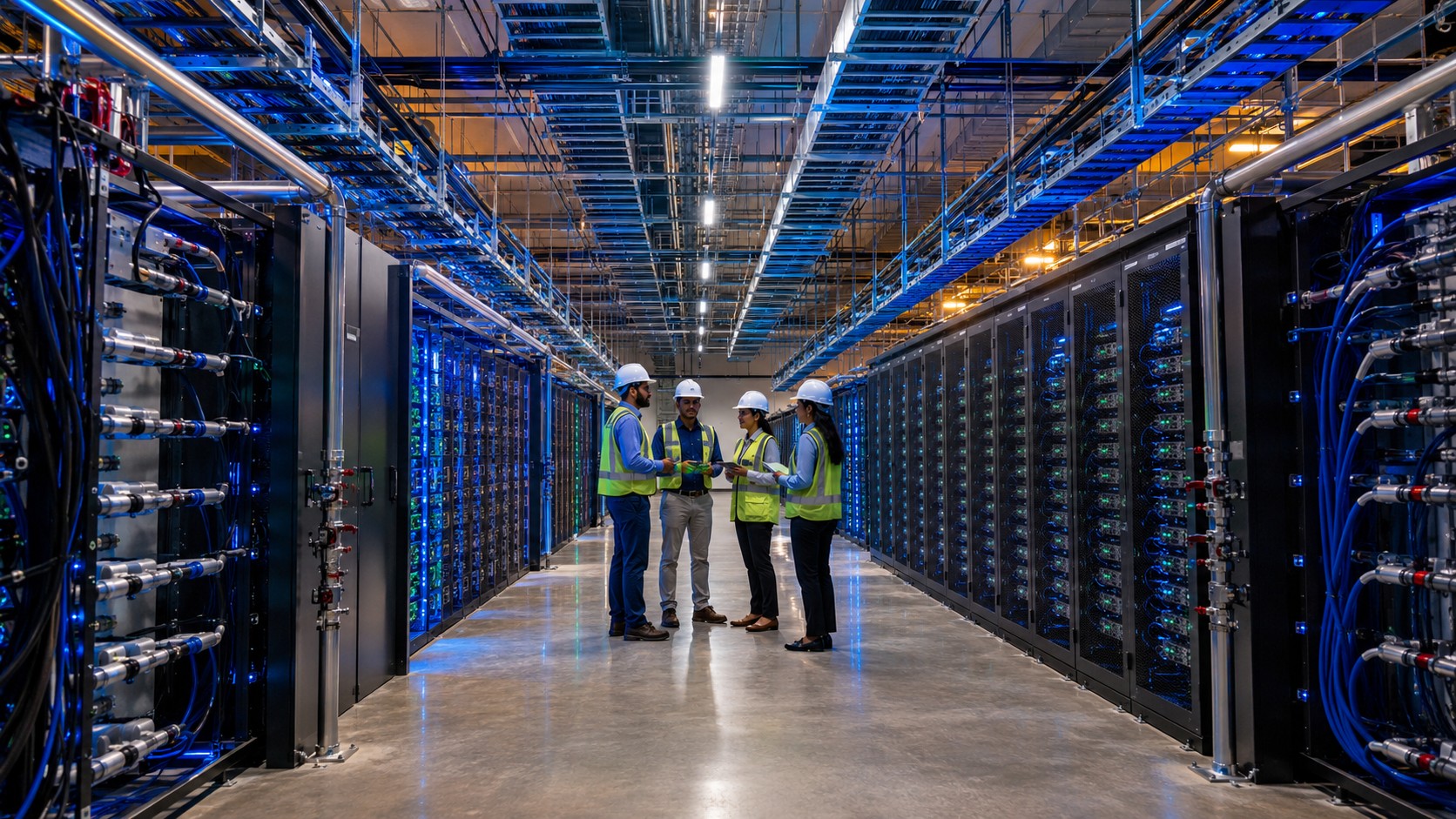
Larsen & Toubro will deploy 10,000 Nvidia B300 processors for US-based Together AI, strengthening India’s ambition to become a global centre for advanced computing infrastructure.
India’s Larsen & Toubro has secured an artificial intelligence infrastructure order worth as much as 150 billion rupees, or approximately $1.57 billion, from US-based cloud platform Together AI.
The project represents one of India’s largest investments in dedicated AI computing capacity and marks the engineering conglomerate’s entry into the rapidly expanding “AI factory” business.

A landmark infrastructure order
The contract, valued at between 100 billion and 150 billion rupees, was awarded to LTN Compute, the AI infrastructure subsidiary of Larsen & Toubro’s Vyoma.AI business.
The facility will be located at Vyoma.AI’s data-centre campus in Chennai and will contain 10,000 Nvidia B300 graphics processing units. Larsen & Toubro described it as India’s largest single-cluster deployment of the advanced processors.
Together AI will use the infrastructure to provide computing services for AI inference, model fine-tuning and large-scale training. The Nvidia B300 is among the company’s most powerful processors for data-centre workloads and is designed to handle increasingly complex generative and agentic AI applications.
Larsen & Toubro shares gained as much as 1.2 per cent during trading on the day the order was announced.
India’s infrastructure ambitions expand
The agreement comes during a sharp acceleration in Indian AI and cloud investment. Global technology companies and domestic conglomerates are committing billions of dollars to data centres, computing clusters and supporting energy infrastructure.
Microsoft recently opened its largest Indian data-centre region in Hyderabad, while Google is developing a planned $15 billion AI and data-centre hub in Andhra Pradesh. Indian technology group HCLTech has separately announced a $1.48 billion AI data-centre project in Odisha.
India offers investors a combination of a large digital market, an extensive engineering workforce and rising demand for locally hosted computing services. Domestic capacity can reduce the time required to process AI requests and may help companies address data-sovereignty and regulatory requirements.
Emerging markets move up the AI value chain
The Chennai project illustrates how emerging economies are seeking a larger role in the AI industry. Many previously participated mainly through software services, business-process outsourcing or the supply of raw materials. Large computing clusters allow them to move further into the infrastructure supporting AI development and commercial deployment.
Larsen & Toubro’s involvement is significant because the company is primarily associated with construction, engineering and industrial projects. Its move into GPU-based computing shows how the AI boom is drawing traditional infrastructure groups into technology markets.
However, the economics remain demanding. AI facilities require large and reliable electricity supplies, advanced cooling systems and expensive imported processors. Operators must also maintain high utilisation rates while managing the risk that new generations of chips make existing equipment less competitive.
Execution will determine the return
Investors will watch the project’s construction schedule, financing structure and eventual customer demand. Together AI provides an important anchor client, but long-term returns will depend on power costs, operational reliability and continued demand for training and inference services.
If successfully delivered, the Chennai facility could provide a model for infrastructure companies across Asia, Africa and Latin America. It would also demonstrate that global AI investment can create substantial opportunities beyond the established computing centres of the United States, Europe and East Asia.
REFH – Newshub, Emerging Markets, 20 August 2026

Ask NF GPT
If you have an account with ChatGPT you get deeper explanations,
background and context related to what you are reading.
Recent Comments