
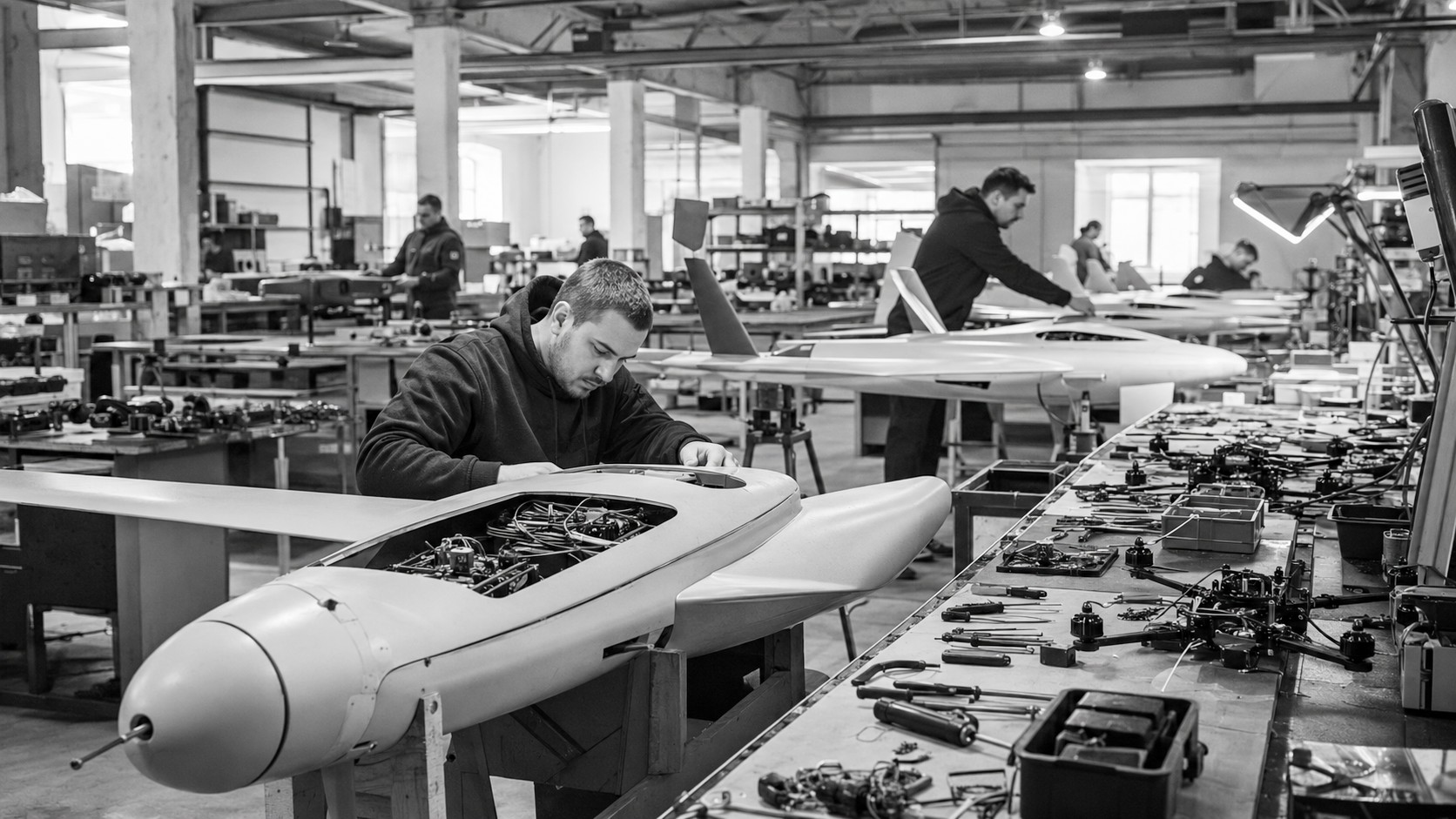
Ukraine’s drone industry grows from workshops to strikes deep inside Russia
Ukraine has transformed its drone sector from a small collection of workshops into one of the world’s largest military unmanned-systems industries. Domestic manufacturers now produce millions of battlefield drones, interceptor aircraft, maritime systems and long-range weapons capable of reaching targets thousands of kilometres inside Russia.
Production rises from thousands to millions
Ukraine manufactured only several thousand drones in 2022, when fewer than ten specialised defence companies were operating in the country. By 2026, approximately 1,500 defence businesses had emerged, with around one-third working primarily on unmanned systems.


Production reached approximately four million drones in 2025. Ukraine is expected to manufacture between six million and seven million small first-person-view attack drones during 2026, equivalent to about 500,000 units each month.
The government’s broader target exceeds seven million drones of different types. Officials say annual capacity could eventually reach 20 million units if sufficient domestic and international financing becomes available.
Drones perform increasingly varied roles
Small FPV aircraft remain central to frontline operations. They are used against armoured vehicles, artillery, defensive positions and supply movements, allowing Ukraine to compensate partly for shortages of ammunition and personnel.
Reconnaissance drones identify targets and monitor Russian movements, while bomber drones repeatedly release munitions before returning for reuse. Fibre-optic models maintain control despite electronic jamming, and artificial intelligence is increasingly assisting navigation and target recognition.
Ukraine has also developed low-cost interceptor drones to destroy Russian attack aircraft. By late 2025, almost 1,000 interceptor systems were reportedly being supplied to Ukrainian units each day.
Uncrewed ground vehicles transport ammunition, deliver supplies and evacuate wounded soldiers. Maritime drones have attacked Russian naval assets and disrupted operations in the Black Sea, while modified sea platforms can carry smaller aerial drones closer to operational areas.
Deep-strike range reaches Siberia
Ukraine’s long-range capability has developed from modified commercial systems into purpose-built fixed-wing aircraft carrying larger payloads over considerable distances.
In July, Ukrainian FP-1 drones struck the Omsk oil refinery in Siberia. Russian regional authorities confirmed the attack. The facility lies approximately 2,700 kilometres from Ukrainian-controlled territory, making it one of Ukraine’s deepest publicly confirmed strikes of the war.
President Volodymyr Zelenskyy has said upgraded Ukrainian drones can fly operational routes of around 2,500 kilometres and that the next generation is designed to exceed 3,000 kilometres.
That range potentially places much of European Russia, the Ural industrial region and parts of western Siberia within reach. Ukraine has concentrated its deep-strike campaign on oil refineries, fuel storage sites, arms factories, airfields, ports and military logistics infrastructure.
Range alone does not guarantee success. Russian air defences, electronic warfare, changing flight routes and the size of each drone’s payload all influence whether a mission reaches its intended destination.
Rapid innovation remains essential
More than 500 Ukrainian companies now develop or manufacture aerial drones. The Brave1 defence-technology network includes over 2,300 companies and thousands of proposed systems, enabling military units to test and purchase new equipment more quickly than conventional defence procurement normally permits.
Designs are frequently modified within weeks as Russian forces introduce new jamming equipment and defensive measures. This rapid cycle between frontline experience, engineering and production has become one of Ukraine’s principal military advantages.
However, the industry still depends on imported batteries, motors, electronics and thermal sensors. Funding shortages and vulnerable international supply chains could restrict further expansion.
Ukraine’s achievement is therefore not simply producing more drones. It has created an adaptable wartime industry capable of operating on the front line, defending cities, contesting the Black Sea and conducting strikes as far as 2,700 kilometres inside Russia.
Newshub Editorial in Europe – 17 August 2026

Ask NF GPT
If you have an account with ChatGPT you get deeper explanations,
background and context related to what you are reading.
Ukraine’s drone industry grows from workshops to strikes deep inside Russia
Recent Comments