
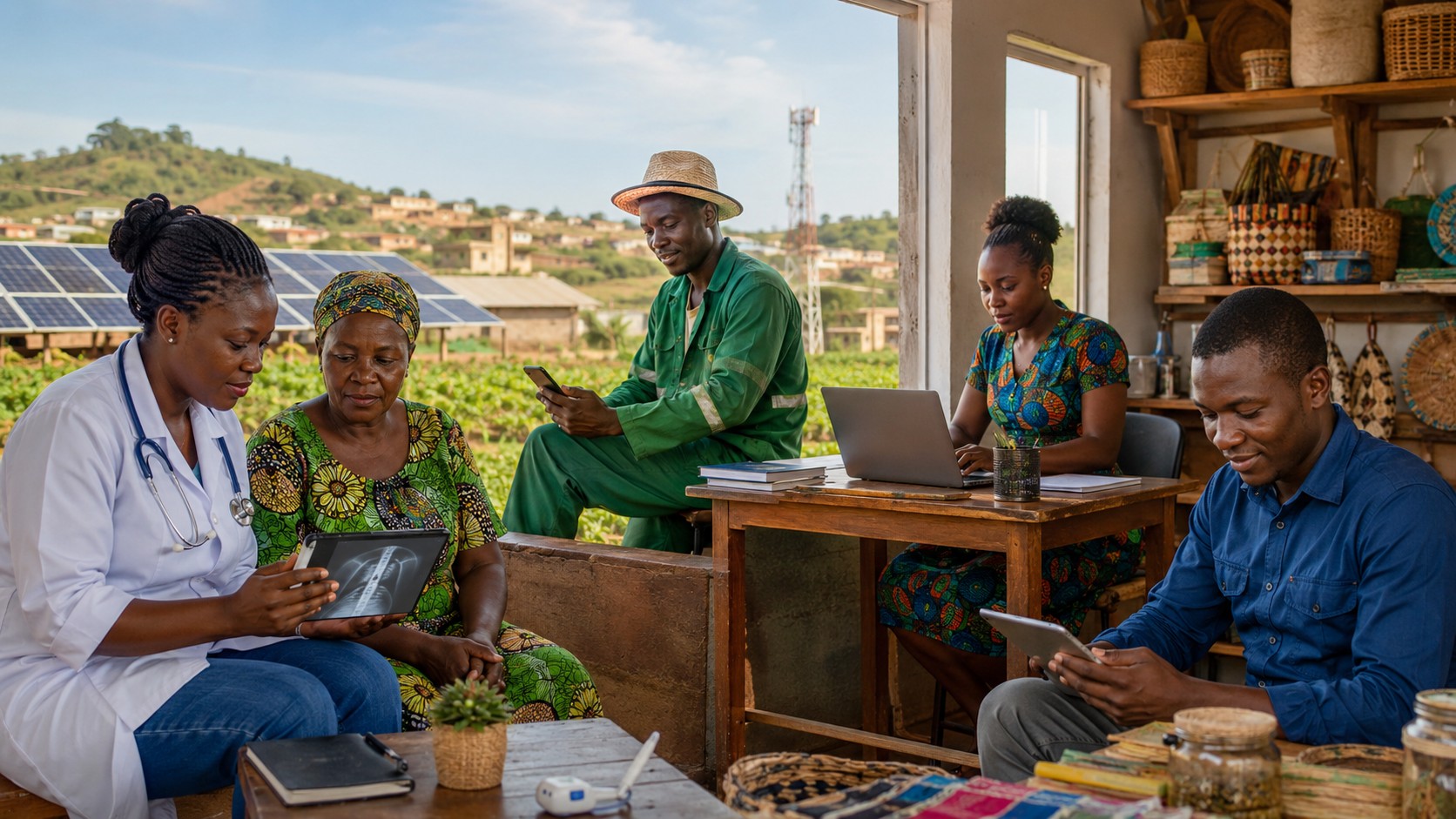
Artificial intelligence could allow developing economies to achieve within a decade advances that might otherwise take a century, according to the World Bank. Its latest development report argues that affordable AI tools can raise productivity, improve essential services and help emerging markets overcome persistent shortages of skilled professionals.
Small AI could deliver the greatest gains
The World Development Report 2026 challenges the assumption that emerging economies must build costly data centres or develop their own advanced language models. Instead, it recommends adopting existing technology and adapting smaller, lower-cost AI systems to local conditions.
These tools can operate through text messages, voice calls and basic mobile phones, making them potentially useful in communities with limited access to smartphones or high-speed internet. Local-language services could place specialist knowledge within reach of millions of people who currently lack regular access to doctors, teachers, agricultural advisers or government services.

Productivity gains could outweigh job losses
The report estimates that 16.2 per cent of jobs in developing economies could receive meaningful productivity benefits from AI, close to the 18.7 per cent estimated for high-income countries.
At the same time, only 4.5 per cent of jobs in low- and middle-income economies are considered directly vulnerable to generative AI automation. That compares with 14.2 per cent in wealthier countries, where a larger share of employment involves administrative and knowledge-based tasks that can be automated.
For emerging markets, the immediate opportunity is therefore more likely to involve supporting workers than replacing them. AI could help health professionals diagnose illnesses, assist teachers in preparing lessons, provide farmers with improved weather and crop information, and allow small businesses to manage operations more efficiently.
Public services offer a powerful starting point
Governments could use AI to strengthen tax collection, identify people eligible for social programmes, improve disaster warnings and expand access to healthcare and education. These applications could be especially valuable in countries where public institutions face shortages of staff, reliable records and specialist expertise.
The World Bank recommends a three-stage approach: adopt available tools, adapt them to local languages and circumstances, and gradually advance domestic AI capabilities as infrastructure and skills improve.
This strategy could also create opportunities for local technology companies. Governments that establish clearer procurement systems, accessible data resources and practical testing environments could help start-ups develop services designed for local markets rather than importing unsuitable foreign solutions.
Infrastructure remains the decisive challenge
The benefits are not guaranteed. Reliable electricity, affordable internet access, computing capacity, education and trustworthy institutions remain essential. In Sub-Saharan Africa, nearly one-third of rural schools still lack reliable electricity and more than two-thirds lack dependable internet connectivity.
The World Bank and its partners are working through Mission 300 to provide electricity access to 300 million people across Sub-Saharan Africa by 2030. Such investment would support wider economic development while also creating the foundations required for digital and AI services.
A narrow window for emerging economies
AI could still increase inequality, strengthen dominant technology providers and expose vulnerable populations to misinformation, surveillance and weak data protection. Governments must therefore combine innovation with safeguards for privacy, competition and public accountability.
However, the wider message is optimistic. Emerging markets do not need to lead the global race to build the largest AI models. By directing affordable technology towards practical problems, they could accelerate economic development and improve services without repeating the high-cost industrial path followed by wealthier economies.
Newshub Editorial in Global Markets – 13 August 2026

Ask NF GPT
If you have an account with ChatGPT you get deeper explanations,
background and context related to what you are reading.
Recent Comments