
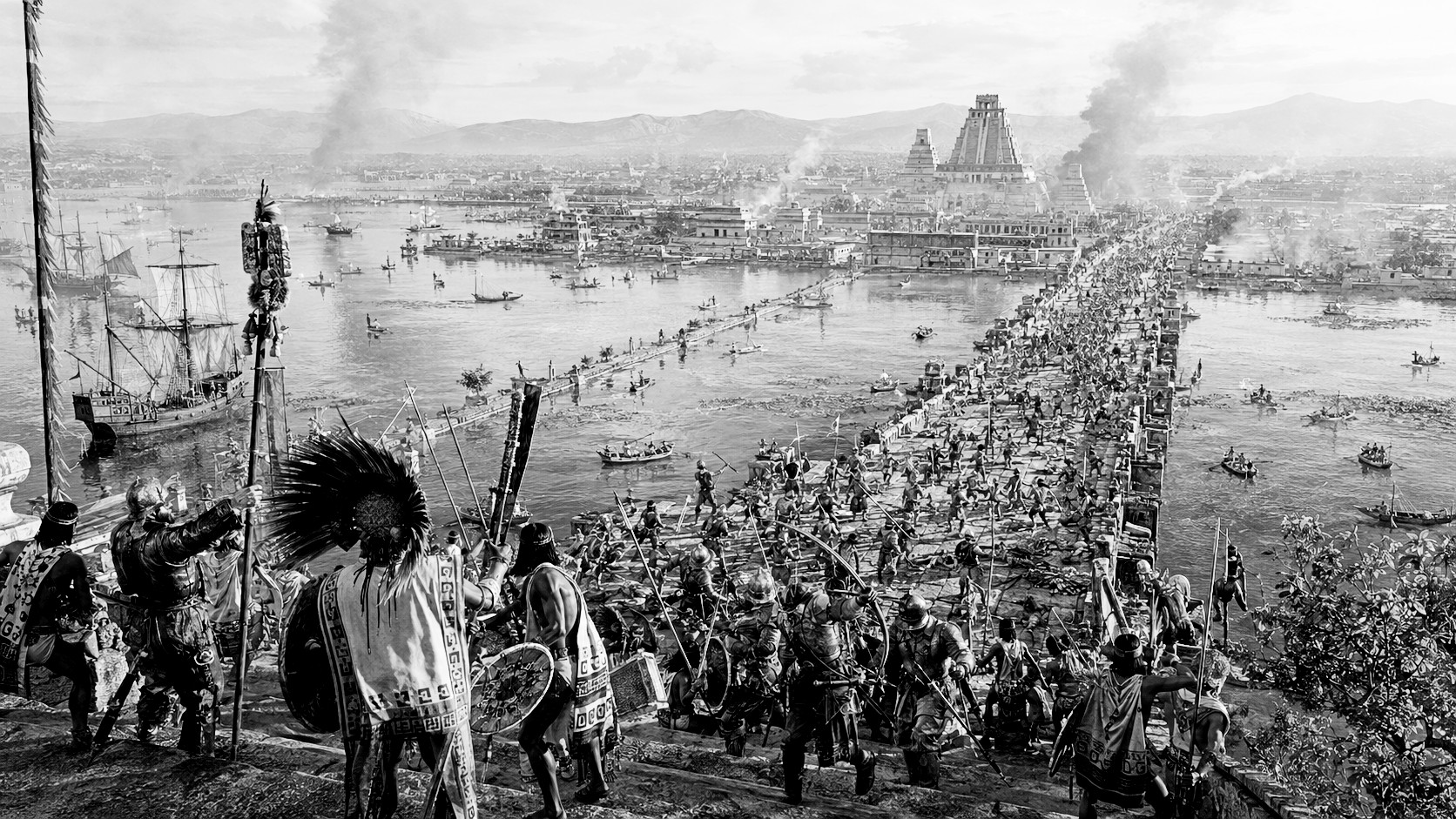
On 13 August 1521, the magnificent city of Tenochtitlan surrendered after a devastating siege by Spanish forces and their Indigenous allies. The capture of the last Aztec ruler, Cuauhtémoc, brought one of the most powerful empires in the Americas to a violent end.
A city that astonished the Europeans
When Hernán Cortés and his expedition reached central Mexico in 1519, the Aztec Empire dominated much of the region through warfare, alliances and an extensive tribute system.


At its heart stood Tenochtitlan, built on islands in Lake Texcoco and connected to the mainland by raised causeways. With canals, aqueducts, temples, palaces and crowded markets, it was among the largest and most sophisticated cities in the world. Its population may have reached 200,000 people.
The empire was led by Moctezuma II, who initially received Cortés and his men peacefully. The relationship soon collapsed. The Spaniards took Moctezuma hostage, while growing resentment against their presence brought the capital to the edge of rebellion.
The Spaniards were not fighting alone
The conquest is often described as a victory by a small group of Europeans over an enormous empire. In reality, Cortés depended heavily upon thousands of Indigenous warriors.
The Aztec tribute system had created powerful enemies. The Tlaxcalans, in particular, became essential allies of the Spaniards, providing soldiers, supplies and knowledge of the region. Other communities also joined the campaign, seeing an opportunity to break free from Aztec rule.
In 1520, the population of Tenochtitlan rose against the intruders. Cortés and his forces were driven from the city during the disastrous retreat remembered as La Noche Triste – the Night of Sorrows. Hundreds of Spaniards and allied warriors were killed.
The Aztec victory, however, proved temporary.
Disease, starvation and siege
Smallpox spread through the region after being introduced from Europe. The population had no previous immunity, and the epidemic killed enormous numbers of people, including the Aztec ruler Cuitláhuac, who had succeeded Moctezuma.
Cortés rebuilt his army and returned in 1521 with Spanish soldiers and a much larger force of Indigenous allies. Brigantines were launched on Lake Texcoco, allowing the attackers to blockade the capital and cut its vital supply routes.
For approximately three months, Tenochtitlan endured relentless fighting, hunger, disease and a severe shortage of fresh water. The defenders resisted street by street as buildings were destroyed and the once-thriving city was reduced to ruins.
On 13 August, Cuauhtémoc attempted to escape across the lake but was captured. Organised resistance inside the capital collapsed, marking the fall of the Aztec Empire.
An empire destroyed, a culture that survived
The Spaniards demolished much of Tenochtitlan and constructed Mexico City over its remains. Churches and colonial buildings rose above former temples, while the territory became the centre of New Spain.
Yet the fall of the empire did not mean the disappearance of its people. Nahuatl remains widely spoken, and Mexica traditions, food, art and identity continue to shape modern Mexico.
The ruins beneath Mexico City still testify to a civilisation that conquest could defeat, but never completely erase.
Newshub Editorial in North America – 13 August 2026

Ask NF GPT
If you have an account with ChatGPT you get deeper explanations,
background and context related to what you are reading.
On 13 August 1521, the magnificent city of Tenochtitlan surrendered after a devastating siege by Spanish forces and their Indigenous allies. The capture of the last Aztec ruler, Cuauhtémoc, brought one of the most powerful empires in the Americas to a violent end.
Recent Comments