
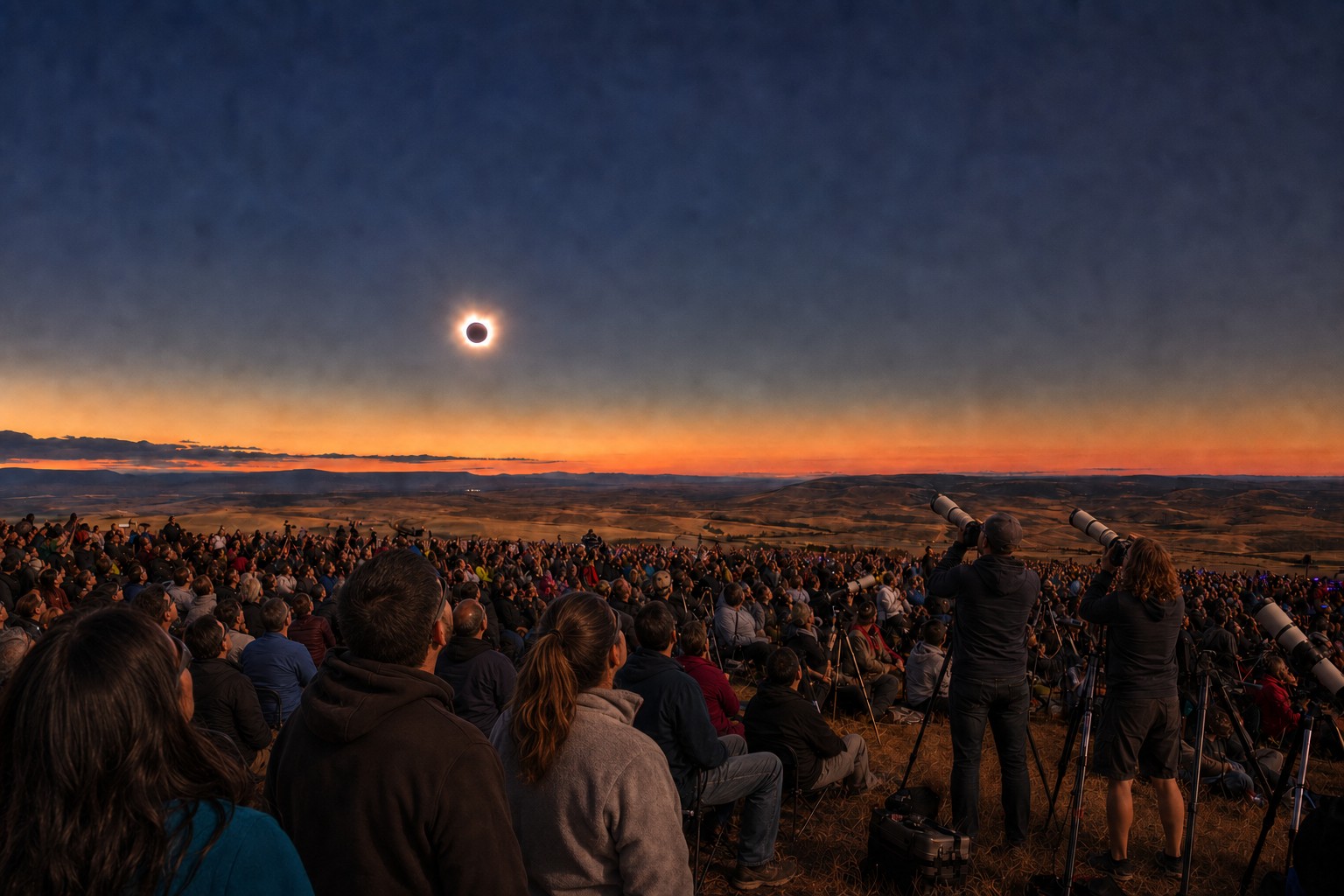
Millions of eclipse chasers, tourists and astronomers are converging on Spain ahead of Wednesday evening’s total solar eclipse, searching for clear skies and an unobstructed western horizon. The country is expected to offer mainland Europe’s best view of the rare event, during which the Moon will completely cover the Sun and briefly turn daylight into darkness.
A historic shadow crosses Spain
The path of totality will stretch in a band about 200 kilometres wide from A Coruña in north-western Spain across the country to Valencia and the Mediterranean island of Mallorca. Cities including León, Zaragoza, Bilbao and Valencia lie within the path, while Madrid and Barcelona will experience an eclipse of approximately 99%.
Spain has not witnessed a total solar eclipse since 1905. The Moon’s shadow is expected to cross the Iberian Peninsula between approximately 20.27 and 20.32 CEST, shortly before sunset. Depending on location, totality will last for less than two minutes, reaching up to about one minute and 40 seconds in parts of Spain.


The race for clear skies
Spain’s generally favourable summer weather has made it the leading European destination for the event. Cloudier forecasts in Greenland and Iceland have encouraged many international eclipse hunters to travel south, although local cloud cover remains a concern in some Spanish regions.
Because the Sun will be low in the sky, observers need a clear view towards the western horizon. Some visitors have prepared several alternative locations and are ready to drive into the countryside at short notice if clouds threaten their chosen viewing point.
Tourism surge tests local infrastructure
Officials estimate that as many as six million people could travel into the eclipse zone. Around 460,000 international visitors are believed to have arrived in Spain, including travellers from the United States, Canada, Japan and across Europe. More than 300,000 are expected to head towards smaller towns and rural communities.
Hotels, campsites and motorhome rentals have reported heavy demand, while authorities are preparing for up to 1.5 million additional road journeys. More than 24,000 police officers are being deployed to manage traffic, crowds and emergency access.
Astronomers prepare for a global audience
NASA, the European Space Agency and research institutions have established observation sites and international broadcasts. Scientists will study the Sun’s corona, its normally hidden outer atmosphere, while Iberia plans to transmit images from a specially arranged flight operating above much of the cloud cover.
Demand for certified eclipse glasses has surged, with many opticians and pharmacies reporting that supplies have sold out.
Safety warnings accompany the excitement
Authorities have warned spectators never to look directly at the Sun during the partial phases without certified protection. Ordinary sunglasses are not sufficient, and cameras, telescopes and binoculars require specialist solar filters.
Temperatures approaching 40C and extremely dry vegetation have also created a serious wildfire threat. Visitors have been told not to light fires, use barbecues or fireworks, or park vehicles on dry grass.
Two minutes that may never be forgotten
For experienced eclipse chasers, totality is less an astronomical observation than an emotional encounter. As darkness falls, temperatures drop and the Sun’s corona emerges around the Moon, millions across Spain will share one of nature’s most dramatic and fleeting spectacles.
Newshub Editorial in Europe – 12 August 2026

Ask NF GPT
If you have an account with ChatGPT you get deeper explanations,
background and context related to what you are reading.
Millions of eclipse chasers, tourists and astronomers are converging on Spain ahead of Wednesday evening’s total solar eclipse, searching for clear skies and an unobstructed western horizon. The country is expected to offer mainland Europe’s best view of the rare event, during which the Moon will completely cover the Sun and briefly turn daylight into darkness.
Recent Comments