
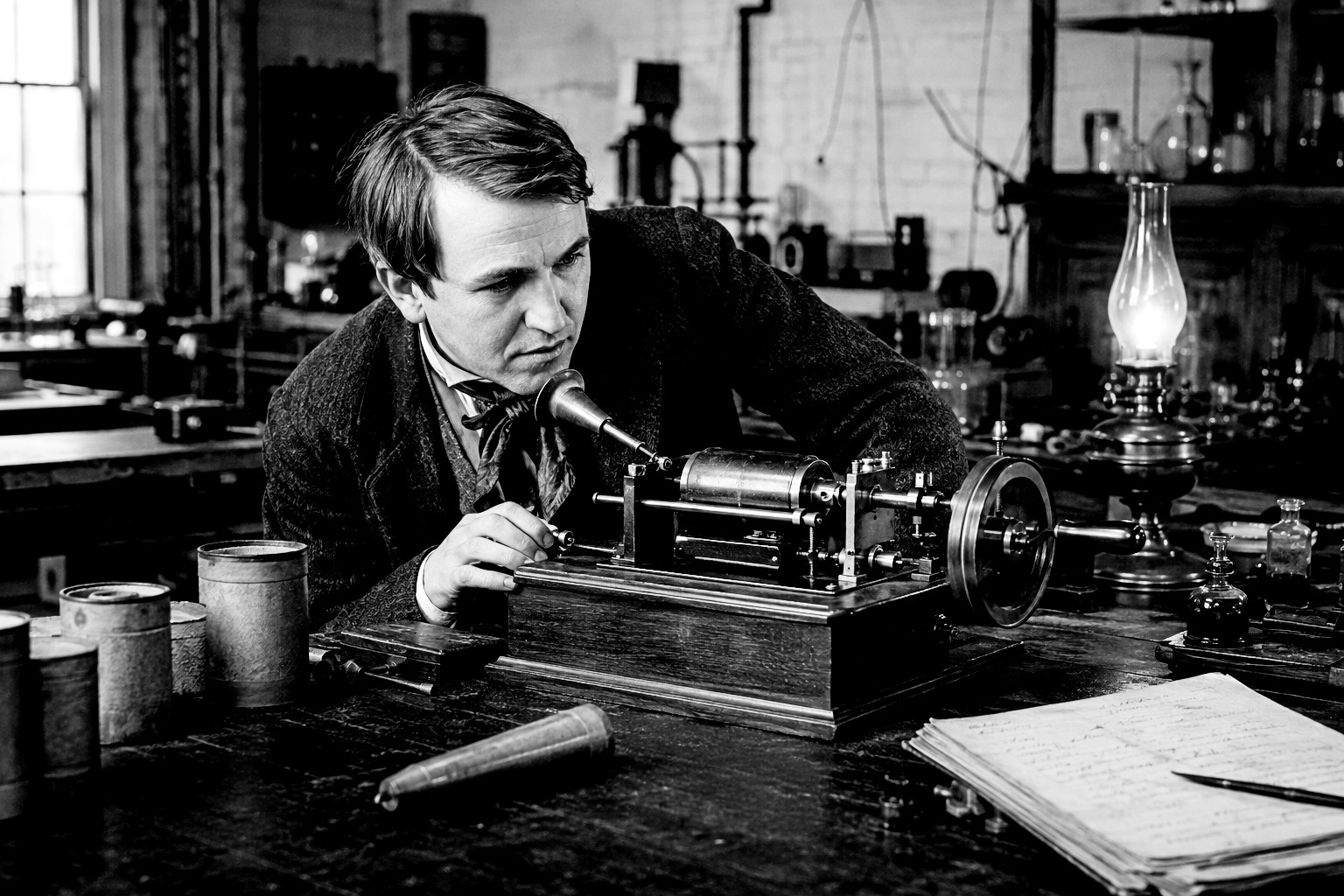
On 12 August 1877, Thomas Alva Edison is traditionally credited with completing the design that became the phonograph—the first practical machine capable of both recording and reproducing sound. The invention transformed the human voice and music from fleeting experiences into something that could be preserved, repeated and distributed, laying the technological foundation for the global recording industry.
From telegraph signals to recorded sound
Edison developed the idea while working on improvements to the telegraph and telephone at his laboratory in Menlo Park, New Jersey. He realised that the vibrations produced by speech might be captured mechanically in much the same way that telegraph messages could be recorded. His concept used a vibrating diaphragm connected to a stylus, which pressed the pattern of sound into a rotating cylinder covered with thin tinfoil.
A machine that spoke back
Edison gave his sketch to machinist John Kruesi, who constructed the first working model. Edison reportedly tested the machine by speaking the nursery rhyme “Mary Had a Little Lamb” into its mouthpiece. When the cylinder was turned again, the machine reproduced his words. The sound was faint and distorted, but the result astonished those who heard it. For the first time, a machine appeared to remember a human voice and speak it back.


The date remains debated
Although 12 August 1877 is popularly recognised as the date of the phonograph’s invention, surviving documentation suggests that the first working machine may not have been built and demonstrated until later that year. Edison announced the device publicly in November, applied for a patent on 24 December 1877 and received US Patent No. 200,521 on 19 February 1878. The broad patent covered the recording and reproduction of sound and established Edison as one of the most celebrated inventors of his time.
Earlier experiments and Edison’s breakthrough
French inventor Édouard-Léon Scott de Martinville had captured sound waves visually with his phonautograph decades earlier, but his machine could not play them back. Edison’s crucial achievement was combining recording with immediate reproduction. That distinction turned sound recording from a scientific experiment into a practical technology with commercial potential.
From cylinders to a global industry
The original tinfoil recordings were fragile and could survive only a few playbacks. Later inventors improved the technology by introducing wax cylinders, while Emile Berliner’s gramophone popularised flat discs. These developments eventually produced record companies, recording studios, home entertainment systems and entirely new professions for musicians, performers and producers.
A revolution that still surrounds us
Modern streaming services, podcasts, voice messages and digital archives are technologically distant from Edison’s hand-cranked machine, yet they share its central idea: sound can be captured, stored and heard again. The phonograph did more than create a new device. It changed humanity’s relationship with memory, music and the spoken word.
Newshub Editorial in North America – 12 August 2026

Ask NF GPT
If you have an account with ChatGPT you get deeper explanations,
background and context related to what you are reading.
On 12 August 1877, Thomas Alva Edison is traditionally credited with completing the design that became the phonograph—the first practical machine capable of both recording and reproducing sound. The invention transformed the human voice and music from fleeting experiences into something that could be preserved, repeated and distributed, laying the technological foundation for the global recording industry.
Recent Comments