
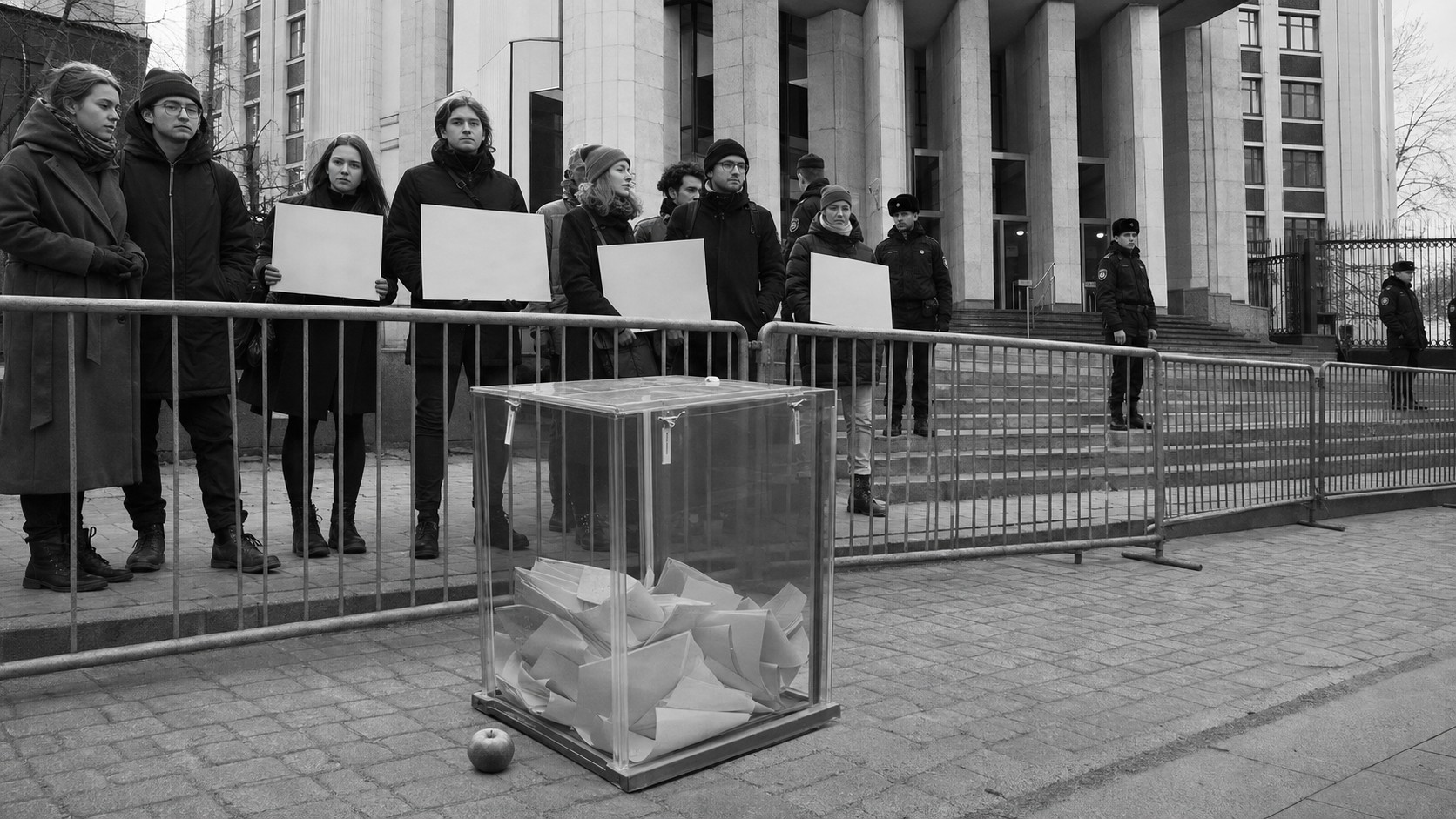
Russia’s Supreme Court has barred the liberal Yabloko party from contesting September’s parliamentary election, removing the only registered political organisation openly campaigning against the war in Ukraine. The decision leaves Russian voters without an anti-war party on the federal ballot as the Kremlin continues to restrict political opposition and public criticism of the conflict.
Entire Yabloko slate disqualified
The court cancelled the registration of Yabloko’s entire federal list of candidates for the State Duma election, scheduled for 18–20 September. Russia’s Central Election Commission had previously approved the party alongside ten other political groups.
The ruling followed a challenge submitted by Rodina, or Motherland, a nationalist party supportive of the Kremlin. It accused Yabloko of receiving undeclared campaign assistance, including alleged foreign support, and of violating electoral and copyright regulations.

Yabloko rejected the accusations as politically motivated and unconstitutional. Party chairman Nikolai Rybakov said the organisation would appeal and continue promoting peace despite being removed from the election.
A campaign built around ending the war
Yabloko had planned to campaign for an immediate ceasefire, negotiations with Kyiv and an end to Russia’s military operations in Ukraine. Although the party holds no seats in the current national parliament and possesses only limited regional representation, it remained the last legally registered party offering voters an explicitly anti-war programme.
Other prominent Kremlin critics have been imprisoned, forced into exile, designated as foreign agents or prevented from seeking office. Several Yabloko members have also faced prosecution or administrative penalties over public opposition to the war.
The remaining parliamentary parties either support the invasion or avoid directly challenging the Kremlin’s military policy. United Russia, which is closely aligned with President Vladimir Putin, dominates the State Duma and is expected to retain control after September’s vote.
Yabloko’s exclusion therefore carries greater symbolic than immediate electoral significance. It removes a legal channel through which Russian citizens could register opposition to the war, even if the party had little realistic prospect of forming a parliamentary majority.
War support shows signs of weakening
Independent polling has indicated growing war fatigue and stronger public interest in negotiations. Support for Russia’s military campaign has reportedly fallen to approximately 66%, its lowest level since the full-scale invasion began in February 2022.
The political environment nevertheless makes it difficult to measure public opinion accurately. Wartime censorship laws carry severe penalties for descriptions of the conflict that contradict official government statements, while independent media organisations have largely been blocked or forced abroad.
Russia accelerates satellite network
The election ruling came as Ukrainian military intelligence warned that Russia was developing its Rassvet satellite internet system more rapidly than anticipated.
Rassvet is intended to provide secure, low-orbit internet coverage comparable to the battlefield connectivity offered by SpaceX’s Starlink network. Reliable satellite communication can support command systems, drone operations and military units working in areas where conventional infrastructure is damaged or unavailable.
Russia currently has 16 Rassvet satellites in orbit, according to Ukrainian intelligence. Moscow reportedly aims to expand the constellation to 292 satellites by 2027 and 924 by 2035.
The system presently provides only intermittent coverage windows, limiting its operational use. Ukrainian officials warned, however, that a larger constellation could eventually give Russian forces an independent communications network and reduce their reliance on foreign equipment.
Political and military pressure intensifies
Ukraine successfully pressed SpaceX to disable unauthorised Starlink terminals used by Russian forces. A domestically controlled alternative would make similar restrictions more difficult and could strengthen Russia’s battlefield communications.
Together, Yabloko’s removal and the accelerating satellite programme illustrate two parallel elements of Moscow’s wartime strategy: tighter control over political dissent at home and continued investment in military technology for a prolonged conflict abroad.
Newshub Editorial in Europe – 11 August 2026

Ask NF GPT
If you have an account with ChatGPT you get deeper explanations,
background and context related to what you are reading.
Recent Comments