
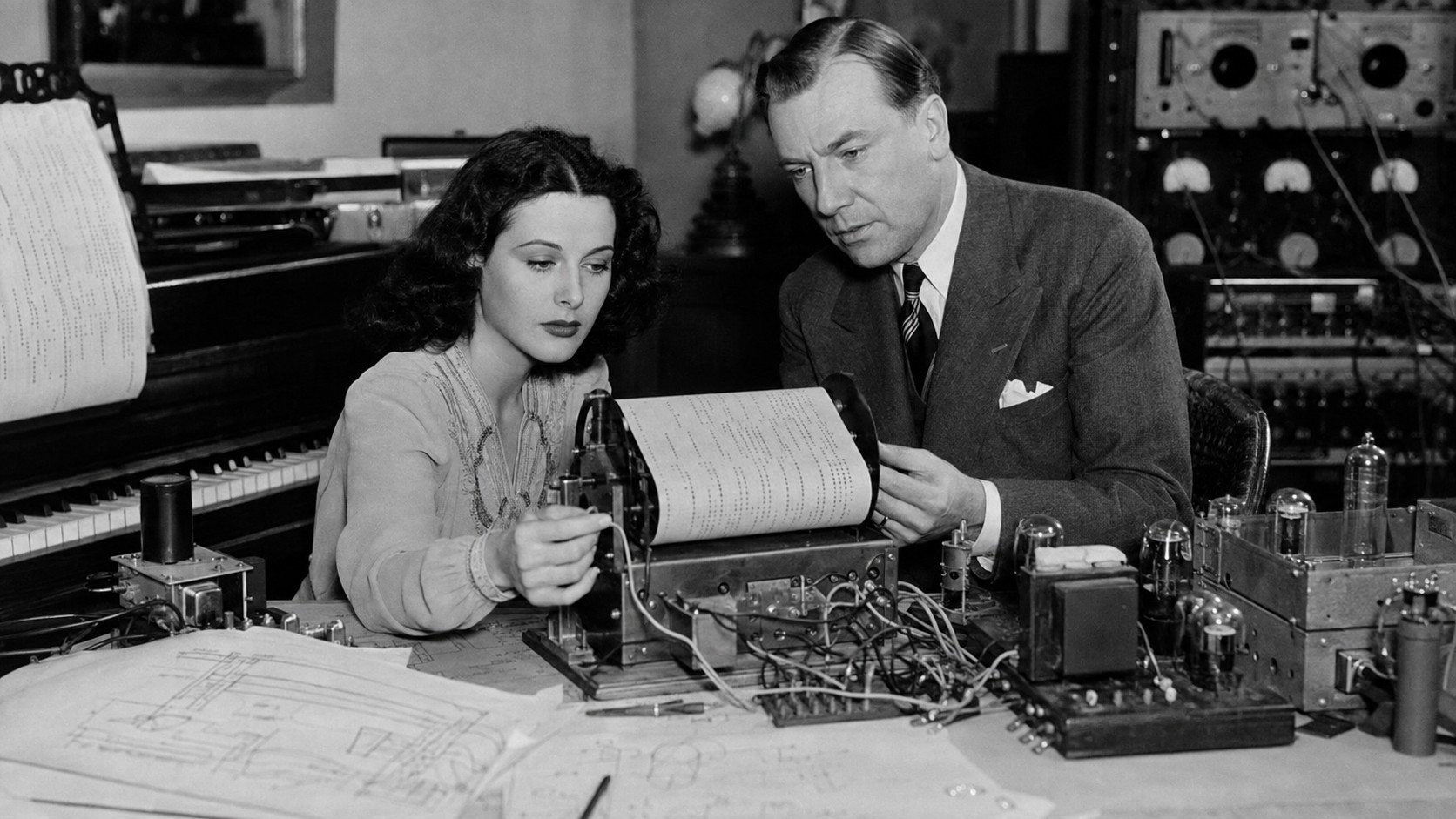
On 11 August 1942, American actress Hedy Lamarr and avant-garde composer George Antheil received a US patent for an ingenious communications system designed to prevent enemies from jamming radio-controlled torpedoes. Largely overlooked at the time, the principles behind their invention would later influence technologies used in satellite communications, mobile phones and other wireless systems.
An unlikely partnership
Lamarr was one of Hollywood’s most recognisable stars, celebrated for films including Algiers, Ziegfeld Girl and Samson and Delilah. Born Hedwig Eva Maria Kiesler in Vienna in 1914, she possessed a strong interest in engineering and frequently worked on inventions between film assignments.
Antheil was an American composer, pianist and author known for experimental works such as Ballet Mécanique. His experience with player pianos and the precise synchronisation of mechanical instruments proved essential when the two began discussing how radio signals could be protected from deliberate interference.

The wartime problem
During the Second World War, radio-controlled torpedoes offered a potentially powerful weapon. However, their guidance signals could be detected and jammed by an enemy transmitting interference on the same radio frequency. Once the connection was disrupted, the torpedo could be sent off course.
Lamarr proposed that the guidance signal should continually switch, or “hop”, between different frequencies. If the transmitter controlling the torpedo and the receiver inside it changed frequency simultaneously, an enemy would find it considerably more difficult to identify and block the signal.
Music provided the mechanism
Antheil helped devise a method of synchronising these rapid changes. Drawing upon his knowledge of automated musical instruments, the inventors proposed using perforated rolls similar to those found in player pianos.
Their design moved between 88 different frequencies, matching the number of keys on a piano. Identical rolls would control the transmitter and receiver, allowing both devices to change frequency according to the same predetermined sequence.
Lamarr and Antheil filed their application in June 1941. US Patent No. 2,292,387, titled “Secret Communication System”, was granted on 11 August 1942 under Lamarr’s married name, Hedy Kiesler Markey, and Antheil’s name.
Recognition arrived decades later
The US Navy did not adopt their mechanical system during the war. It was considered difficult to install inside a torpedo, and the inventors received no financial reward from the patent.
Nevertheless, the broader concept of coordinated frequency hopping became increasingly valuable as electronic components grew smaller and more advanced. Spread-spectrum techniques were subsequently developed for secure military communications and influenced later wireless systems.
It would be inaccurate to describe Lamarr and Antheil’s original mechanical device as the direct invention of every modern wireless technology. However, their work represented an important early contribution to methods used to make radio communication more resistant to interference, interception and congestion.
A legacy beyond Hollywood
Lamarr’s technical achievement remained overshadowed by her film career for much of her life. In 1997, she and Antheil received the Electronic Frontier Foundation Pioneer Award, bringing renewed attention to their work. Both were inducted into the National Inventors Hall of Fame in 2014.
Their collaboration remains a striking example of innovation emerging from unexpected disciplines: a Hollywood actress and an experimental composer combining engineering, music and wartime necessity to anticipate an important feature of the wireless age.
Newshub Editorial in North America – 11 August 2026

Ask NF GPT
If you have an account with ChatGPT you get deeper explanations,
background and context related to what you are reading.
Recent Comments