
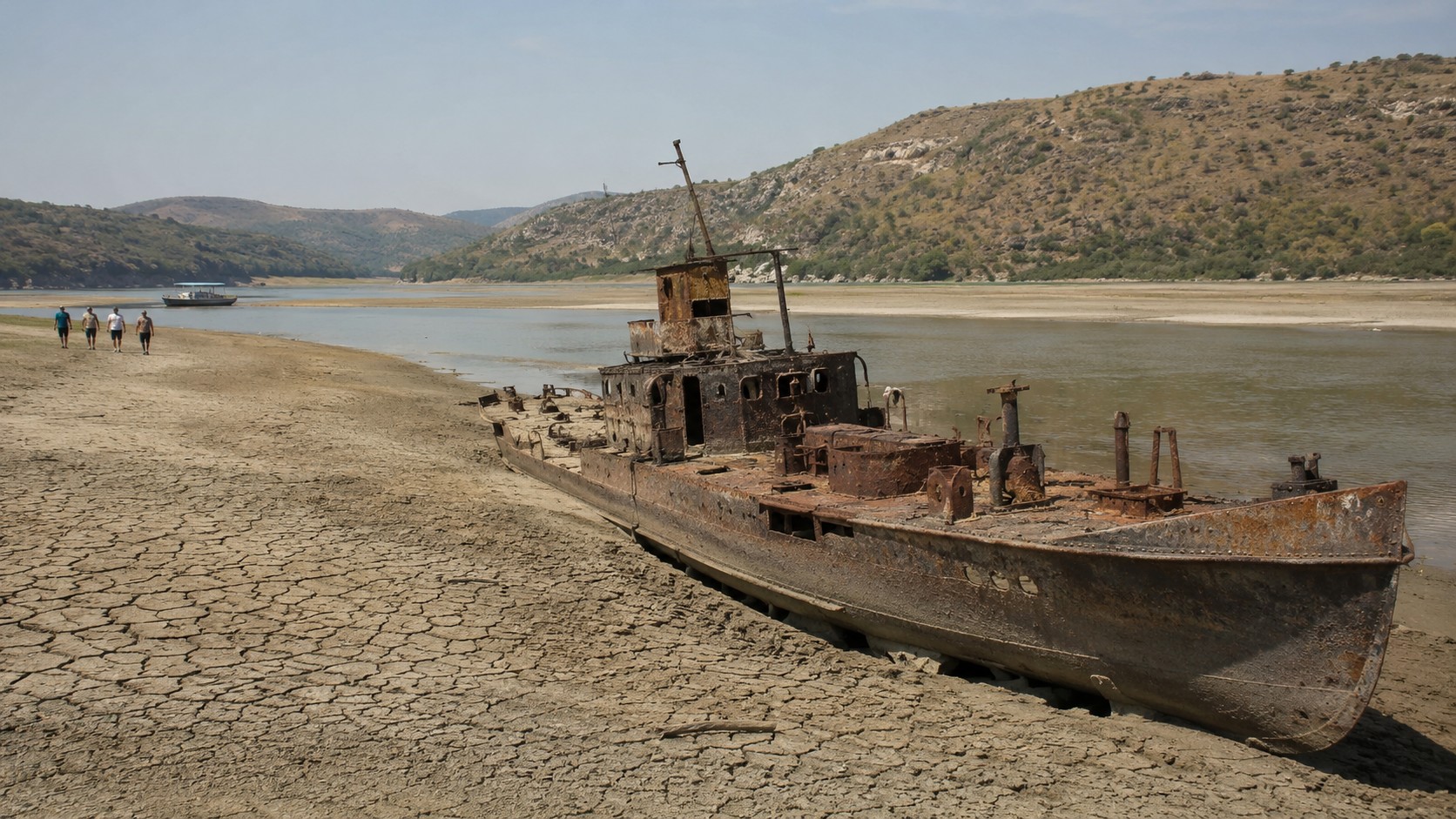
The rusting remains of Nazi German warships are emerging from the Danube as extreme heat and prolonged drought drive Europe’s second-longest river to record-low levels. Near the Serbian port of Prahovo, broken hulls, masts and sections of military vessels have risen above newly exposed sandbanks, revealing a dangerous legacy of the Second World War.
A fleet deliberately sunk in 1944
At least 20 German wartime wrecks can now be seen from the riverbank near Prahovo, close to the border between Serbia and Romania. Historians believe that as many as 200 vessels belonging to Nazi Germany’s Black Sea fleet were deliberately scuttled in September 1944.
German forces were retreating from the advancing Soviet army and sank their own ships in an attempt to block navigation through the strategically important Iron Gates section of the Danube. Many of the vessels carried weapons, ammunition and explosives when they went down.


The wrecks have periodically become visible during previous droughts, but the exceptionally low water levels of 2026 have exposed more of the vessels and surrounding riverbed.
History becomes a modern danger
The ships are not simply archaeological remains. Unexploded ordnance may still be present inside or around several wrecks, making them hazardous to visitors, salvage teams and river traffic.
Their position also narrows the navigable channel near Prahovo. Cargo vessels must travel through increasingly restricted stretches of water, raising the risk of groundings and delays. Removal operations have begun on selected wrecks, but the presence of explosives makes the work slow, difficult and expensive.
Other remnants of Europe’s past have also emerged. A wartime bomb was exposed near Budapest’s Margaret Bridge, forcing authorities to restrict access. In Bulgaria, receding water near the village of Ryahovo revealed what scientists believe are the remains of a woolly mammoth, including a jawbone, tusk fragments and part of a leg.
Shipping and tourism disrupted
The drought is already affecting commercial and passenger traffic. In the Bulgarian port city of Vidin, almost 200 tourists were evacuated after a river cruise vessel struck a shoal.
Fishing boats and smaller commercial vessels have become trapped on dry banks, while larger cargo ships are being forced to carry lighter loads to reduce their draught. Transporting less cargo increases the cost of moving grain, fuel, industrial products and raw materials through Central and Eastern Europe.
The Danube passes through or borders ten countries and connects major industrial and agricultural regions with the Black Sea. Extended disruption therefore carries economic consequences far beyond the communities along the exposed riverbanks.
Energy supplies face growing pressure
Record-low flows are also threatening electricity production. Romania has shut one reactor at the Cernavodă nuclear plant, which normally supplies around one-fifth of the country’s electricity. Military engineers have used controlled explosions to remove underwater rock and improve the flow of cooling water towards the facility.
Hungary’s Paks nuclear power plant has also reduced production because the Danube can no longer provide sufficient cooling water. Hydroelectric generation in Serbia has fallen sharply, adding pressure to regional power networks during a period of exceptionally high demand for air conditioning.
A warning from a warming continent
In Budapest, the Danube gauge fell to approximately 10 centimetres, below the previous record of 33 centimetres established in 2018. River flows in parts of Romania have dropped to around one-third of their normal seasonal level.
Low rainfall initiated the drought, but persistent extreme heat has accelerated evaporation, dried soils and reduced the amount of water reaching rivers. Scientists warn that human-driven climate change is making European heatwaves more frequent and intense, increasing the probability of severe hydrological drought.
The Nazi wrecks offer a striking image of Europe’s retreating waters. Yet the greater warning lies beyond the rusting steel: a major continental river is losing its ability to support transport, energy production, industry and wildlife during increasingly hostile summers.
Newshub Editorial in Europe – 10 August 2026

Ask NF GPT
If you have an account with ChatGPT you get deeper explanations,
background and context related to what you are reading.
The rusting remains of Nazi German warships are emerging from the Danube as extreme heat and prolonged drought drive Europe’s second-longest river to record-low levels. Near the Serbian port of Prahovo, broken hulls, masts and sections of military vessels have risen above newly exposed sandbanks, revealing a dangerous legacy of the Second World War.
Recent Comments