
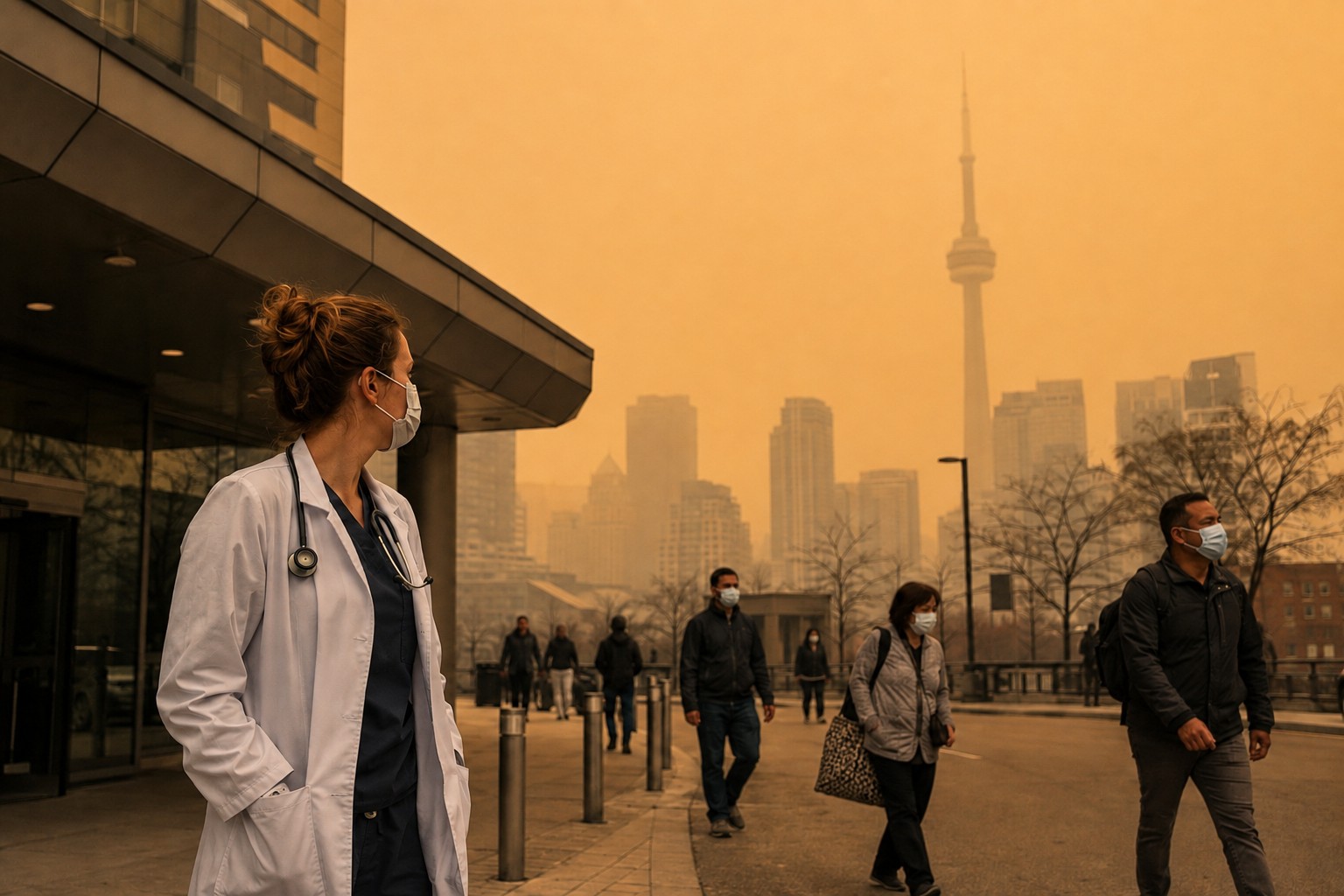
A thousand kilometres from the wildfires consuming northern Ontario’s boreal forests, the sky above Toronto turned an almost apocalyptic orange. Outside Toronto General Hospital, emergency physician Erin O’Connor encountered smoke so dense and pungent that it felt as though she were standing beside a campfire. Inside, filtration systems protected patients from the worst of the polluted air.
Smoke travels far beyond the flames
Wildfire smoke can rise high into the atmosphere and travel thousands of kilometres across national borders and oceans. During July, smoke from the Canadian fires moved across major parts of Canada and the United States, exposing millions of people who were nowhere near an active fire.
Toronto General and Toronto Western hospitals recorded an 80 per cent increase in emergency visits related to respiratory problems and poor air quality during one particularly severe period. Doctors treated patients experiencing asthma attacks, breathing difficulties, chest discomfort and worsening symptoms from existing lung conditions.


Children, older people, pregnant women and those with cardiovascular or respiratory illnesses are particularly vulnerable. However, specialists warn that heavy smoke can also affect otherwise healthy adults.
Tiny particles create serious risks
The principal health concern is PM2.5, particulate matter measuring less than 2.5 micrometres across. These particles are small enough to reach deep into the lungs and, in some cases, enter the bloodstream.
Wildfire smoke also contains carbon monoxide, nitrogen oxides and a changing mixture of organic chemicals. Its precise composition depends on what is burning, the temperature of the fire and whether flames consume forests, peat, buildings, vehicles or industrial materials.
Research in California found that wildfire-related PM2.5 could have up to ten times the effect on respiratory hospital admissions as similar concentrations of particles from other pollution sources. Scientists have not yet reached a complete explanation for this difference.
Calculating the hidden death toll
Researchers estimate that air pollution from landscape fires was associated with approximately 1.5 million deaths annually between 2000 and 2019. Most occurred in lower- and middle-income countries, where monitoring, healthcare and access to filtered indoor environments may be limited.
A separate study of Canada’s record-breaking 2023 wildfire season estimated approximately 5,400 acute deaths in North America during the most intense smoke episodes. It also associated prolonged exposure with about 82,100 premature deaths worldwide.
These figures are estimates rather than individually recorded deaths. Death certificates rarely identify wildfire smoke as the direct cause. Scientists instead combine satellite observations, atmospheric modelling, population data and established relationships between pollution exposure and mortality.
Complex connections remain unresolved
Separating the effect of smoke from heat, existing air pollution, poverty, underlying illness and other environmental factors remains difficult. Researchers are also working to understand the consequences of repeated exposure over several fire seasons, including possible effects on the heart, brain, kidneys, pregnancy and childhood development.
The uncertainty does not mean the risk is insignificant. Rather, scientists believe current calculations may omit important long-term consequences while potentially overlapping acute and chronic effects in other areas.
Fire weather becomes more common
Hotter temperatures, prolonged drought and declining soil moisture are creating more frequent periods of fire weather. A recent analysis concluded that human-driven climate change had at least doubled the likelihood of the extreme conditions behind major Canadian fires in Ontario and the Northwest Territories.
Public health authorities increasingly recommend monitoring air-quality alerts, keeping windows closed, using effective indoor filtration and wearing well-fitted respirator masks when outdoor exposure cannot be avoided. Cities may also need more publicly accessible clean-air shelters.
As fire seasons intensify, wildfire smoke is no longer only an emergency for communities facing evacuation. It is becoming a widespread and persistent public-health threat capable of reaching people far beyond the visible flames.
Newshub Editorial in North America – 8 August 2026

Ask NF GPT
If you have an account with ChatGPT you get deeper explanations,
background and context related to what you are reading.
A thousand kilometres from the wildfires consuming northern Ontario’s boreal forests, the sky above Toronto turned an almost apocalyptic orange. Outside Toronto General Hospital, emergency physician Erin O’Connor encountered smoke so dense and pungent that it felt as though she were standing beside a campfire. Inside, filtration systems protected patients from the worst of the polluted air.
Recent Comments