
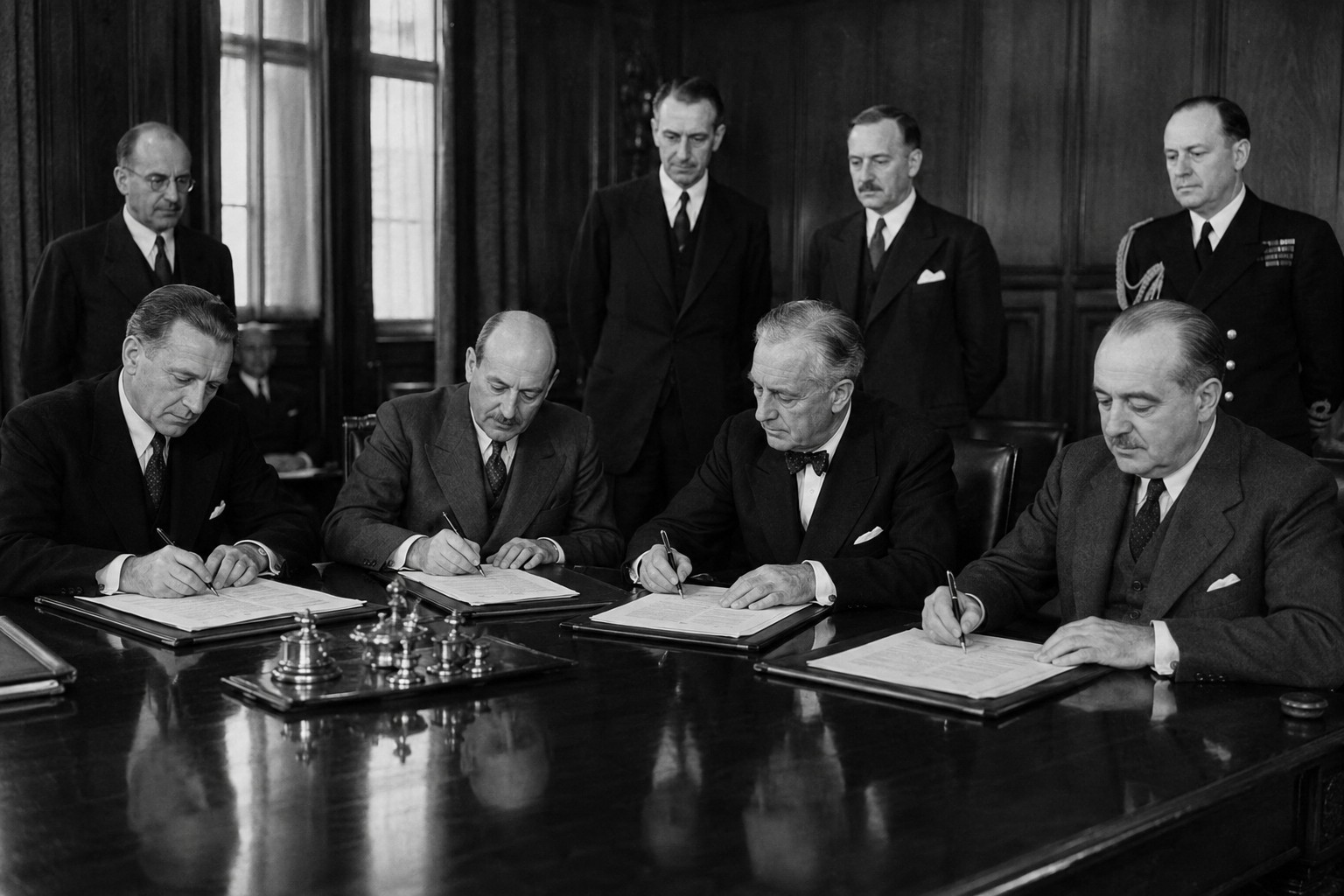
On 8 August 1945, the United States, the Soviet Union, the United Kingdom and France signed the London Agreement, establishing the legal framework for prosecuting the leading figures of Nazi Germany. The historic accord created the International Military Tribunal and paved the way for the Nuremberg trials, which would become a defining moment in the development of international criminal law.
Justice after an unprecedented war
The agreement was reached only three months after Germany’s unconditional surrender had ended the Second World War in Europe. Allied forces had uncovered extensive evidence of mass murder, forced labour, persecution and systematic atrocities committed by the Nazi regime across occupied Europe.
The scale and organised nature of these crimes created a legal challenge. Although individual countries could prosecute offences committed within their territories, many senior Nazi officials had directed operations spanning several nations. The Allies therefore sought a common international mechanism capable of trying those considered primarily responsible.


Four powers reach agreement
The London Agreement was signed by representatives of the four principal Allied powers. Robert H. Jackson signed for the United States, Robert Falco for the provisional government of France, Lord Chancellor William Jowitt for the United Kingdom, and Iona Nikitchenko and Aron Trainin for the Soviet Union.
Negotiations had required the countries to reconcile different legal traditions and political priorities. Despite these differences, they agreed that senior political, military and economic leaders could be held personally responsible for crimes committed under state authority.
The agreement also allowed other Allied governments to join. Nineteen additional countries eventually adhered to its principles, giving the tribunal broader international support.
Three categories of international crime
Attached to the agreement was the Charter of the International Military Tribunal, commonly known as the Nuremberg Charter. It defined three major categories of offences: crimes against peace, war crimes and crimes against humanity.
Crimes against peace included planning, preparing or launching a war of aggression. War crimes covered violations of the established laws and customs of warfare, including the murder or mistreatment of prisoners and civilians. Crimes against humanity included murder, extermination, deportation, enslavement and persecution directed against civilian populations.
One of the charter’s most important principles was that individuals could not automatically escape responsibility by claiming that they had acted on behalf of a government or followed orders from a superior. Official position could no longer provide complete protection against prosecution for international crimes.
The road to Nuremberg
The International Military Tribunal opened proceedings in Nuremberg on 20 November 1945. Twenty-four leading Nazi officials were indicted, although not all ultimately appeared before the court. Prosecutors presented an enormous collection of documents, films, photographs and witness testimony detailing the regime’s actions.
The trial concluded in 1946 with convictions, acquittals and sentences ranging from imprisonment to death. Its procedures and judgments were sometimes criticised as retrospective or as justice imposed by the victorious powers. Nevertheless, the tribunal established principles that profoundly influenced later international law.
A lasting legal legacy
The London Agreement demonstrated that political and military leaders could be held personally accountable before an international court. Its principles helped shape later conventions on genocide and human rights, as well as tribunals addressing atrocities in the former Yugoslavia, Rwanda and other conflicts.
Modern international criminal justice remains contested and unevenly applied. Yet the agreement signed in London on 8 August 1945 marked a decisive shift: state power would no longer be accepted as an absolute shield for those accused of humanity’s gravest crimes.
Newshub Editorial in Europe – 8 August 2026

Ask NF GPT
If you have an account with ChatGPT you get deeper explanations,
background and context related to what you are reading.
On 8 August 1945, the United States, the Soviet Union, the United Kingdom and France signed the London Agreement, establishing the legal framework for prosecuting the leading figures of Nazi Germany. The historic accord created the International Military Tribunal and paved the way for the Nuremberg trials, which would become a defining moment in the development of international criminal law.
Recent Comments