
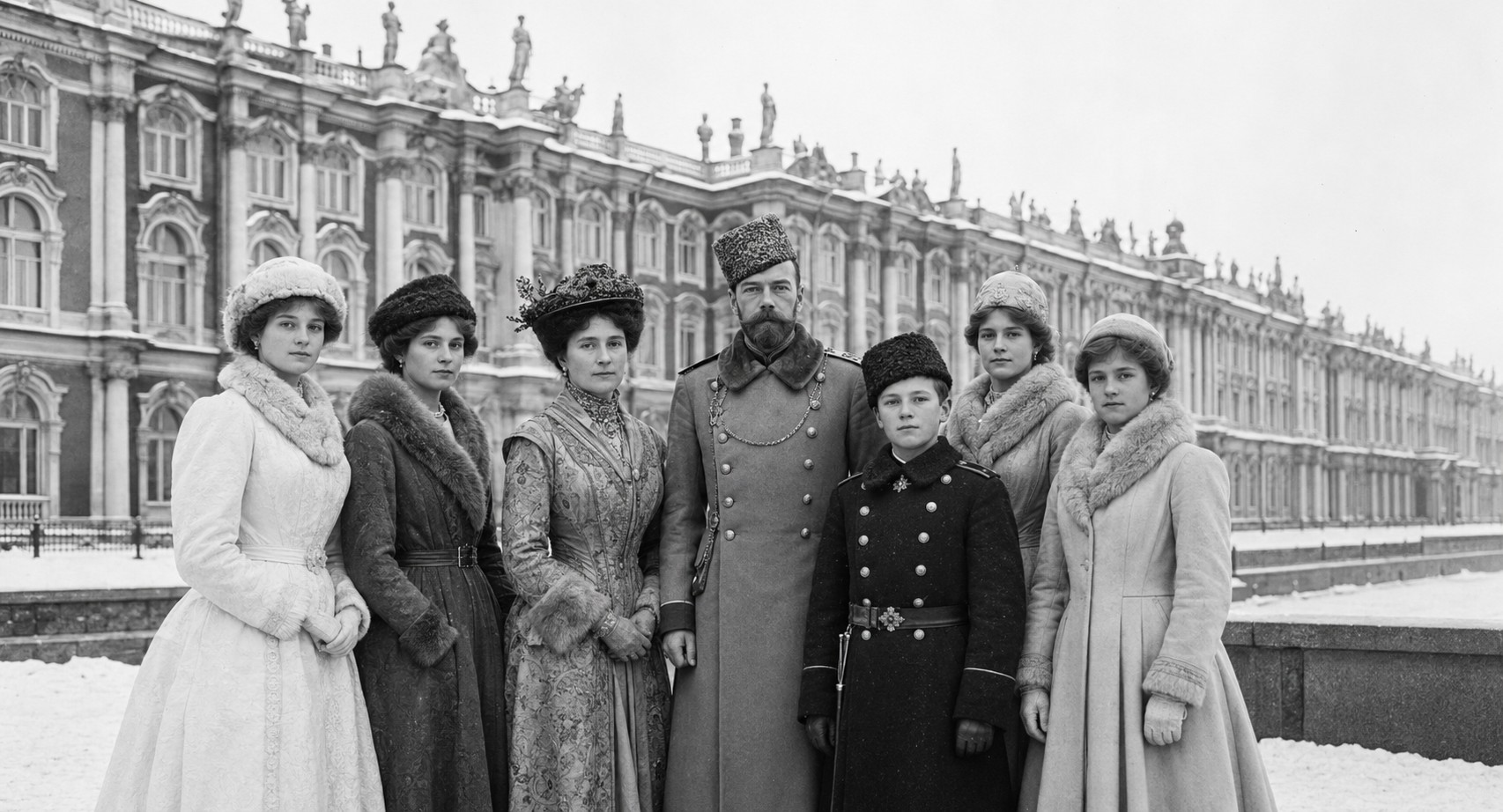
For more than 300 years, the House of Romanov ruled one of the world’s largest empires, transforming Russia from an unstable medieval state into a major European power. Its reign produced military victories, territorial expansion and sweeping reforms, but also deep inequality, political repression and growing social unrest. The dynasty’s dramatic collapse in 1917 remains one of history’s most consequential political turning points.
A dynasty born from disorder
The Romanov era began in 1613 when 16-year-old Mikhail Romanov was elected tsar by the Zemsky Sobor, an assembly representing Russia’s leading social and political groups. His accession ended the “Time of Troubles”, a period marked by famine, foreign intervention and competing claims to the throne.
Mikhail’s selection established a dynasty that would rule Russia until the early 20th century. During its first decades, the Romanov government restored central authority, strengthened the monarchy and gradually expanded Russian territory.

Peter the Great transforms Russia
One of the dynasty’s most influential rulers was Peter I, commonly known as Peter the Great. Taking full control in 1689, he pursued an ambitious programme to modernise Russia’s military, administration and economy.
Peter travelled through Western Europe to study shipbuilding, manufacturing and government. He subsequently reorganised the armed forces, promoted industrial development and required members of the Russian elite to adopt Western customs.
His victory over Sweden in the Great Northern War secured Russian access to the Baltic Sea. In 1703, Peter founded Saint Petersburg, which became the imperial capital and a symbol of Russia’s European ambitions. In 1721, he adopted the title of emperor.
Expansion and contradiction
Under Catherine the Great, who ruled from 1762 to 1796, the Russian Empire expanded further into Eastern Europe and towards the Black Sea. Catherine supported education, arts and selected Enlightenment ideas, but her government also strengthened the privileges of the nobility and extended serfdom.
This contradiction became a recurring feature of Romanov rule. Successive emperors sought to modernise the state while preserving an autocratic political system. Russia became increasingly powerful abroad, yet millions of peasants remained poor and subject to harsh social conditions.
Alexander II attempted significant reform by emancipating the serfs in 1861. However, the measure did not resolve rural poverty or demands for political representation. He was assassinated by revolutionaries in 1881, after which the monarchy returned to more restrictive policies.
The dynasty’s final crisis
Nicholas II became emperor in 1894. His reign coincided with rapid industrialisation, labour unrest and the growth of revolutionary political movements. Defeat in the Russo-Japanese War contributed to the 1905 Revolution, forcing Nicholas to establish an elected parliament, the State Duma. Nevertheless, genuine political power remained concentrated around the monarchy.
Russia’s participation in the First World War brought enormous military losses, inflation and food shortages. In March 1917, mass protests and mutinies forced Nicholas to abdicate, ending Romanov rule.
Nicholas, his wife Alexandra and their five children were later held by the Bolsheviks. In July 1918, the family and several attendants were executed in Yekaterinburg.
A complex imperial legacy
The Romanovs left behind a vast and culturally influential empire, but also unresolved political and social divisions. Their history illustrates both the potential and the danger of modernisation imposed from above without corresponding political reform.
More than a century after the dynasty’s fall, the Romanovs continue to occupy a prominent place in debates about Russian identity, imperial power and the country’s relationship with Europe.
Newshub Editorial in Europe – 17 July 2026

Ask NF GPT
If you have an account with ChatGPT you get deeper explanations,
background and context related to what you are reading.
Recent Comments