
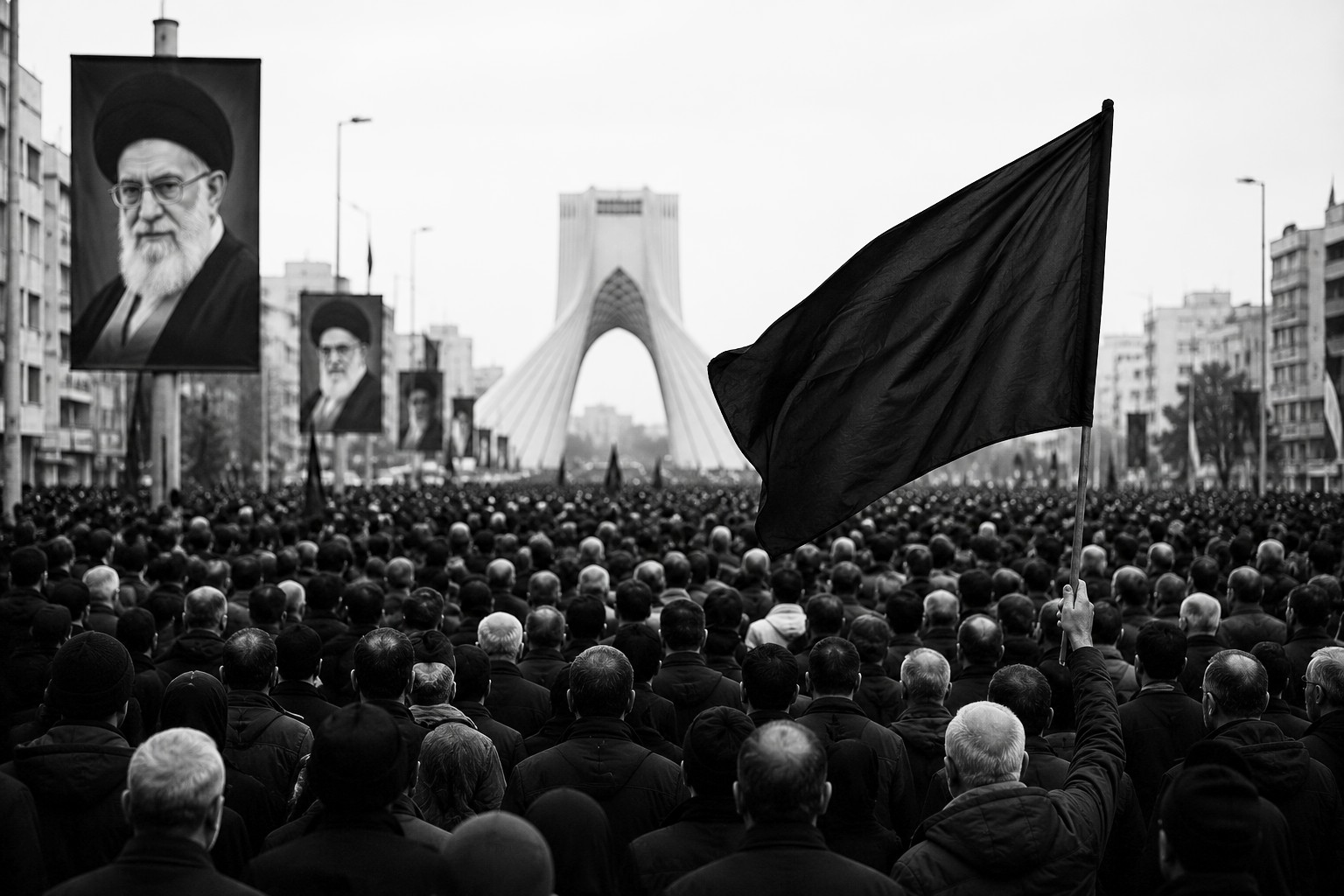
Millions of mourners are expected to take part in a six-day state funeral for Iran’s Supreme Leader, Ali Khamenei, as authorities prepare one of the largest public commemorations in the country’s modern history. The ceremonies, beginning in Tehran, are intended not only to honour Khamenei’s 36 years in power but also to project a message of national unity and resistance at a time of heightened regional tensions.
Tehran prepares for unprecedented crowds
In the early hours of Friday, preparations intensified across the Iranian capital as police checkpoints, military vehicles, temporary facilities and large commemorative displays were erected ahead of the official ceremonies. Authorities have implemented extensive security measures and traffic restrictions in anticipation of millions of mourners travelling from across Iran to attend the funeral.
Government offices, religious institutions and public organisations have mobilised to support what officials describe as one of the largest state events in decades. Ceremonies are expected to continue over six days, culminating in major religious observances and national tributes.

Leadership emphasises resistance
Senior Iranian officials have used the occasion to reaffirm the country’s political direction, declaring that Iran will never surrender to external pressure. Government leaders have portrayed the funeral as an opportunity to demonstrate resilience in the face of international sanctions, regional conflict and diplomatic isolation.
Officials say the scale of the memorial is intended to send a message both to the Iranian public and to the international community that the country’s political institutions remain stable and united despite recent challenges.
The theme of resistance has featured prominently in official statements, reflecting a central element of Iran’s political narrative throughout Khamenei’s leadership.
A defining figure in modern Iran
Ali Khamenei served as Iran’s Supreme Leader for 36 years, shaping the country’s domestic politics, foreign policy and security strategy through periods marked by sanctions, regional conflicts and shifting international alliances.
During his tenure, Iran expanded its influence across parts of the Middle East while simultaneously facing mounting economic pressure and increasingly strained relations with Western governments. Supporters credit Khamenei with defending Iran’s sovereignty and preserving the Islamic Republic, while critics argue that his rule limited political freedoms and contributed to prolonged international isolation.
His death marks the end of one of the longest-serving leaderships in the contemporary Middle East.
The world watches Iran’s next chapter
Beyond the funeral itself, attention is turning to Iran’s political future and the country’s leadership transition. Analysts say the coming weeks will be closely watched by regional governments and international powers seeking to assess whether Tehran’s strategic direction will remain unchanged.
The funeral is expected to attract senior officials, religious leaders and delegations from allied countries, underscoring Iran’s continuing regional relationships despite ongoing geopolitical tensions.
As millions gather in Tehran and other cities, the ceremonies are likely to serve not only as a farewell to a long-serving leader but also as a carefully choreographed demonstration of continuity, stability and the Islamic Republic’s determination to project strength during a pivotal moment in its history.
Newshub Editorial – Middle East – 4 July 2026

If you have an account with ChatGPT you get deeper explanations,
background and context related to what you are reading.
Open an account:
Open an account
Recent Comments