
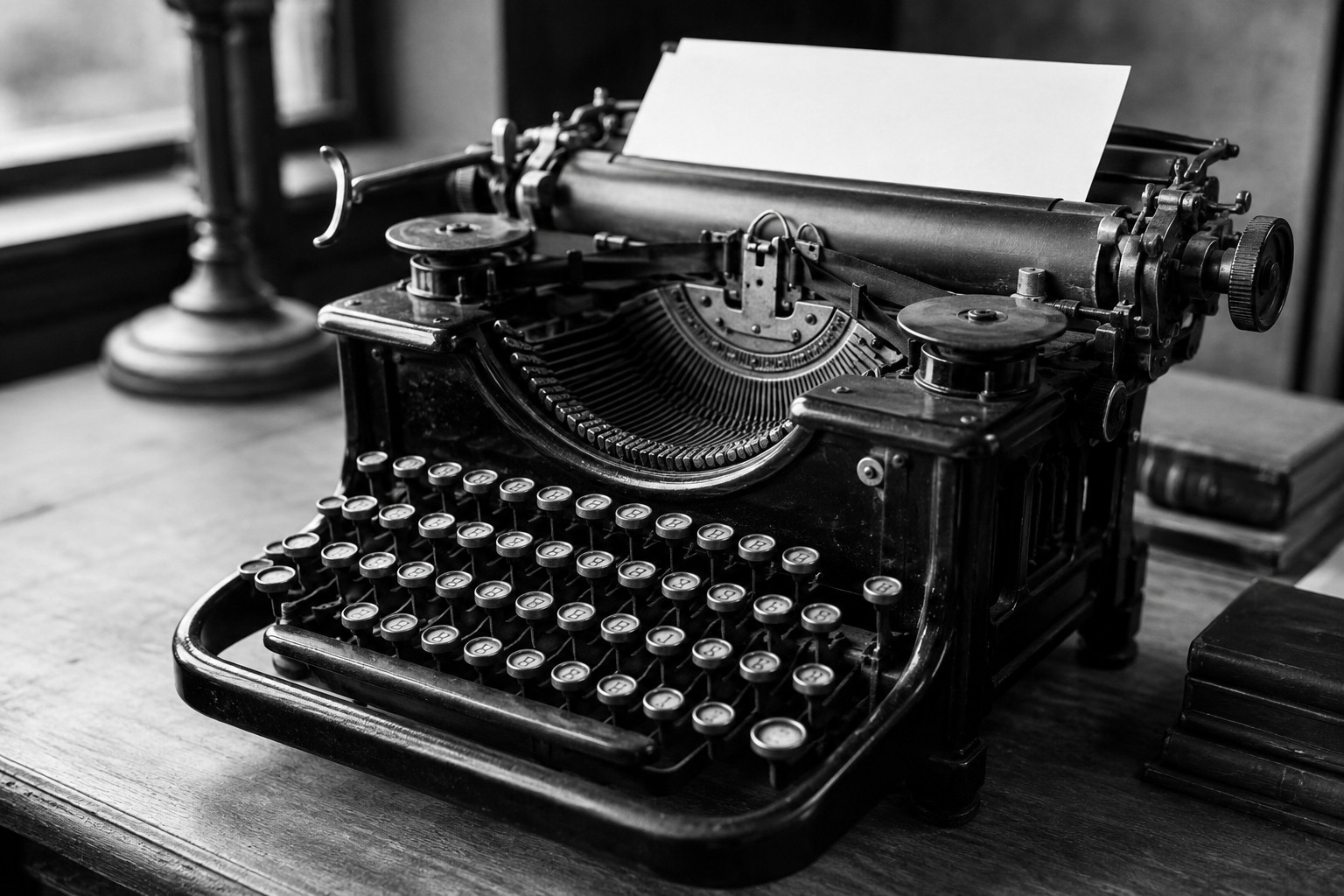
The introduction of the first practical typewriter marked one of the most significant technological advances in modern communication. Long before computers and smartphones revolutionised the way people exchanged information, the typewriter changed offices, businesses and governments by making written documents faster, clearer and more professional than ever before.
The birth of a revolutionary invention
The first commercially successful typewriter was introduced in 1874 by the American company E. Remington and Sons. Known as the Remington No. 1, the machine was based on designs created by inventors Christopher Latham Sholes, Carlos Glidden and Samuel W. Soule.
The machine introduced a practical way to produce legible, standardised text at a speed impossible to achieve through handwriting. It also popularised the now-famous QWERTY keyboard layout, which remains the dominant keyboard arrangement used worldwide today.

Transforming business and administration
Before the typewriter, virtually all correspondence, contracts and official records were written by hand. This process was slow, labour-intensive and often difficult to read. The arrival of the typewriter dramatically improved efficiency in offices and government departments.
Businesses quickly adopted the technology to prepare invoices, letters and reports. Legal documents became easier to reproduce, while government agencies could process information more rapidly. The machine helped create entirely new administrative professions and transformed workplace productivity during the late nineteenth century.
Creating new opportunities
The spread of typewriters also had a profound social impact. As offices expanded, demand grew for skilled typists and secretaries. This created new employment opportunities, particularly for women, who entered clerical professions in large numbers during the late nineteenth and early twentieth centuries.
Typing schools emerged across Europe and North America, teaching thousands of students how to operate the new machines efficiently. The typewriter became a symbol of modernity, professionalism and economic progress.
The foundation of modern computing
Although mechanical typewriters have largely disappeared from everyday use, their influence remains visible in modern technology. Computer keyboards, word processors and digital communication systems all trace their origins to the pioneering machines introduced more than 150 years ago.
The first typewriter did more than improve writing—it fundamentally changed how information was created, shared and preserved. It laid the groundwork for the information age and helped shape the modern office, leaving a legacy that continues to influence communication around the world today.
Newshub Editorial in Europe – 23 June 2026

If you have an account with ChatGPT you get deeper explanations,
background and context related to what you are reading.
Open an account:
Open an account
Recent Comments